Friday, 18 March 2022

Beside The North Sea

If you were here for my last post about wonderful Winterton you'll recall we were going to Horsey Gap to look for some seals. As we bumped down the track and into the car park we saw an encouraging sight - a woman in a high-vis jacket, carrying a bucket. The bucket was for donations and the bright yellow jacket indicated that she was from that excellent charity Friends Of Horsey Seals. And where there are Friends there will be seals.


"Many seals about?" we enquired. "Hundreds" came the reply.


Now this may look like some kind of Grey Seal orgy and in a way it is - an orgy of itching and scratching.


Having given birth to their pups between November and January, the seals return to the sea for a few weeks to feed up. Then they come back to this beach from late February to moult and grow a new coat for the next year.


The whole process takes about six weeks and they live off their reserves of fat during this time as they wait to regrow the protective waterproof layer.


Unlike when they are giving birth it's OK to go on to the beach at this time, as long as you stay at least ten metres away from them and don't do anything to scare them. They also get a lot closer to each other when they don't have young ones to protect.


Incidentally you sometimes see pictures of seals "waving" to the camera. It's adorable, isn't it? But what people don't realise is that this apparent friendly behaviour is actually the seal saying "Back off, mate, you're too close!". It's amazing what you can learn if you chat to the volunteer wardens.

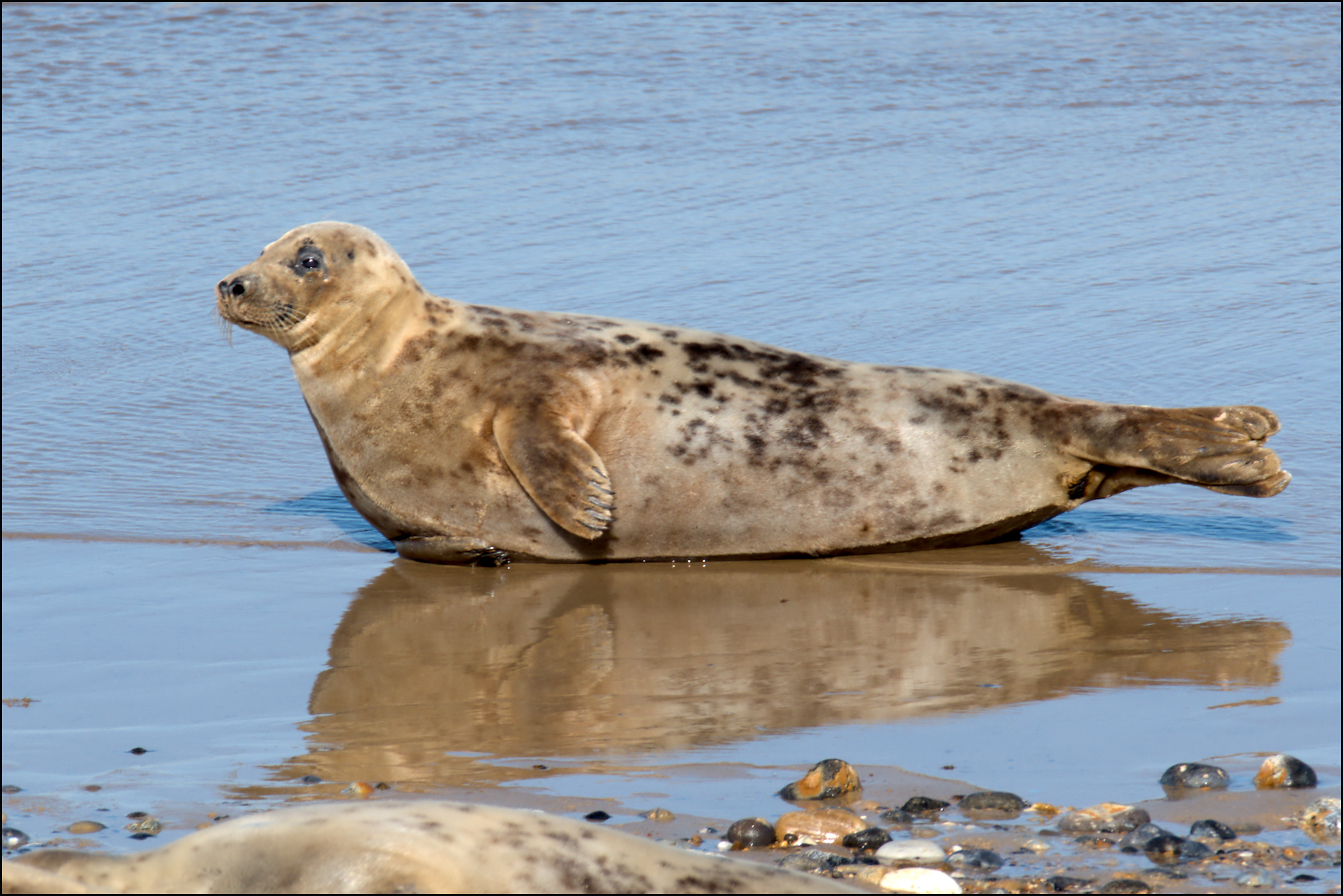


They must be doing something right along this stretch of our coastline. In 2002/2003 there were about a hundred Grey Seals here and they raised perhaps 50 or 60 pups. The numbers have increased at around 10% each year and this past winter there were around 2,500 pups raised.


The seals come just far enough up the beach to get out of the water, which leaves plenty of room to wander along maintaining enough distance between you and them. These photos were of course taken with a long telephoto lens.

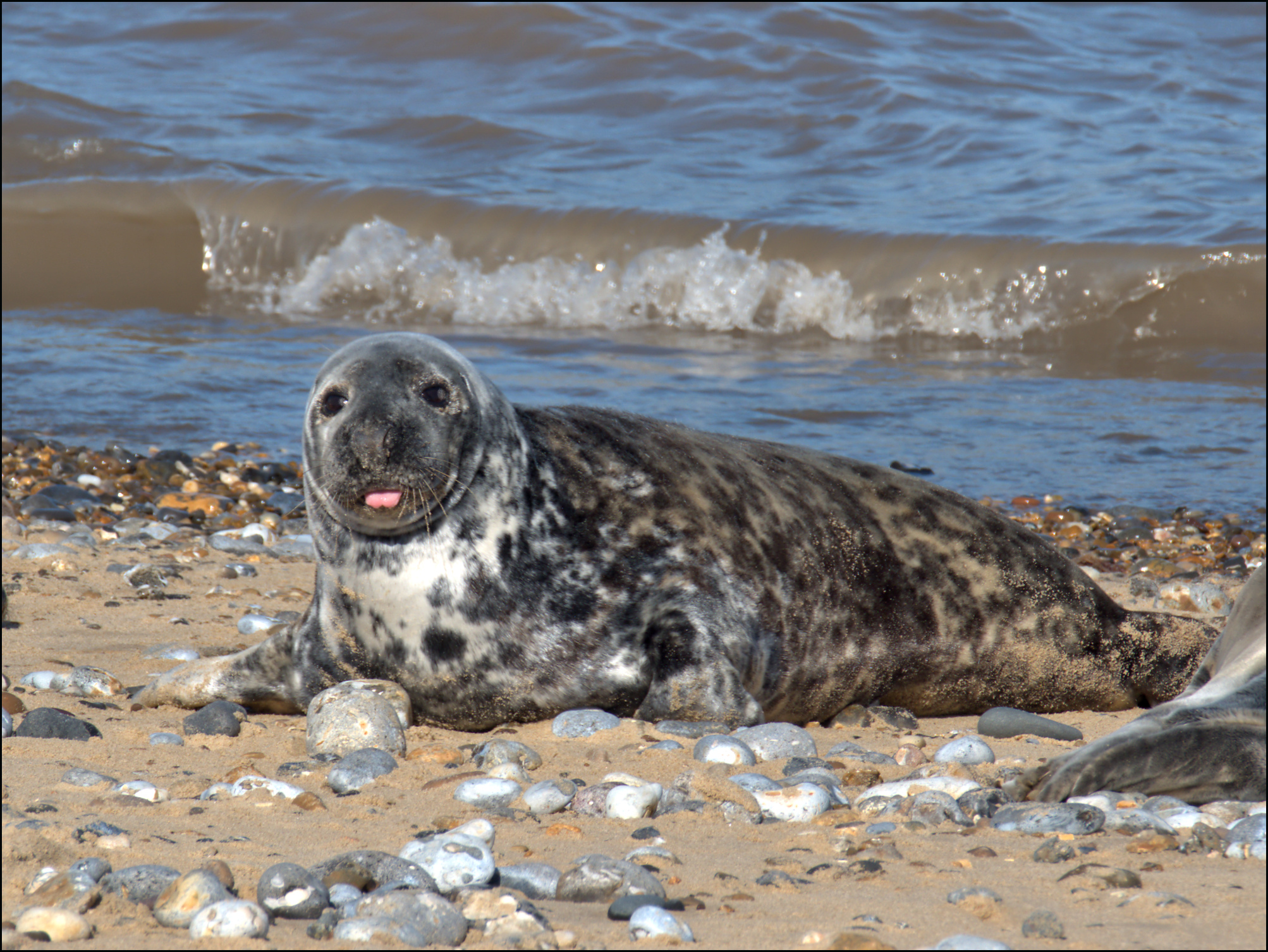


"If you're going to stick your tongues out at us, then we're leaving"


"Good, then we can get on with this tiring business of growing new coats".


Incidentally, we needn't have travelled to the coast in search of sand. This was the top of my re-cycling bin the next day......


....that's dust from the Sahara, picked up by the wind and then dumped on us by a passing shower, leaving a fine coating of sand on every surface. There's plenty on my windows too, if anyone wants a job.


Take care.


Thursday, 17 March 2022

Now Goin' To Winterton

On the north coast of Norfolk there are seaside towns like Hunstanton and Cromer, while on the east-facing coast there's the resort of Great Yarmouth. These places capitalised on our desire for sea-air and added such attractions as fairground rides, crazy golf, bowling alleys, bingo, end-of-the-pier shows, Sea Life, Jurassic Journey and The World's Biggest Joke Shop. But we're not going anywhere like that; today we're off to Winterton-on-Sea. 


Here, along the more remote, north-eastern shoreline they still have some tourists, but the local people are content with being beside the sea, wandering through the dunes, enjoying a pint in the pub and talking to each other (especially talking to each other) and assumed that any visitors would also find these simple attractions sufficient to their needs.


We drove down the beach road to the car park, where a man sat in a small, wooden kiosk to greet us - no ticket machine here and you can forget about paying with a card or a phone app, you'll need real money. It was here too that we encountered that rare survival, the Norfolk "now". Whereas most of us would say "I'm going down the road" or "I'm going down the road now", here it's "I'm NOW going down the road". But if you think the emphasis on "now" implies urgency then think again. So when the car park attendant told us "I'm NOW getting your change" we understood that he meant that once he'd finished his phone call, he'd do his best to fish out some coins for us. 


A few fishermen still work from the beach and there is a rumour, not backed up by any solid research, that Winterton was long ago a seasonal settlement; farming people moving here during winter to make a living from the sea during a slack time of year. Hence it was Winter-town, or Winterton. To add weight to this idea just a little way inland you can find the village of Somerton - the Summer-town.


We're NOW going to stroll along the beach. I hope that will suit you too.


I had hoped we might find some seals on the beach, but this was our closest view of the friends whose company we'd enjoyed during our recent visit to Horsey Gap. It didn't matter at all, like the local people we were happy to wander along the endless golden sands with just the gently lapping waves to entertain us.


Not that the waves are always so placid; they can destroy cliffs or dump extensive dune systems along this stretch of coast, when whipped into a frenzy by winter storms. Huge rocks have been used to form breakwaters to try to control the sea's worst excesses.


Other smaller stones and pebbles add interest to the sands as we wander along looking for the path leading inland.


Just behind the beach there's a wide expanse of dunes and heathland, intersected by a network of rough, sandy paths. We can make our way back towards Winterton through this maze of heather, gorse and stunted trees.


Here we met a woman who was, I kid you not, searching for early butterflies. She was also interested to hear that we'd seen two pairs of Stonechats. She thought there were less of these smart little birds around these days, perhaps because there were more birds of prey, she suggested. She also told us that seals didn't come ashore at this time of year. I thought she was wrong there, but didn't say so.


The gorse continues to look more golden every day as we made our way back.


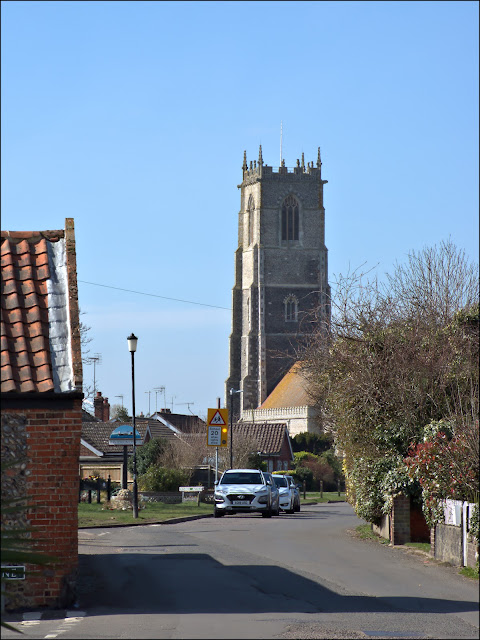
The mighty, seven-stage tower of Holy Trinity And All Saints church began to show above the dunes. Although the village doesn't make too many concessions to tourists it does have a small fish and chip shop, which was where we intended to get our lunch. We arrived a few minutes early, but saw the lady who runs the shop with her husband, "We're just NOW opening!" she announced. 


And sure enough fifteen minutes later they did. We ordered our fish and chips and were told it would be ready in another quarter of an hour, "so we could have a nice little walk around", which we were happy to do. We found a sunny bench in a neat little public garden where we could come to eat our lunch.

We're NOW going to Horsey Gap to see if there are any seals there - just as soon as we've eaten this freshly cooked cod and chips, had a chat with a man with a dog (neither of whom appeared to have any particularly pressing engagements), wandered back to the car park and changed our boots. See you there.


Take care.


Tuesday, 15 March 2022

It's In The Air

My neighbour got his lawnmower out at the weekend and the ice-cream man came around ringing his chimes - two sure signs that Spring is on its way. I went out for a stroll on Monday morning to see what else I could find. 


And I heard the first Chiffchaff singing. These plain little birds are always among the first to return each year and start up their incessant chiff-chaff-chiff-chaff song the moment they arrive.


Take care.


Sunday, 13 March 2022

Five Photos And A Funniful Man

A rather brief post today as I somehow managed to take only a handful of pictures on my most recent outing with my brother. 


The Little Church In The Forest - This tiny church with its unusual octagonal tower is in the non-existent village of Santon, alongside the Little Ouse river in the midst of Thetford Forest in Norfolk. It was built in 1628 but soon fell into decay, and was then resurrected as a sort of private chapel by the vicar of Brandon in the nineteenth century. It's open to the public now and is on my list of places to photograph one day.


Glorious Gorse - Common gorse flowers at any time from January through until June. What's more there are two other species which flower at other times, so you can find gorse in flower at pretty much any time of year - hence the well-known saying "When gorse is in flower then kissing's in season". It's already looking spectacular in Breckland though it won't reach its peak till April.


Catkins Over The Water - these are the catkins, as well as one or two tiny cones, of the Alder, a tree of damp places. It's the bird-watchers' friend as winter visitors like Siskins and Redpolls come to feed on it, though usually high up in the branches.


The Lonely Birch - although most of Thetford Forest is commercial forestry, based on armies of coniferous trees, there's room along the riverside for a more varied tree-scape. On spring days like this it's the place to watch out for Woodlarks, perched at the edge of clearings, singing their lilting song of love. We did see a couple of Woodlarks but ours were on the ground and squabbling!


The Dead Tree Appreciation Society - is a dogged band of enthusiasts who every year in mid-March tramp along this section of the river and stand admiring a small plantation of mostly dying trees. As you've probably guessed, they claim to be looking for a bird, the fabled Lesser Spotted Woodpecker, which is the smallest of our three species of Woodpecker. Many people think it may be an urban myth, a piece of fake news dreamed up by the marketing department of an optics manufacturer in order to sell more expensive and powerful binoculars. But I can tell you that the bird does exist, or at least it did a few years ago when I last set eyes on one.

And that explains what I was doing when I could have been taking more pictures for you.


Need cheering up?


Take care.


Thursday, 10 March 2022

Breathing Space

The village of Wrabness sits on a low hill on the southern shore of the River Stour, just tentatively dipping its toes in the muddy waters of the estuary. A few boats rise and fall with the tides as gnarled oak trees stand patiently watching the scene.


You can wander east or west along the strand, sometimes on a raised bank, or else on picking your way along the muddy foreshore; in places you'll be on the edge of a farmer's field and at times there's a sandy beach beneath your feet.


Wrabness has its own Nature Reserve too, though a rather strange one it must be admitted. It's on the site of what was once a wartime military base and the perimeter road can still be followed. Although there are plenty of paths and tracks a lot of the land is fenced off, both to contain a few grazing stock in summer as well as to keep some areas safe for wildlife. There are probably more dog-walkers than naturalists to be found here, though as we discovered, the dog-walkers were full of information about what could be found there.


But mostly we came here to wander along beside the estuary on this bright and breezy day and breathe deeply on the early spring air.  


The river breathes too; twice every day it gulps in a huge draught of sea-water, the river levels rise, boats bob at anchor and birds move towards the shore. Then the water sighs out again and leaves wide expanses of mud and stranded boats.


If you were a worm and you'd worked out a way to live a cheerful and blameless life submerged in the waterlogged mud, you might expect that you could enjoy an untroubled existence - but no. Birds with beaks specially designed for the purpose come to probe the mud and feed at every low tide - Dunlin, Godwits, Plovers, Curlew and Knot just won't leave a worm alone.


As the tide rises huge flocks of birds take to the air. It's difficult to identify them at this distance, but they are possibly Knot - or possibly not! There you are - a birdwatcher's joke!


Parts of Ragmarsh Farm have clearly seen better days and there's a feeling of much of the area being neglected, marginal land. That actually suits a lot of wildlife as well as the eccentric human visitors who are in on the secret. We only saw one other person along the estuary-side in about two hours during the morning and a handful more in the afternoon.


We did come across this rusty gear, though I'm not sure what it might have been part of. 


You may remember walking along here with us in September 2020. Part of the bank of the estuary has changed since then as a tree has tumbled over the edge, along with some fencing wire; the result of winter storms. Nothing is ever completely permanent on the living, shifting edge of the land.


The weekend boating shacks on the other hand looked a bit smarter than we remembered and a few burnt-out shacks had been replaced.


One of the paths had also been destroyed by the winter storms so we had to walk back, the way we'd come, along the "beach"; no great hardship on a sunny afternoon. 


A bird list:   Kestrel, Carrion Crow, Rook, Magpie, Jay, Robin, Blackbird, Song Thrush, Mistle Thrush, Dunnock, Meadow Pipit, Skylark, Green Woodpecker, Long-Tailed Tit, Great Tit, Black-Headed Gull, Herring Gull, Lesser Black-Backed Gull, Shelduck, Mallard, Wigeon, Teal, Moorhen, Pheasant, Brent Goose, Curlew, Redshank, Knot, Dunlin, Grey Plover, Bar-Tailed Godwit, Turnstone, Oystercatcher, Great Crested Grebe, Grey Heron, Wood Pigeon, Collared Dove, Little Egret,  (also possible Short-Eared Owl).
Animals: Fox.

Take care.


Friday, 4 March 2022

Thyme

Somehow, despite the very pedestrian pace of my life, I missed the sad news that the English singer, Norma Waterson, passed away on 30th January this year (the anniversary of my Dad's death, as it happens).

Norma Waterson (15 August 1939 – 30 January 2022)

Norma, her sister Lal and brother Mike were brought up by their grandmother, Eliza Ward, who was descended from an Irish travelling family and knew many old songs. The young Watersons eventually sang together in the early folk clubs in the 1960s. The group formed and re-formed over the years but was always a family affair, more recently also featuring Norma's husband, Martin Carthy, and their daughter Eliza.

In recent years Norma had health problems which restricted her in many areas of life, though somehow she always managed to sing. Here she is, flanked by Martin and Eliza, and with other family and friends supplying harmonies:


I only ever knew them through their many recordings and live performances, but such was the warmth and honesty of everything they sang that, like many others, I thought of them all as old friends. 


Take care.