Showing posts with label Hertfordshire. Show all posts

Tuesday, 17 September 2024

Versions Of A Walk

Sometimes the kind of walk you enjoy depends on other factors than where you go and what kind of weather you get. Sometimes my walks vary according to the version of myself that sets out to explore the countryside.


The first living creature encountered on this walk was a Red Admiral butterfly feeding on the ivy. For whatever reason butterflies have been scarce on my travels this summer, and those I have met made it clear they had no intention to linger. But this was an odd day weather-wise - chilly, breezy, but with warm sun in sheltered spots. This little creature was too busy lapping up nectar and sunshine to take much notice of me.


Just across the water from Amwell Nature Reserve there's a wood. The birdwatchers who gather here know that on sunny days there are often birds of prey riding the thermals above the treetops. I once saw seventeen Common Buzzards circling there. It may have been that day when I first set off to see if there was a way into the wood, for if there are birds of prey then there will be other creatures present too.


So I must have soon passed this delightful scene, known as Tumbling Bay according to the map. On that first occasion I was looking for birds and probably encountered a selection of the more common wildfowl. This time, although I had an eye out for birds, my mind was more set on searching for pretty pictures.


And butterflies of course! This one allowed me even closer.


We were briefly sidetracked towards Hollycross Lake, which is sometimes a place for dragonflies - or water voles, if you're lucky. Not too bad scenically either.


And then we followed the valley of the River Ash for a while. Jays were calling and to my ear sounded as if they were complaining about the injustice of it all. Meanwhile a Buzzard mewed in its sympathetic but world-weary way. You can actually see the Buzzard in the centre of the shot, just above the trees. There's a peculiarly English beauty to this section of the walk, despite the presence of earth-moving machinery and chain-saws down beside the river. Or more accurately BECAUSE of said machines; they are involved in a long-term project to restore this chalk-stream.


This Comma butterfly maybe appreciates the combined efforts of the Wildlife Trusts and the farmer to tip the balance more in nature's favour. If I'd had my documentary or environmental head on I'd have taken photos of the way they are encouraging the river to meander, but today I was searching out those pretty views.


That's looking back and you can see that we are circling the "buzzard wood", which is on the left as we see it in the above photo. And, just as I discovered all those years ago when first I came this way, it's protected by little signs saying "Private Property". There's also a sign on the road which proclaims that it's a Christian college, though the buildings are completely hidden by the trees. 


There's something about the farms and fields around here that shouts to me that this was once all part of a big estate, probably centred on that large building, now a college, in among the trees. As we walked around the wood this was more or less confirmed by stylish houses called "North Lodge" and "South Lodge" on the roads leading in; these were the old gatekeepers' lodges. Other similar buildings on the periphery probably housed gamekeepers or perhaps farm managers.


The version of me who looks for birds and the one intent on taking photographs never investigated further, but this time I had Les with me and he asked a few questions which sent me off on a romp through the internet when I got home. But not before I'd photographed this Speckled Wood butterfly, another fluttering friend who was soaking up the September sun.


What I found online was that Easneye Mansion was built for Sir Thomas Fowell Buxton in 1868. His father, who had the same name and title, was responsible for eventually getting the Emancipation of Slaves bill through parliament, having been entrusted to do so by the ailing William Wilberforce. Buxton had made his fortune like many in this area from the brewing industry, but the family soon turned their attention to good works. In fact brewing porter was seen at the time as being beneficial to society as it was considered less harmful than gin, which was creating huge problems in nineteenth century London.   


The Buxtons were social reformers who were also involved in missionary work and so it was that Easneye Mansion became a Christian college aimed at creating a new kind of missionary who liaised with existing religions in far-off lands rather than trying to change beliefs. For some reason I remembered an elderly couple by the name of Buxton who lived near my mother. He was a very learned gentleman and despite a fairly modest lifestyle it was obvious that both were well-educated and came from a privileged background. A few clicks of the mouse confirmed that they were indeed related to the Easneye Buxtons. But it was not their money or learning that impressed my mum: it was their simple kindness.


The mansion is one of those heritage buildings which can not be viewed by the general public as far as I can discover. However no such restrictions apply to the Jolly Fishermen pub, just down the road in Stanstead Abbots. It was the hungry version of my brother and I that devoured substantial meals within.


Take care.


Tuesday, 21 November 2023

From Blue To Gold

Hitch Wood, in Hertfordshire, is a well-known local beauty spot. It's so popular that it has its own small car park and a special waymarked trail to lead you through the best bits. But that's in spring, when the bluebells are in full bloom. What's it like in autumn?


We began our walk at the church in St Paul's Walden, which we visited back in May. A path then leads behind back gardens and alongside fields, reaching the road at the gate to Stagenhoe Park, a former manor house which is now an assisted living facility for those with long-term neurological problems.


Two impressive stags adorn the gateposts. From here we dodge across the road, go through a wood, across a meadow, over a muddy field, and then follow ancient tracks to come out opposite Hitch Wood.


Our very brief survey suggested that a lot fewer people come out to see the autumn leaves than the hordes who visit the bluebells. Not only that, but of the handful of folks we saw, one was talking so loudly that their thoughts must have been elsewhere and another looked puzzled when I commented on the beauty of the scene. But.....


I ❤ AUTUMN WOODS!
 A mossy heart-shaped stump sits like a coral atoll in an ocean of gold.


The paths were a lot harder to follow at this time of year, covered as they were by the fallen leaves. It's important to try to stay on the paths here, not only to avoid getting lost but also because trampling the ground where bluebells grow can harm the plants, even when the bulbs are lying dormant.


A Buzzard was crying overhead and though I didn't spot the bird I did notice (and photograph) the vaulted canopy.


We didn't quite follow our intended route, but drifted on to a parallel track which brought us out of the wood within a few yards of where we wanted to be.


A very English landscape unfolded before us, probably because this land is used for shooting pheasants which need the cover of hedgerows and scattered woods. 


Soon we were on a muddy path through Chalkley's Wood.


There were lots of small fungi in the wood - and then there was a line of these impressive forms. I think they might be what are called Trooping Funnels; they grow in straight lines and have this general appearance. But then again I'm no expert.


A walk beside horse paddocks brought us to a place where we could see over the rooftops of Whitwell in the valley of the River Mimram. Here we turned north towards St Paul's Walden Bury.


This is the house where the Queen Mother was born and lived part of her early life. We sat for a while on a tree stump where we were approached by a woman who told us she'd suggested putting a proper bench there, but in the end it was decided to site it elsewhere.


We are now on the country lane leading from the big house back towards the church. Big houses are OK, but this is the one that always fascinates me....


It backs on to the walled garden and is said to have been built about 1770 for the head gardener. In style it's a quainter and more restrained version of what is known as Strawberry Hill Gothick.


I particularly like those quatrefoil windows as they catch the autumn colours.


Then it was just a matter of following the lane back to our starting point.


Take care.


Wednesday, 25 October 2023

The Way Through The Woods

Rainy old England. Even down here in the south of the country, which largely escaped the attentions of storm Babet, there seems to have been rain or showers every day for the past couple of weeks. But it's getting to the time of year when the first signs of autumnal colour should start to shine forth. Time to head for the woods.


Counter-intuitively, perhaps, we head down the A10 road towards London, turning off down a rabbit warren of minor roads till we reach White Stubbs Lane and attempt to find one of the two small car parks that give access to Bencroft Wood, Nut Wood and Westfield Grove. 


All these variously named patches of woodland join up and form the Broxbourne Woods National Nature Reserve.


In the vicinity of the road and the car parks, there's well surfaced and heavily signposted network of paths. We always visit during weekdays but I imagine that it must get busy here on Saturday and Sunday afternoons. 


But we'll leave behind these well worn routes and turn off along narrower, muddier paths that lead into the heart of the woodland - not that it's really remote and you'll still run into the occasional dog-walker or horse-rider, even during the week.


This is what we'd hoped to see - plenty of fungi. During a wet, soggy autumn they pop up everywhere, especially in woods, forests and plantations. I'm not going to try to identify them all as it's easy to make mistakes and I always forget them all by the next autumn anyway!


The only problem with photographing them - apart from the increasing difficulties of bending down and getting back up again - is that once you get your eye in you see them everywhere and it's easy to forget to photograph anything else.


I've recently been reading a book about fungi by the prodigiously knowledgeable and wildly eccentric Merlin Sheldrake which has further impressed upon me just how vital it is to have a thriving population of fungi in woodland areas. It looks as though these woods are doing OK, at least for the time being.


Our path has led us to the edge of the trees where the shafts of sunlight make me raise my head for a few moments. There are many meadows breaking up the tree cover and giving variety to the landscape.


But how did this pattern of land use come about, so close to London? Before the days of easy and efficient transport it was vital that the growing city had a nearby supply of timber (for house-building, ship-building, furniture-making and fuel) and of fresh milk. This part of Hertfordshire, with its heavy soils which could not easily be drained and ploughed, fitted the bill perfectly. And now, of course, it's part of the Metropolitan Green Belt and protected from large-scale development.


Heads down for more dainty mushrooms!


We met a woman who told us that there were "proper fairy-tale mushrooms, you know, the red ones with white spots" in a certain part of the wood - "in the place where I walk my dog". Hmmm....


Another person we met explained how, despite appearances, the reserve is under pressure in these modern times. The population around here has grown, is more mobile and now information is shared so easily by social media. Whereas there were once just a few local people picking mushrooms, there are now large numbers descending on the area. There is a theoretical limit imposed on how many 'shrooms you can take, but it's not enforced.


In spring there was a "secret" bluebell meadow, known only to a few. Then someone thought it was a good idea to mention it on national television, and irresponsible visitors trampled the area to get their "selfies".


Across the centre of the wood there's a wide, rough road that follows a dead straight line, crossing a couple of small streams. Absolutely ideal to ride motorbikes up and down! They'd been there at the weekend and churned up the path so much that we abandoned our plan to follow it, after I'd made a closer-than-intended inspection of Hertfordshire's heavy, ill-drained soils.


This old tractor has been here for many years. I photographed it some ten years ago, when there was slightly more of it than there is now.


Back to the fungi. I noticed that there were fewer of them as we got nearer to the road - was that the result of foraging or maybe just that the road follows drier ground which is less suited to the growth of fungi. Oh, but how did I forget this one...


The star of the show, the unmistakable Fly Agaric or amanita muscaria. It is poisonous and contains psychoactive substances. I always wondered if its association with elves and fairies is due to people eating it and hallucinating.


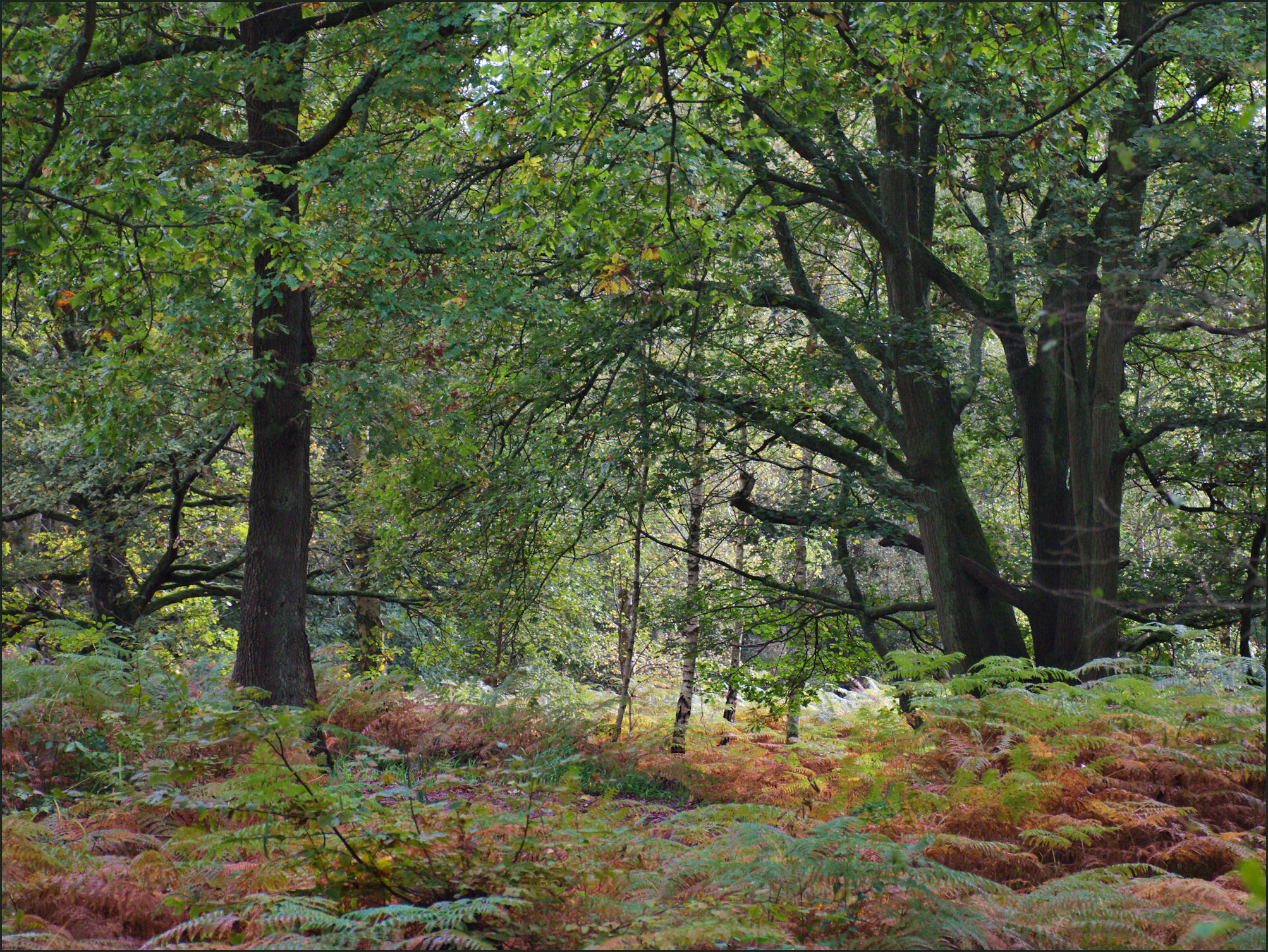
As usual the bracken beneath the trees is changing colour before the leaves. 


Despite its occasional problems it remains a wonderful place to wander and observe the changing seasons. With any luck we're on the path which will lead us back to the car.


*******


On the way home we passed this remarkable structure....


It stands in the village of Little Berkhamsted and is called Stratton's Tower. Admiral John Stratton had it built in 1789, allegedly so that he could see the ships on the Thames. It's made of old hand-made bricks which had been salvaged from a large house nearby. They are at least 250 years older than the tower itself. The idea that you might see ships from here is usually rubbished by all modern writers. But it is only 17 miles away as the crow flies, and you can easily see the towers of Canary Wharf from ground level a few miles north of here. So, with the height of his tower and a good telescope might Admiral Stratton have been able to at least see the masts of ships navigating the Thames?


Take care.