Sunday, 12 November 2023

All We Are Saying......

 
Remembrance Sunday 2023
small section of the bench outside our Village Hall


Take care.


Friday, 10 November 2023

Fair Play

In September and October, you may remember, we visited a few country fairs of various kinds. Although I try to concentrate on what's going on - or at least the bits that interest me - I also occasionally like to play around with small details of the scene. It might be a fragment of an ornate mechanical organ, a steam engine, a rusty tractor or the fairground rides. Here's a small selection....


Take care.


Monday, 6 November 2023

Loitering Locally

Yesterday I spent an enjoyable afternoon slopping about up to my calves in water, in the very place where, back in the spring, I'd been lying down photographing cowslips and buttercups. It is a nature reserve, but one that a quick glance would dismiss as just an untidy grassy field. However this little area, between villages, which consists of two boggy meadows, a grassy lane, a muddy footpath and a small field, is one to which I keep returning.


I was hardly expecting to see cowslips here in November, but I wasn't expecting to see cows either. There is some dry ground for them, but much of the land is flooded at this time of year. I expect they'll be moved in the next few days.


Perhaps they weren't expecting to see me and they followed me for a while till they lost interest and resumed their grazing.


This land is the flood plain of Guilden Brook so it's doing exactly what it's supposed to in spells of wet weather. Actually the Brook has been modified and drains what is now agricultural land, so water levels in it fluctuate more than the other little streams in our area, consequently this pocket of rough grazing land gets more than its share of flooding.


The little wooden bridge leads out to the field path. It's not quite doing its job anymore and you end up having to step into the water. Not that it matters much; anyone not wearing wellies is unlikely to have got this far!


A few autumn leaves float daintily on the water.


The old lane appears to be paved with gold at this time of year.


Back in our watery meadow there's some lush-looking grass which the cattle don't seem to have visited lately. In spring this corner of the field is scented with the heavy perfume of the May blossom.


A few Hawthorn berries have landed on a rampant patch of fungi. If you think I put them there then I'll admit that you're partially right. They were there when I arrived, but in removing some dead grasses which were spoiling my photo, I managed to dislodge the berries and had to replace them where I thought they looked right.


At other times dead grasses help to make the picture - I certainly wasn't going to try moving that lot!


The afternoon was now fairly advanced and I decided I would loiter a little longer to see if the setting sun would put on a show.


Stray shafts of sunlight pierced the cloud cover in the west and made me optimistic, though I think I like this late golden light every bit as much as I like a fiery sunset.


The cows were enjoying a late snack as I feasted on the last vestiges of this glorious light.


The sunset never really happened, though the skies opposite to the setting sun were briefly illuminated by a pinkish glow. 


One final shot then I turned to walk the mile and a half back home.


Take care.


Friday, 3 November 2023

Country Pubs

It's time that we had another collection of pub signs encountered on my rambles. In 1393, during the reign of King Richard II, pubs were first required to hang a sign outside to make them clearly visible. In those days few people were able to read and using a picture was a practical solution - "I'll meet thee for a tankard of mead at the sign of the Red Bull". 


The Red Lion is one of the most common pub names you'll find; it's a symbol much used in heraldry and may derive in some cases from the arms of John of Gaunt. The particular Red Lion sign seen above is outside a pub which the brewery wanted to close down. The villagers did not agree and overcame many legal problems to make it the first community-owned pub in England.

The Queen's Head in Newton, Cambridgeshire, did close and stood empty for some years before the arrival of the Short family in 1962 - they still run the pub today. It's one of "The Famous Five" pubs which have been included in CAMRA's Good Beer Guide for the whole fifty years of its publication. Inside it's not much changed since I used to make my way there for a pint of Adnams and a game of darts in the early 1970s.

The Plough, Shepreth is another community pub, just down the road from me and a music venue as well as serving meals and good beer. They've also got a cracking good sign in my opinion.

The John Bunyan gets its name from the Puritan preacher who was associated with the ruined cottage which lies just across the road. There are many pubs which have changed their names to reflect local history. It's unlikely that Bunyan ever popped in for a pint - or that the poet Rupert Brooke ever drank in the pub that bears his name - or that the Hermit Of Redcoats ever stopped being a hermit and joined the merry throng in the pub just a short distance from the house where he famously holed up for twenty-five years without washing or venturing outside.

The Woodman is one of many pubs which takes its name from the occupation of its onetime customers. Not that there are that there are many woods around Chapmore End in Hertfordshire. Presumably the woodmen cut them down before retiring for a well earned pint.


I feel I can't leave you without mentioning The Queen's Head Soup of the Day, part of a limited but hearty menu on offer in that famed and quirky establishment:


That should baffle TripAdvisor!


Take care.


Tuesday, 31 October 2023

The Outs And Ins Of Early Autumn

I always get rather impatient at this time of year, waiting for the full blaze of autumn glory to show up. On our little island, warmed by the influence of ocean currents and westerly winds bringing drizzly rain, autumn takes a long time to arrive. But that doesn't stop me from going outside to look....


And all I find is confusion!


A few oak leaves are playing the game; though most of the tree will resolutely hang on to her green gown for a few more weeks.


In the churchyard the little recently-planted maple glows like the embers of an October bonfire while its neighbours still think it's summer.


But I'm trying to focus on autumn today - or am I?.....


These back-lit, unfocussed leaves somehow remind me of modern stained glass.


And the same autumn colours are nicely reflected in the waters of the little River Mel.


Those half-dozen photos are all I came home with from my walk, though on the way back through the village street I frequently stopped and pocketed any fallen leaf that caught my eye. After a cup of tea I BluTac'ed the leaves to an upstairs window and got out my macro lens and small tripod. This is what I came up with from my indoor experiment...


And that's all I have to say about our autumn so far.


Take care.


Wednesday, 25 October 2023

The Way Through The Woods

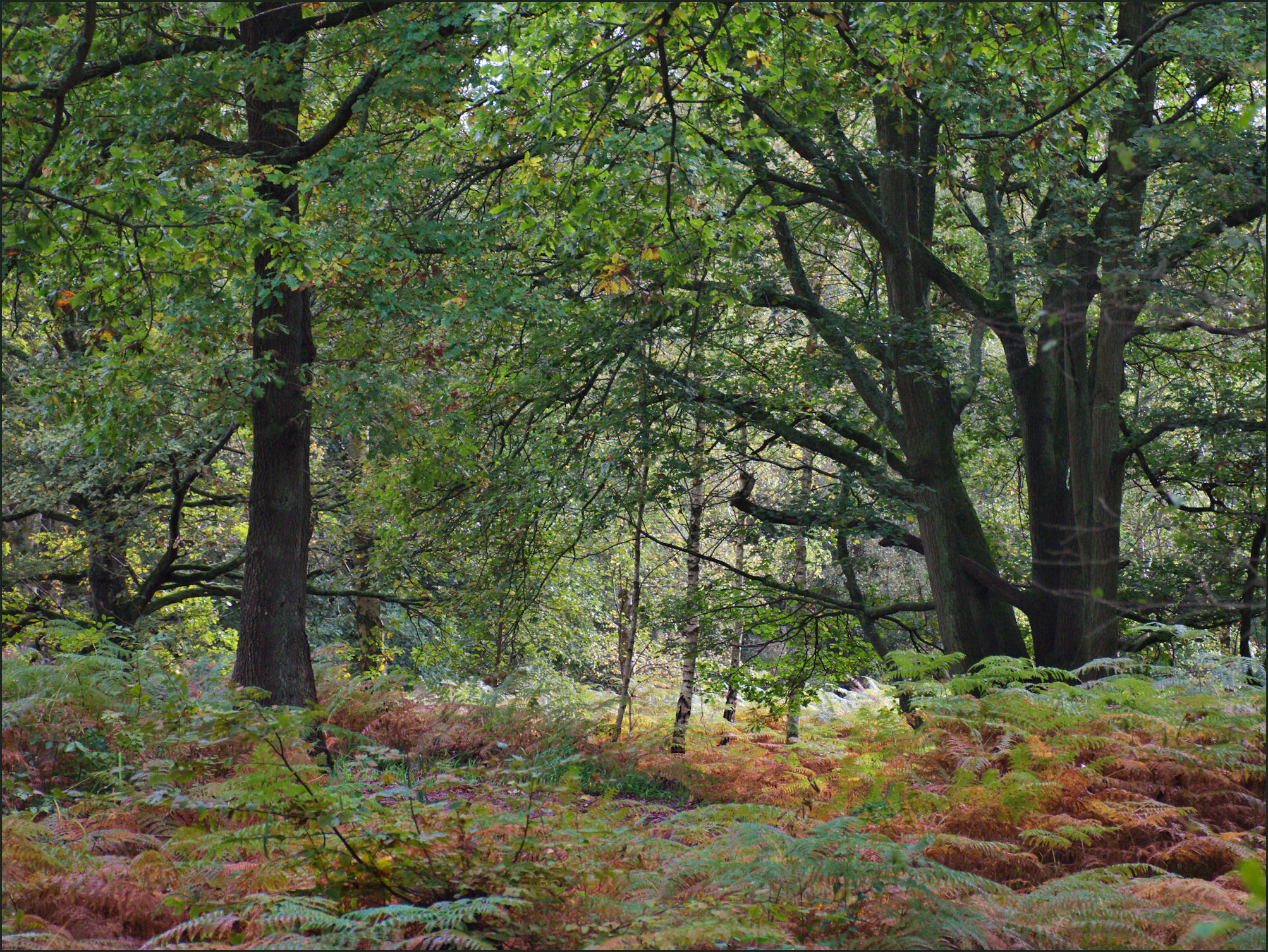
Rainy old England. Even down here in the south of the country, which largely escaped the attentions of storm Babet, there seems to have been rain or showers every day for the past couple of weeks. But it's getting to the time of year when the first signs of autumnal colour should start to shine forth. Time to head for the woods.


Counter-intuitively, perhaps, we head down the A10 road towards London, turning off down a rabbit warren of minor roads till we reach White Stubbs Lane and attempt to find one of the two small car parks that give access to Bencroft Wood, Nut Wood and Westfield Grove. 


All these variously named patches of woodland join up and form the Broxbourne Woods National Nature Reserve.


In the vicinity of the road and the car parks, there's well surfaced and heavily signposted network of paths. We always visit during weekdays but I imagine that it must get busy here on Saturday and Sunday afternoons. 


But we'll leave behind these well worn routes and turn off along narrower, muddier paths that lead into the heart of the woodland - not that it's really remote and you'll still run into the occasional dog-walker or horse-rider, even during the week.


This is what we'd hoped to see - plenty of fungi. During a wet, soggy autumn they pop up everywhere, especially in woods, forests and plantations. I'm not going to try to identify them all as it's easy to make mistakes and I always forget them all by the next autumn anyway!


The only problem with photographing them - apart from the increasing difficulties of bending down and getting back up again - is that once you get your eye in you see them everywhere and it's easy to forget to photograph anything else.


I've recently been reading a book about fungi by the prodigiously knowledgeable and wildly eccentric Merlin Sheldrake which has further impressed upon me just how vital it is to have a thriving population of fungi in woodland areas. It looks as though these woods are doing OK, at least for the time being.


Our path has led us to the edge of the trees where the shafts of sunlight make me raise my head for a few moments. There are many meadows breaking up the tree cover and giving variety to the landscape.


But how did this pattern of land use come about, so close to London? Before the days of easy and efficient transport it was vital that the growing city had a nearby supply of timber (for house-building, ship-building, furniture-making and fuel) and of fresh milk. This part of Hertfordshire, with its heavy soils which could not easily be drained and ploughed, fitted the bill perfectly. And now, of course, it's part of the Metropolitan Green Belt and protected from large-scale development.


Heads down for more dainty mushrooms!


We met a woman who told us that there were "proper fairy-tale mushrooms, you know, the red ones with white spots" in a certain part of the wood - "in the place where I walk my dog". Hmmm....


Another person we met explained how, despite appearances, the reserve is under pressure in these modern times. The population around here has grown, is more mobile and now information is shared so easily by social media. Whereas there were once just a few local people picking mushrooms, there are now large numbers descending on the area. There is a theoretical limit imposed on how many 'shrooms you can take, but it's not enforced.


In spring there was a "secret" bluebell meadow, known only to a few. Then someone thought it was a good idea to mention it on national television, and irresponsible visitors trampled the area to get their "selfies".


Across the centre of the wood there's a wide, rough road that follows a dead straight line, crossing a couple of small streams. Absolutely ideal to ride motorbikes up and down! They'd been there at the weekend and churned up the path so much that we abandoned our plan to follow it, after I'd made a closer-than-intended inspection of Hertfordshire's heavy, ill-drained soils.


This old tractor has been here for many years. I photographed it some ten years ago, when there was slightly more of it than there is now.


Back to the fungi. I noticed that there were fewer of them as we got nearer to the road - was that the result of foraging or maybe just that the road follows drier ground which is less suited to the growth of fungi. Oh, but how did I forget this one...


The star of the show, the unmistakable Fly Agaric or amanita muscaria. It is poisonous and contains psychoactive substances. I always wondered if its association with elves and fairies is due to people eating it and hallucinating.


As usual the bracken beneath the trees is changing colour before the leaves. 


Despite its occasional problems it remains a wonderful place to wander and observe the changing seasons. With any luck we're on the path which will lead us back to the car.


*******


On the way home we passed this remarkable structure....


It stands in the village of Little Berkhamsted and is called Stratton's Tower. Admiral John Stratton had it built in 1789, allegedly so that he could see the ships on the Thames. It's made of old hand-made bricks which had been salvaged from a large house nearby. They are at least 250 years older than the tower itself. The idea that you might see ships from here is usually rubbished by all modern writers. But it is only 17 miles away as the crow flies, and you can easily see the towers of Canary Wharf from ground level a few miles north of here. So, with the height of his tower and a good telescope might Admiral Stratton have been able to at least see the masts of ships navigating the Thames?


Take care.