Showing posts with label Royston. Show all posts

Wednesday, 4 December 2019

An Unplanned Jaunt

I didn't expect to find myself on the wide open hills above Royston early on Monday morning. It happened like this...


I just popped outside to photograph the crimson skies of the pre-dawn, but as it was frosty I'd put on my coat, boots, hat and gloves and grabbed the rucksack that had the camera in it. Having taken a few pictures I noticed several people making their way to the village railway station. I had a sudden idea.


As I had no maps with me I'd take just a four-minute journey up the line to Royston and do a walk I know well. It looked like it'd be a fine, though chilly morning.


By the time I was tramping up the path beside the Heath the sun was just peeping above the horizon. A proper landscape photographer would have sussed out the best viewpoint and would wait patiently for the sun to flood its light across the scene: I decided to press on - while waiting here I might miss something elsewhere and I'd get cold too!


I love the look of frosted leaves as well as the crunch of them beneath my boots. The path led between the rolling arable fields. It's a rather austere and uncompromising landscape, though not without a strange scenic charm which is difficult to describe and harder still to photograph.


Just before Therfield I said hello to a fine old gentleman walking his dog. He introduced me to his canine friend and asked about my route. After a couple of minutes we were somehow talking about the hills of Northern Scotland. "I can't walk and climb like that any more", he sighed. "I've still got the books though! With a glass of whisky I can imagine my way back into the Highlands!" His dog may have heard all this before and showed she was keen to continue the walk, so we went our separate ways, a little cheerier for our brief chat.


Apart from a few motorists I didn't see anyone as I walked along Pedlar's Lane, skirting the village of Therfield. I found the little gate to the sunken lane which leads out to the bare hills once more.


We have plenty of big arable fields in Cambridgeshire, but nothing quite like this. I think though that this area has been as treeless and hedgeless as this for centuries. Before big tractors trundled across the chalky soils this was sheep country with huge flocks grazing up here, especially during the summer months.


Where last summer's wheat stubble is still unploughed you can almost imagine sheep dotting the scene. I find the gentle heave of this solid ocean oddly exhilarating and with the ground still frozen hard, the air crisp and clean, and the track leading downhill, it's almost like having a huge encouraging hand kindly guiding you on your way.


The path leads through Thrift Farm then along a grassy stretch known as Kings' Ride. Indeed the sport of kings is still here in the form of a racehorse stable and a couple of thoroughbreds were being exercised on the gallops. 


There are several small woodlands and plantations along the steep northern slope of the hills and the low sun was only just raking through the trees in late morning.


There are long, grassy corridors following dry valleys leading down off the chalk lands. Could these be the ancient droves or driftways down which the flocks were driven on their way to market?


We're making our way towards the edge of the golf course and I noticed that the Par 3 Fifth is called "Shepherd's Rest". There's a short, steep-sided dry valley which would be an ideal sheltered nook where a shepherd might enjoy forty winks on a warm day. The golfers however cannot relax here; the tee is on one side of the valley and the idea is to float the ball across the deep intervening depression to the small green on the opposite side. Many little tracks leading down through the rough grass suggest that not all are successful.


It's getting towards mid-day and the sun is still just reaching some frosty pockets.


Just a few autumn leaves are hanging on in sheltered places along the way. Then a path will lead down across the golf course, alongside the rugby pitch and into the streets of Royston where I can call into the shop before getting the train home. I hope you've enjoyed this unplanned jaunt as much as I have.


Take care.


Wednesday, 23 October 2019

Top o' the Heath


The Heath begins just a few hundred yards from the centre of the little town of Royston, which is just a four minute train ride from home. It's not really a heath at all; there's no heather here just a gently sloping grassland, grazed by sheep and walked by golfers. Officially it's the scarp slope of a chalk escarpment and along the top of the slope is a straggly band of trees which in places forms small woods. It's much walked and there are numerous paths among the trees. Here's what it looks like in early autumn.


As you'll have seen there are plenty of autumn fungi around and just a tinge of autumn colour, just a rumour of gold in these hills. We don't really get the fiery reds in this part of the world. Then walking back through Royston.....


Take care.


Sunday, 17 December 2017

Men Of Royston

In contrast to the grace, elegance and beauty of the swans in my last post, I came upon something a little more rugged and violent as I walked across Royston Heath on Saturday.
  

A Rugby Union game was taking place between Royston's 1st XV and Saracens Amateurs. Not teams of the highest calibre it's true, but nevertheless a fast, exciting, physical game for those few of us who were willing to stand out on "the blasted heath" on a cold December afternoon.


Royston, in the black and white hooped shirts, soon began to overwhelm their opponents by both speed and power.


There were some very large men involved and in Rugby the biggest and strongest often come out on top. Royston's powerful scrum dominated the play.


One smaller person was definitely in charge however. 


I'm not about to explain the rules (yes, there are rules!) to those from lands deprived of the beauties of Rugby Union Football; we'd be here all day and you wouldn't be much the wiser. Lets just say there's a lot of pushing and shoving, grunting and groaning, and pulling and pushing.


But there's also a lot of exciting running moves....


....and skillful passing.


...till things are brought to a sudden, crunching conclusion.

Royston ended the game victorious by 39 points to 7, according to the results published online, though to tell the truth I'd lost count towards the end of the game. 


I was also beginning to lose the feeling in my fingers towards the end of the afternoon as there was a bitterly cold wind blowing across the heath.


Take care.


Friday, 4 April 2014

Small, Rare And Beautiful


We're off in search of something small, rare and very beautiful today. It may be there or it may not. It may be putting on a show or it may be shy and retiring. But first we have to go to the town of Royston and from there we have quite a trek across what is universally known as The Heath, but is actually a chalk grassland.


Up on the Heath, keeping one eye out for flying golf balls, you may find cowslips growing on the slopes.


Skylarks were singing overhead and underfoot (almost literally!) was this fine fellow....


....I think it's a Bloody-Nosed Beetle, he gets his name from the way in which he releases his foul-smelling blood from his mouthparts in order to dissuade potential predators. If it is a Bloody-Nosed Beetle then it fulfils the "small" and possibly even the "beautiful" elements of our quest but is not actually very rare. We need to walk a little further.....


....past what looks like the golf-hole-at-the-edge-of-the-world, and into Fox Covert Wood....


There are some small and beautiful flowers blooming in here if you look closely....


 ....yes, violets, but they're not rare either - they even grow in the garden, whether you want them to or not!


Dog's Mercury is there too, an indicator of old woodland but not at all rare and hardly beautiful. No we have to look out for Church Hill.
Ah, there it is!


It's that little bump in the middle distance. Not much of a hill, I know, but if you walk around the far side you might find....


Pulsatilla Vulgaris or the Pasque Flower. It gets its common name from "Paschal" meaning to do with Easter, the time of year it blooms.


Small, very beautiful and pretty rare too, only growing on long-undisturbed chalk grassland. It is the county flower of Hertfordshire and also has the rather more exciting name of Danes' Blood, which is thought to come from its habit of thriving on ancient burial mounds.


Now I've got to walk all the way back!

Take care.


Friday, 31 January 2014

Random Remnants

....being a collection of things which I meant to show you earlier but didn't get around to.


Another Man From Thetford


The gentleman above should have taken his place among the four people with connections to the town of Thetford that I introduced you to in an earlier post. Meet Dr Allan Minns. He was born in The Bahamas in 1858 where he received a good education which led him to Guy's Hospital in London, where he qualified as a doctor. He went on to become the doctor at the workhouse in Thetford. He was elected Mayor of Thetford in 1904, the first black man to become a mayor in the UK. His grandmother had been a slave in the West Indies.


Roysia's Stone


Standing in my local town of Royston, right on the cross-roads of two ancient routes, is this great hunk of rock. The routes in question are the Icknield Way and Ermine Street, two of the oldest roads in this country (we're talking BC rather than AD here!). The rock was transported here by an ice-sheet during the last Ice Age; it's Millstone Grit, which probably means it started its journey in Yorkshire or Derbyshire! It's known as the Royce Stone and there's a hole in the centre which once supported the shaft of a preaching cross set up by Lady Roysia in Norman times. The names have been shortened over the centuries - Roysia's Stone became Royce Stone and the town became Royston.


A Rural Skyscraper


A high-rise office block in the sleepy village of Hatley? Well, it does house offices these days but that's not its original purpose. It's part of a farm which was rebuilt in the late nineteenth century to incorporate all the best practices of the age. Such farms were known as "model farms" and their owners were naturally proud of their creations. So proud in fact that they didn't want anything as unsightly as a water tower to upset their idea of perfection so they disguised it as (an admittedly rather tall) dwelling.


Strange Fruit


Stone pineapples are often featured as decoration on the gateposts of large houses. When the fruit first appeared in the UK, having been discovered by Columbus, it was horrendously expensive - it was many years before they could be grown under glass in this country. It became something which was only eaten when important guests were to be received. As a result it became a symbol of hospitality.


George Lawrence's Eastern Cousin


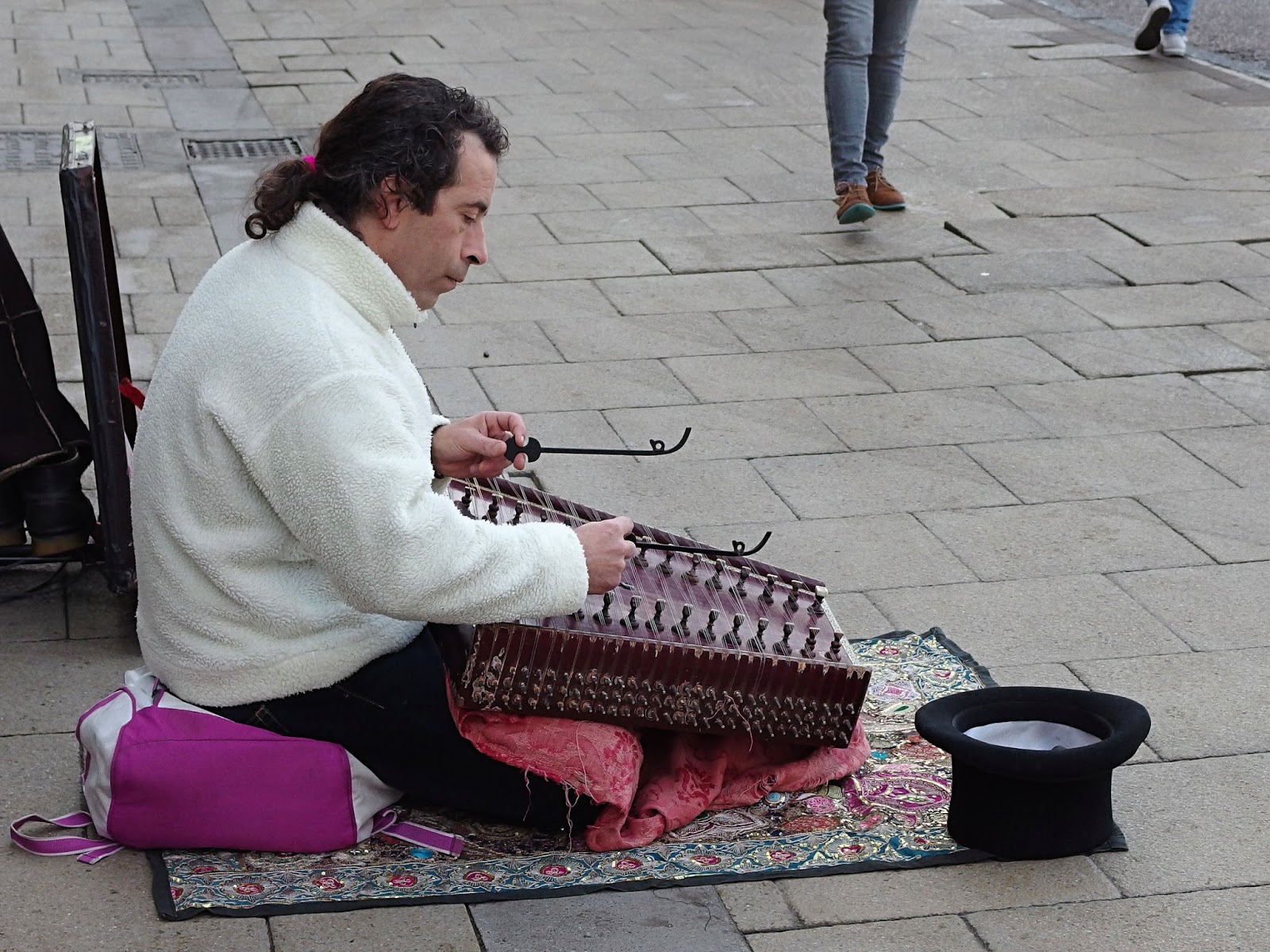
Recently I showed you George Lawrence's hammer dulcimer which is on display in Cambridge Folk Museum. Shortly after that I encountered this man busking in the streets of Cambridge playing what I believe is an Iranian santur, a very similar instrument. There are, in fact, variations on the dulcimer in just about every country between Ireland to China. 


Bear On The Roof !


It has to be Whittlesea, of course! I've shown you all kinds of beasts rendered in straw by our local thatchers. Naturally enough in Whittlesea it had to be a straw bear! (And if you've no idea what I'm talking about you need to look at this and subsequent posts). 


Take care.