If we'd walked here a couple of hundred years ago we'd be on a narrow track passing between fields on our way to the village of Cherry Hinton. We'd have passed a windmill that would eventually give this busy modern road its name - Mill Road. Things started to change when the railway reached Cambridge and this land was used for cheap housing for those who worked on the railway and in its associated industries.
You might think that no one would want to live in these small, cramped houses today and that the shops here would not survive in this modern world. Maybe it's time to tear it all down and start again. But you'd be wrong on several counts.
These houses are some of the most expensive in the city - in terms of price per square foot at least. Although they were very cramped for the large families of the Victorian era, they are now snapped up by young professionals who value their nearness to the city centre and the vibrant multi-cultural atmosphere. They also support many of the small alternative shops and international cafes and restaurants along Mill Road.
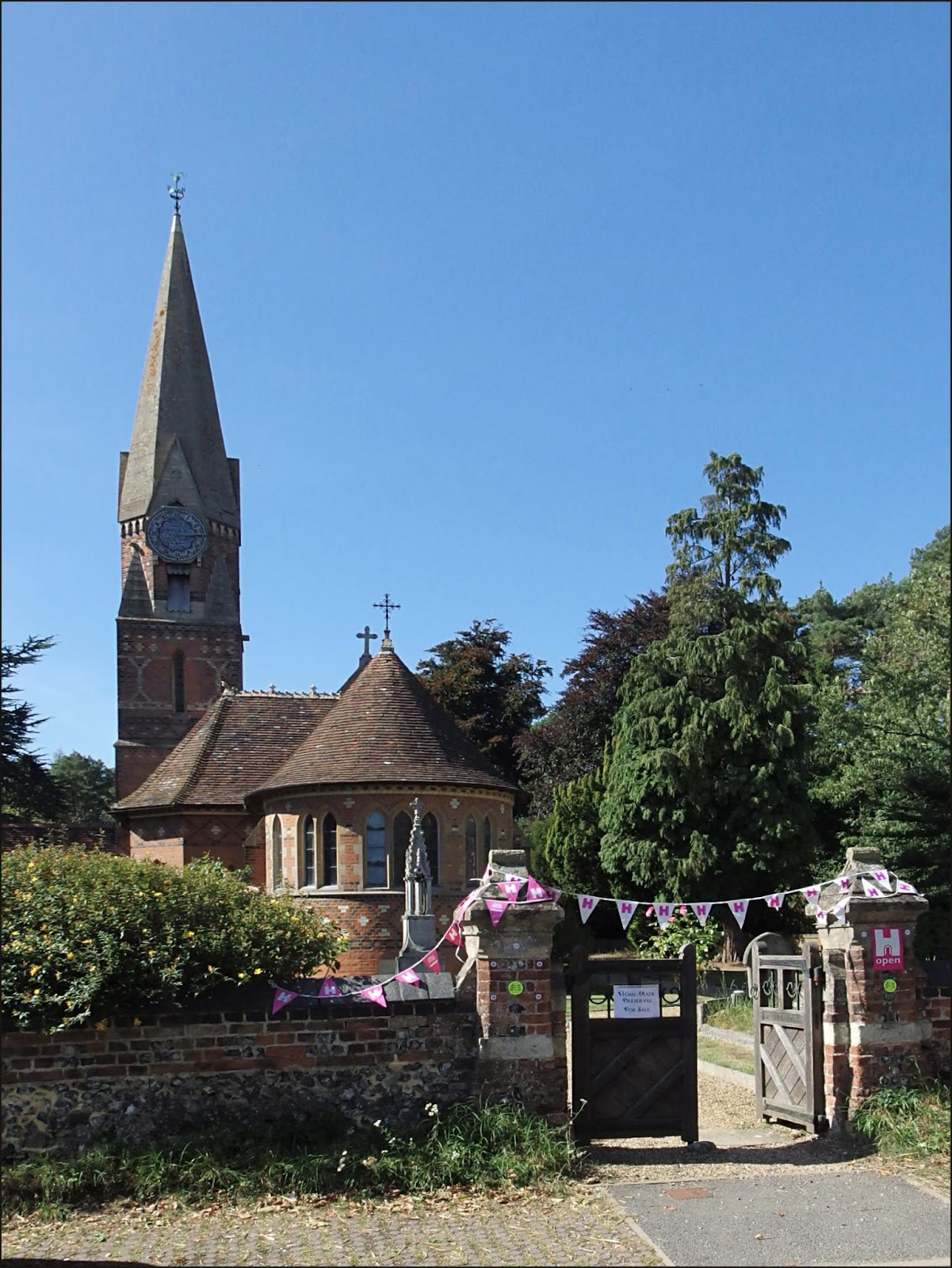
However, although the future of this historic area looks healthy for the time being, there are problems with some of the public buildings. You see, there are only four listed buildings in this whole area. So while some buildings, like St Barnabas Church (above) are protected by planning laws, there are many others which are part of our history but have no such protection.
There are a number of industrial buildings like George Bolton's Warehouse which are surely worth keeping as part of the cityscape. Bolton moved to Cambridge from Hertfordshire in the mid 1800s, initially to work as a porter on the railway but soon set up in business as a general carrier (someone who took goods from the railway station to their intended destinations). Bolton and his sons expanded into building and owning a brickworks, but they were mainly known as furniture removers. The warehouse was used for storing furniture and is now converted to offices.
This fine red-brick building, on the corner of Mill Road and Gwydir Street, was once the public library. It was used for 20 years by the Hindu community as a place of worship until they were unable to fund the necessary repairs. The city council plan make the building some kind of community centre once it's been repaired.
The building above however now provides a mixture of accommodation for elderly people. But for many years it was Cambridge's maternity hospital. Wikipedia will tell you that Douglas Adams, author of The Hitchhiker's Guide To The Galaxy was born here, though it doesn't mention that I first saw the light of day there just a few months later. Its original purpose, when it was built in 1838, was as the Cambridge Union Workhouse to house the poor of the town.
Above the door of this building it says "Lifecraft", which is the name of a user-led organisation to help those with mental health problems. But above that it says "The Bath House" and that's what it was built as in 1927. It provided baths for those whose homes lacked the necessary facilities and, perhaps surprisingly, it still operated into the 1960s.
Right down at the far end of Mill Road we find Brookfields Hospital. This was built as a Hospital for Infectious Diseases from 1885. At the time "germ theory" was not fully understood and most diseases were thought to be caused by "bad air". For this reason it was built at the eastern edge of the town so that the miasma was not blown back into the town.
This building looks a bit sick and neglected too. It's known as The Romsey Town Labour Club and reminds us of a time when this area of Cambridge was nicknamed Little Russia because of the strong left-wing views of many of the people here; the union movement being very strong amongst those employed on the railway and its affiliated industries. These workers lacked funds but had many expert builders among them and the Labour Club was built entirely by voluntary labour. The beautifully carved crest above the door, presumably the work of one of Cambridge's many stone-masons, shows all the different tools used by the craftsmen who worked on the building.
The man responsible for much of the organisation of the Club was Billy Briggs, a local man who had left school at the age of fifteen to work on the railways. He held all kinds of voluntary and political posts and reckoned he knew everyone in Cambridge. He went on to become Cambridge's first Labour mayor. He was a man of firm opinions and demanded that there should be a bar in the Club so workers could get a drink after a hard day's labour. There were many Working Men's Clubs set up around this time, but Romsey Labour Club was perhaps unique in that it always allowed women to join too - you've guessed it, it was at the insistence of Billy Briggs. How sad that this building is so neglected.
Just along the road, the Conservative Salisbury Club is also in need of a facelift, though it is still an active club with snooker and pool tables as well as a function room.
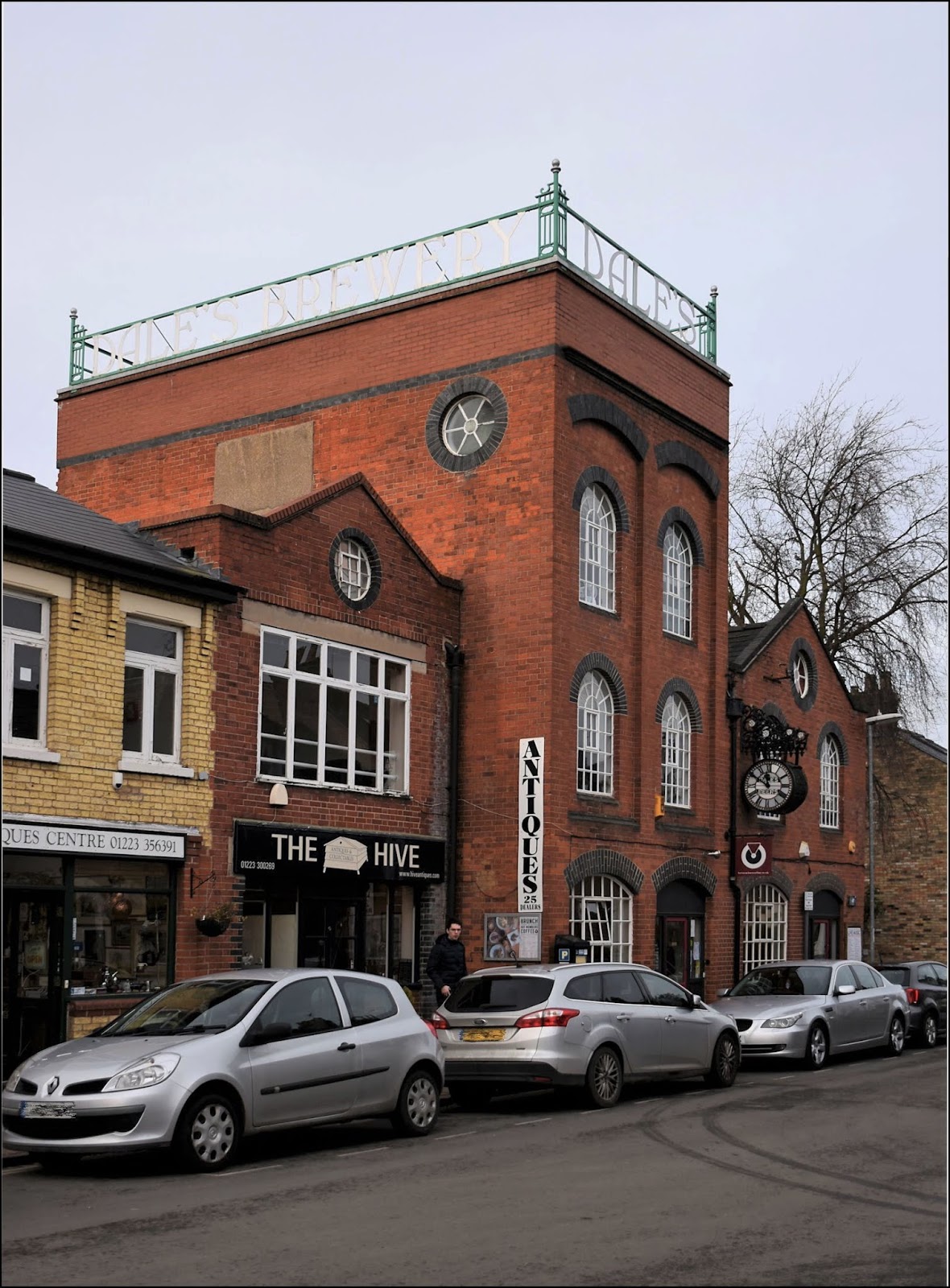
I could go on, for there are many more interesting buildings of similar vintage along the length of Mill Road and its many side turnings. Above is the old Dales Brewery building which seems to be thriving as an antiques shop and a coffee bar. But are there any new buildings being built round here?
Yes, indeed. The golden dome is Cambridge's new mosque which now stands proudly near the far end of Mill Road. You can visit it at any time when prayers are not in progress and I intend to take a tour there later in the year.
Take care.
Showing posts with label Architecture. Show all posts
Monday, 3 February 2020
Friday, 13 December 2019
A Closer Look
As I wandered through Ely Cathedral (as described in the previous post) my attention kept wandering from the overall magnificence to the small details - some beautiful, some interesting, some poignant and some a little absurd.
When you gaze at such a big structure you can easily take in the general shape without noticing the elaborately decorated surfaces which make up the whole. Here you see part of the west tower, south-west transept and Galilee porch, all of which are a mass of intricate carving. Just how many man hours went into carving each of the stones that contribute to the little bit pictured here? And how much into the whole building?
The ceiling painting in the nave is more recent and was painted by two men we've come across on this blog before. Henry L'Estrange Styleman Le Strange was a gentleman land-owner in the nineteenth century and it was he who conceived and completed half of the painted ceiling. The other creation he's remembered for is the seaside town of Hunstanton which he had built on his land to create employment in the area. Unfortunately he died young before either was finished. The ceiling was completed by Thomas Gambier Parry who was also responsible for the frescoes in Hildersham church.
There's even more detailed carving inside the cathedral, with just a few coloured spots of light courtesy of the stained glass windows.
I love it when the sun streams through the coloured glass windows and lights up even the darkest nooks and crannies. These arches are in the south aisle of the nave.
In any other location the round arches of the south aisle would attract attention and admiration - they are nine hundred years old after all - but in this building they are largely ignored.
More sun on stained glass. Almost all of the windows are no earlier than Victorian but no less beautiful for that.
In the Lady Chapel you can still see quite a lot of the medieval painted decoration on some detailed carving, albeit much knocked about by Protestant iconoclasts.
I'm very fond of fancy ironwork and especially the wonderful shadows it throws on the walls and floors.
These are the steps that ascend to the pulpit with the shadows of the iron bannister.
The cathedral contains a series of boards on which are recorded all the men of Cambridgeshire who lost their lives in the Great War. Those two Wilsons at the bottom were my grandmother's two brothers.
This memorial is to a gentleman who was the treasurer for the Duke of Bedford's company engaged in the draining of the peat fens during the eighteenth century. I'm amused by his name: Gotobed East! You might think he must have been a particularly hyperactive child for his parents to have Christened him Go to bed (!) but it's probably just the old tradition around these parts of naming children with their grandmothers' maiden names. Gotobed is a well-known, if uncommon, name around here - they fit in just fine with the Hunneybuns and Puddifoots. If I were named after my two grannies my first names would be Skipp Wilson - not bad at all.
And we'll finish off with another peep at the Christmas tree in the Octagon.
When you gaze at such a big structure you can easily take in the general shape without noticing the elaborately decorated surfaces which make up the whole. Here you see part of the west tower, south-west transept and Galilee porch, all of which are a mass of intricate carving. Just how many man hours went into carving each of the stones that contribute to the little bit pictured here? And how much into the whole building?
The ceiling painting in the nave is more recent and was painted by two men we've come across on this blog before. Henry L'Estrange Styleman Le Strange was a gentleman land-owner in the nineteenth century and it was he who conceived and completed half of the painted ceiling. The other creation he's remembered for is the seaside town of Hunstanton which he had built on his land to create employment in the area. Unfortunately he died young before either was finished. The ceiling was completed by Thomas Gambier Parry who was also responsible for the frescoes in Hildersham church.
There's even more detailed carving inside the cathedral, with just a few coloured spots of light courtesy of the stained glass windows.
I love it when the sun streams through the coloured glass windows and lights up even the darkest nooks and crannies. These arches are in the south aisle of the nave.
In any other location the round arches of the south aisle would attract attention and admiration - they are nine hundred years old after all - but in this building they are largely ignored.
More sun on stained glass. Almost all of the windows are no earlier than Victorian but no less beautiful for that.
In the Lady Chapel you can still see quite a lot of the medieval painted decoration on some detailed carving, albeit much knocked about by Protestant iconoclasts.
I'm very fond of fancy ironwork and especially the wonderful shadows it throws on the walls and floors.
These are the steps that ascend to the pulpit with the shadows of the iron bannister.
The cathedral contains a series of boards on which are recorded all the men of Cambridgeshire who lost their lives in the Great War. Those two Wilsons at the bottom were my grandmother's two brothers.
This memorial is to a gentleman who was the treasurer for the Duke of Bedford's company engaged in the draining of the peat fens during the eighteenth century. I'm amused by his name: Gotobed East! You might think he must have been a particularly hyperactive child for his parents to have Christened him Go to bed (!) but it's probably just the old tradition around these parts of naming children with their grandmothers' maiden names. Gotobed is a well-known, if uncommon, name around here - they fit in just fine with the Hunneybuns and Puddifoots. If I were named after my two grannies my first names would be Skipp Wilson - not bad at all.
And we'll finish off with another peep at the Christmas tree in the Octagon.
Music On Friday
I suppose I should include some church music here but I feel like something a little more like the carving - lively and elaborate. This at least wouldn't sound out of place in church and its title recalls a cathedral. One of its names is "Paul's Steeple" - from the spire on St Paul's Cathedral in London.
"Hang on a minute! St Paul's has a dome not a steeple!". Ah, but the old church that was destroyed in the Great Fire did have steeple and this is a very old piece of music.
To anyone who ever tootled on a recorder or bashed a tambourine as a six-year-old that must be quite a revelation.
(Thanks to Robin Andrea and Roger who first suggested having a little music on a Friday).
Take care.
Monday, 14 October 2019
Fragments Of Our Past
When I'm out for a walk I find it difficult to pass by a country church without having a look inside. More than any other places they preserve our ancient past. Elsewhere whole buildings get destroyed and rebuilt, but there is a great reluctance to change anything to do with churches so layer upon layer of history is allowed to accumulate here. A lot of photographs accumulate on my hard-drive too, so here are just a few of them from various churches I've peeped into.
High up in the chancel of St Mary's church in Guilden Morden I spied this fine angel, which may be medieval but is more likely a more modern replacement as the medieval ones don't usually look very much like our modern idea of angels. It's a fine piece of carving whenever it was done.
The Cambridgeshire fenlands are dotted with little churches that are superficially like this one at Chettisham. They were just big enough to serve the sparse population and rarely have towers or stone spires. Most of them date from the nineteenth century, but not this one! The clue is in the very narrow windows that let very little light in, these indicate a much earlier date.
Go into any church in England and you'll almost certainly find some sort of organ. It may be like this one at Pirton, or they can be huge monsters with multiple keyboards or tiny harmoniums. And you might find them in any part of the church - in the chancel, at either end of the nave or filling a side chapel. For, even though they seem so much part of the church, they are a Victorian innovation and had to be fitted in whatever space was available. Before that music was provided by a band of musicians sitting in a gallery at the west end of the church. Occasionally the gallery still exists, but the days of singing along to fiddles, cellos, serpents and other curious instruments have gone forever.
(It's actually a lot more complicated than I thought. See the comment from Billy Blue Eyes below).
"In memory of Polly and Cornelius Smith, the beloved parents of Gipsy Smith". Rodney "Gipsy" Smith was born in a "bender" (a tent) in a Romani encampment in Epping Forest in 1860. While he was still a child, his mother Polly died of smallpox near the village of Norton in Hertfordshire and was buried in the churchyard. Her husband Cornelius became a practising Christian after listening to a prison chaplain on one of his many spells in jail. At the age of 16 Rodney also converted and spent his life being an evangelist in both Britain and the USA. Presumably he paid for this gravestone to his parents. Gipsy Smith's ashes were scattered at his birthplace in Epping Forest where there is a memorial stone.
In Wiggenhall St Mary stands this old collection box adorned with graffiti dating from 1779 and 1796.
Woodcarving of a somewhat more artistic order was on display in Cockayne Hatley church which we visited a couple of years ago. Henry Cockayne Cust became the vicar there in 1806 and decided to renovate the building. I think it's safe to say he got a bit carried away with the project and bought so much carved wood that he could scarcely fit it all in!
This more modern piece of art was in St Margaret's, Kings Lynn. A steel globe is suspended on thin wires and bears little holders where you can light a candle for world peace.
Up in the gaudily painted rafters of St Edmundsbury Cathedral in Bury St Edmunds is a carved wooden angel that gives some idea of what our churches may have looked like in the Middle Ages. It is, of course, fairly recent, carried out by the architect Stephen Dykes Bower who was determined to continue the Gothic Revival into the twentieth century despite a good deal of criticism from his contemporaries.
This unusual building is a church too, designed by Sir Edwin Lutyens for the town of Knebworth in Hertfordshire. He was married to Lady Emily Bulwer-Lytton whose father owned nearby Knebworth House and was a former viceroy of India. Sir Edwin also designed much of New Delhi. Sometimes it not what you know but...…..
The above tranquil scene is in the village of Magdalen. The brick enclosure in the foreground is really nothing to do with the church at all, but nonetheless shows how central the church was to everything that went on in English villages. It's actually a cattle pound where stray animals would be kept ("impounded") till their owners paid a small fee to retrieve them. Often things which have little to do with religion are preserved simply because they are connected in people's minds with the church.
If you were wealthy in medieval times you might be buried in a stone coffin and they often come to light when building work has to be done around churchyards. It puzzles me how such a heavy casket could be manhandled into position and lowered into the grave. This one was standing outside Crowland Abbey.
And sometimes our ancestors motives are simply beyond our imaginations. Carvings like this are usually called grotesques and always seem to be high up on the walls, either inside or outside. They are usually explained as being representations of evil, but this one just looks plain silly!
Take care.
High up in the chancel of St Mary's church in Guilden Morden I spied this fine angel, which may be medieval but is more likely a more modern replacement as the medieval ones don't usually look very much like our modern idea of angels. It's a fine piece of carving whenever it was done.
The Cambridgeshire fenlands are dotted with little churches that are superficially like this one at Chettisham. They were just big enough to serve the sparse population and rarely have towers or stone spires. Most of them date from the nineteenth century, but not this one! The clue is in the very narrow windows that let very little light in, these indicate a much earlier date.
Go into any church in England and you'll almost certainly find some sort of organ. It may be like this one at Pirton, or they can be huge monsters with multiple keyboards or tiny harmoniums. And you might find them in any part of the church - in the chancel, at either end of the nave or filling a side chapel. For, even though they seem so much part of the church, they are a Victorian innovation and had to be fitted in whatever space was available. Before that music was provided by a band of musicians sitting in a gallery at the west end of the church. Occasionally the gallery still exists, but the days of singing along to fiddles, cellos, serpents and other curious instruments have gone forever.
(It's actually a lot more complicated than I thought. See the comment from Billy Blue Eyes below).
"In memory of Polly and Cornelius Smith, the beloved parents of Gipsy Smith". Rodney "Gipsy" Smith was born in a "bender" (a tent) in a Romani encampment in Epping Forest in 1860. While he was still a child, his mother Polly died of smallpox near the village of Norton in Hertfordshire and was buried in the churchyard. Her husband Cornelius became a practising Christian after listening to a prison chaplain on one of his many spells in jail. At the age of 16 Rodney also converted and spent his life being an evangelist in both Britain and the USA. Presumably he paid for this gravestone to his parents. Gipsy Smith's ashes were scattered at his birthplace in Epping Forest where there is a memorial stone.
In Wiggenhall St Mary stands this old collection box adorned with graffiti dating from 1779 and 1796.
Woodcarving of a somewhat more artistic order was on display in Cockayne Hatley church which we visited a couple of years ago. Henry Cockayne Cust became the vicar there in 1806 and decided to renovate the building. I think it's safe to say he got a bit carried away with the project and bought so much carved wood that he could scarcely fit it all in!
This more modern piece of art was in St Margaret's, Kings Lynn. A steel globe is suspended on thin wires and bears little holders where you can light a candle for world peace.
Up in the gaudily painted rafters of St Edmundsbury Cathedral in Bury St Edmunds is a carved wooden angel that gives some idea of what our churches may have looked like in the Middle Ages. It is, of course, fairly recent, carried out by the architect Stephen Dykes Bower who was determined to continue the Gothic Revival into the twentieth century despite a good deal of criticism from his contemporaries.
This unusual building is a church too, designed by Sir Edwin Lutyens for the town of Knebworth in Hertfordshire. He was married to Lady Emily Bulwer-Lytton whose father owned nearby Knebworth House and was a former viceroy of India. Sir Edwin also designed much of New Delhi. Sometimes it not what you know but...…..
The above tranquil scene is in the village of Magdalen. The brick enclosure in the foreground is really nothing to do with the church at all, but nonetheless shows how central the church was to everything that went on in English villages. It's actually a cattle pound where stray animals would be kept ("impounded") till their owners paid a small fee to retrieve them. Often things which have little to do with religion are preserved simply because they are connected in people's minds with the church.
If you were wealthy in medieval times you might be buried in a stone coffin and they often come to light when building work has to be done around churchyards. It puzzles me how such a heavy casket could be manhandled into position and lowered into the grave. This one was standing outside Crowland Abbey.
And sometimes our ancestors motives are simply beyond our imaginations. Carvings like this are usually called grotesques and always seem to be high up on the walls, either inside or outside. They are usually explained as being representations of evil, but this one just looks plain silly!
Take care.
Sunday, 15 September 2019
Inside Story
Back in August 2015 I was pedalling my bicycle down one of Hertfordshire's minor backroads when I spotted "one of the prettiest little churches I've ever seen". That's what I said then and another viewing hasn't changed my opinion. Yesterday though the door of the church in Ayot St Peter was unlocked for the national Heritage Open Days weekend.
As English churches go it has no great age, it was built as recently as 1875, the previous church having been struck by lightning and burned down the previous year. The architect was J P Seddon who also oversaw most of the internal fittings and decoration too. There have been a few additions since but all in keeping with the original concept and carried out to the highest standard.
What we see today is one of the most complete small churches built in the Arts and Crafts style of the Victorian era.
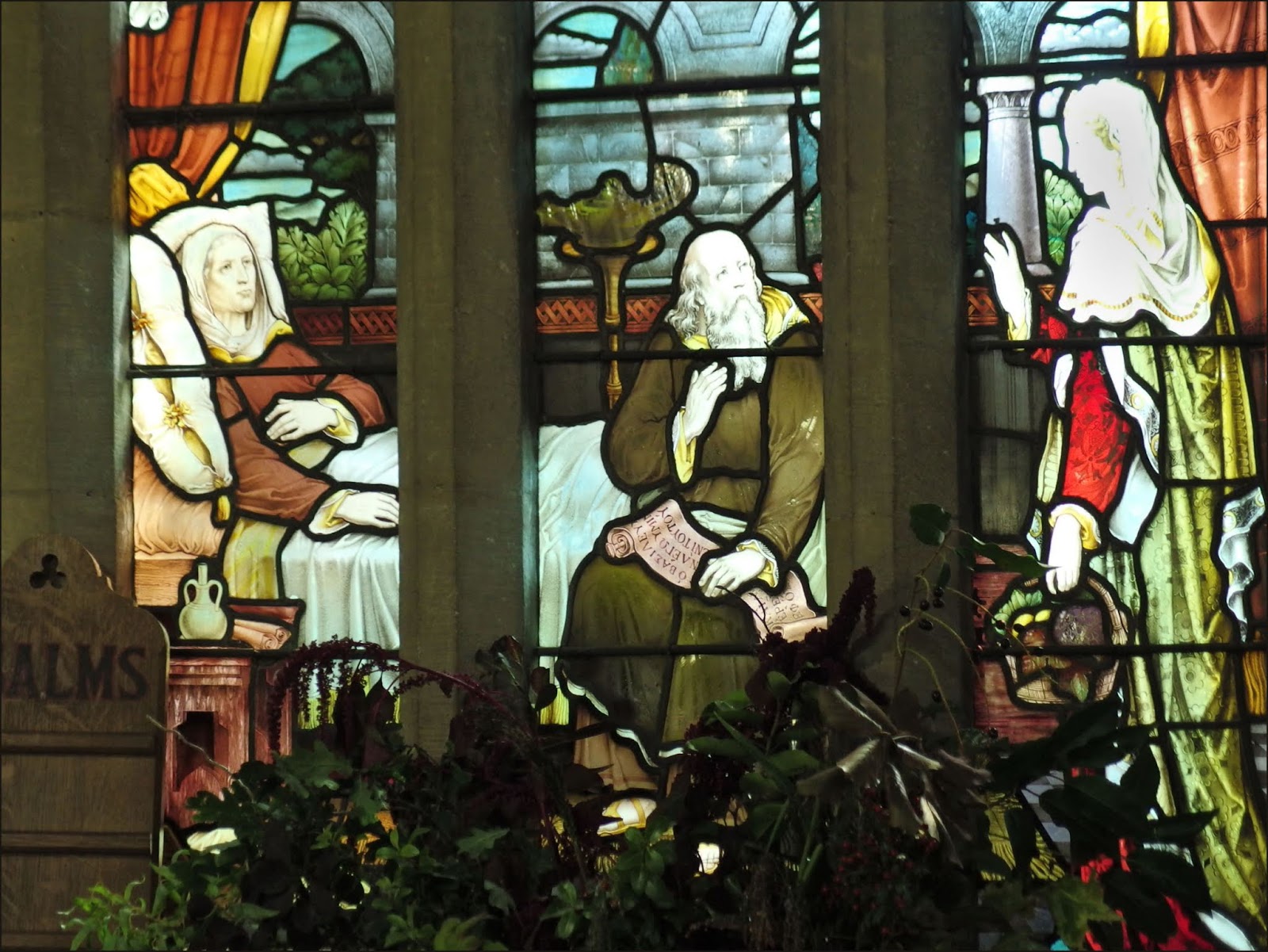
As a special bonus this weekend it's been skilfully and colourfully adorned in readiness for Harvest Festival.
The Arts and Crafts movement grew up in England in response to the rapid industrialisation of the country. Many artists and intellectuals despaired at what they saw as a decline in craftsmanship in the face of mass production and sought a return to traditional values.
There was also a movement within the Church of England to return to what they saw as a golden age of church building before the Reformation. Churches then had been much more colourful and elaborate.
Although the buildings constructed in this style are undoubtedly dazzling, the insistence on craftsmanship and materials of the highest order made them unbelievably expensive. Many a landowner was reduced to poverty by building in this style. Here there must have been several wealthy backers to finance the building of such a fine church. The ongoing cost of maintaining it must also place a heavy burden on the parish.
I've refrained from giving you too much detail about the individual items in the church, but if you want to find out more the village has an excellent website which will provide you with the full details about their beautiful church.
There was just one more thing I wanted to see......
….. a small glass case displays this lump of misshapen metal which comes from the bells of the previous church, melted by that fateful lightning strike in 1874.
Ayot St Peter is in a pleasant bit of countryside just west of Welwyn Garden City. I'll show you a few shots of the walk I took to get there in the next post. What I won't be sharing is the jar of home-made jam made by a local resident and on sale in the church; I'm having that all myself!
Take care.
As English churches go it has no great age, it was built as recently as 1875, the previous church having been struck by lightning and burned down the previous year. The architect was J P Seddon who also oversaw most of the internal fittings and decoration too. There have been a few additions since but all in keeping with the original concept and carried out to the highest standard.
What we see today is one of the most complete small churches built in the Arts and Crafts style of the Victorian era.
As a special bonus this weekend it's been skilfully and colourfully adorned in readiness for Harvest Festival.
The Arts and Crafts movement grew up in England in response to the rapid industrialisation of the country. Many artists and intellectuals despaired at what they saw as a decline in craftsmanship in the face of mass production and sought a return to traditional values.
There was also a movement within the Church of England to return to what they saw as a golden age of church building before the Reformation. Churches then had been much more colourful and elaborate.
Although the buildings constructed in this style are undoubtedly dazzling, the insistence on craftsmanship and materials of the highest order made them unbelievably expensive. Many a landowner was reduced to poverty by building in this style. Here there must have been several wealthy backers to finance the building of such a fine church. The ongoing cost of maintaining it must also place a heavy burden on the parish.
I've refrained from giving you too much detail about the individual items in the church, but if you want to find out more the village has an excellent website which will provide you with the full details about their beautiful church.
There was just one more thing I wanted to see......
….. a small glass case displays this lump of misshapen metal which comes from the bells of the previous church, melted by that fateful lightning strike in 1874.
Ayot St Peter is in a pleasant bit of countryside just west of Welwyn Garden City. I'll show you a few shots of the walk I took to get there in the next post. What I won't be sharing is the jar of home-made jam made by a local resident and on sale in the church; I'm having that all myself!
Take care.
Subscribe to:
Posts (Atom)