Showing posts with label Suffolk. Show all posts

Thursday, 7 September 2023

The Artist As A Young Man

Today we find ourselves on the Suffolk/Essex border, walking part of the way in the footsteps of a schoolboy who regularly passed through these meadows over 200 years ago.


From what we can learn the lad was no great scholar and had been beaten in his previous school. However his father had great hopes that he would one day take over the family business, though it turned out that his talents lay in a different direction - and it appears that his daily walks to and from school, as he perhaps idled along gazing all about him, had a more profound effect than the wise words, or reprimands, of any schoolmaster.


That boy was called John Constable and he went on to become England's most famous painter of rural landscapes. 


You sometimes read that he was the son of "a humble miller", but nothing could be further from the truth. Golding Constable was a wealthy landowner who owned Flatford Mill and, later, also Dedham Mill and a small ship too. The Grammar School at Dedham was built to educate the sons of the well-to-do citizens of the area and it was there that the young Constable made his reluctant way each morning.


The river here is the Stour, which we've met before on our rambles, and a very artistic river it is too. Thomas Gainsborough was born and lived in Sudbury, which was also the birthplace of Maggi Hambling. John Nash lived at Bottengoms Farm in Wormingford (later home to the writer Ronald Blythe). Cedric Morris and Lett Haines lived and taught in Dedham, which was also home to Sir Alfred Munnings. And now Grayson Perry has his astonishing dream house/art installation/shrine to "Julie Cope" on the Stour Estuary near Wrabness.


But today we are quite definitely in what the tourist boards have named "Constable Country" and it attracts bus-loads of sightseers to the National Trust property at Flatford Mill, which is where we must also go if we are to complete our pedestrianised pilgrimage.


Above is the hump-backed footbridge leading to Bridge Cottage and the hamlet of Flatford, all looking very much as it must have in Constable's day - though I'll bet he never had to wait for a group of tourists and their long-winded guide to move before crossing over!


Paintings like "The Haywain" and "Dedham Vale" are so ubiquitous today, appearing in books, magazines, on calendars or chocolate boxes, that it's hard to imagine that in his day Constable was something of innovator. Landscape painting at that time had become a search for an almost dream-like perfection but Constable was in love with the reality of the world around him. "The sound of water escaping from mill dams etc., willows, old rotten planks, slimy posts, and brickwork, I love such things".


Much of the vigorous roughness of his painting is lost as his work is miniaturised for modern consumption. The original paintings are about six feet (2 m) across. Lets have a look at "The Haywain"....
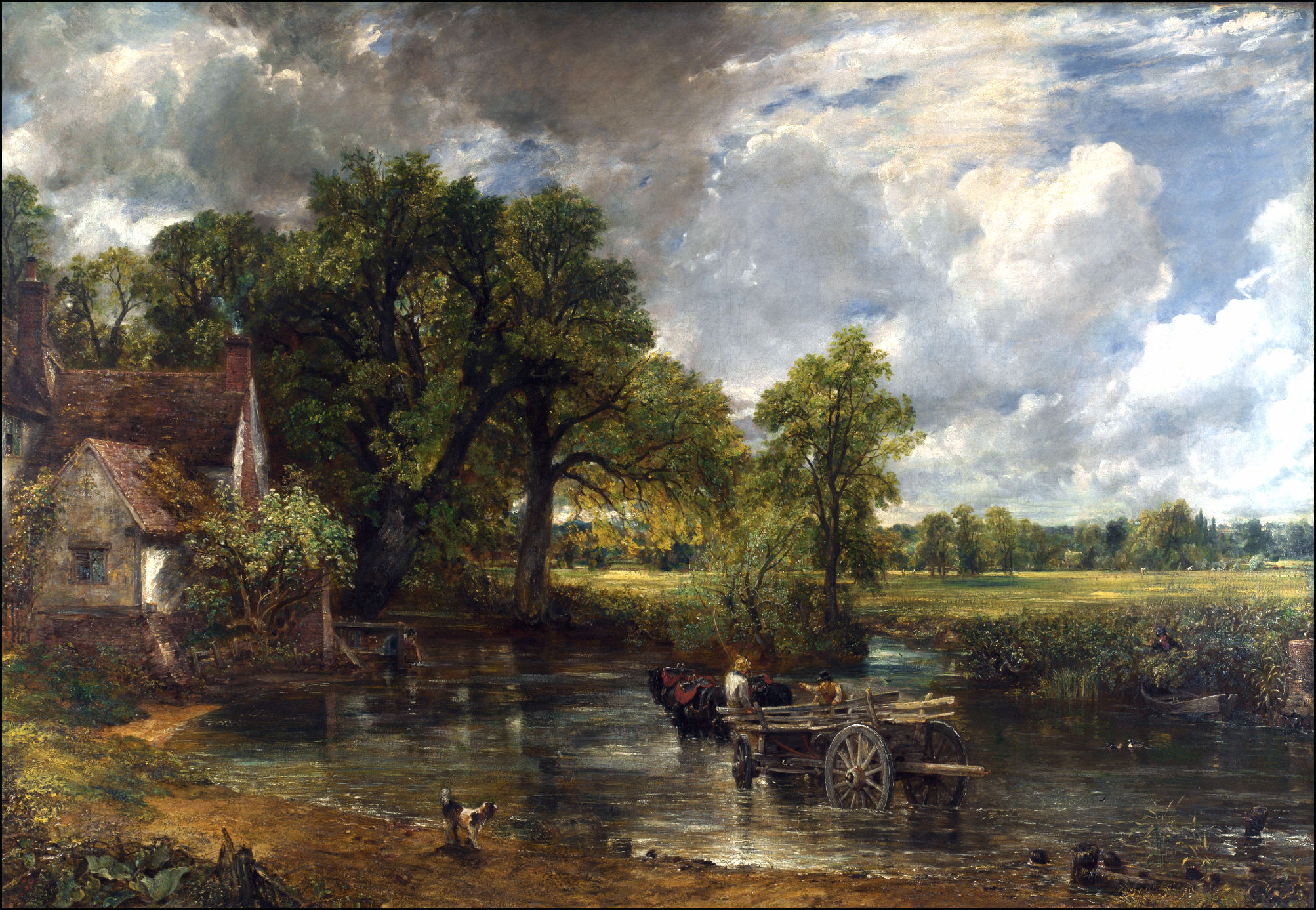


At first glance we have a nostalgic, pastoral scene - even with the artist's forceful brushwork. But lets look at the composition. Those of you who know a little about the "rules" for taking photographs will notice that he's done something very odd: not only has he placed a light-coloured object (Willy Lott's cottage) at the edge of the frame but he's cut it in half! In other works people and animals face out of the picture. He is, I think, trying to make his scenes look more natural and uncontrived.


I contrived to do the same thing when photographing the scene today. (And who would have guessed that there'd be more trees now than there were in the past). Anyway, here's a view of Willy Lott's cottage that's much less familiar...


Back briefly to "The Haywain": Although it is to some extent a nostalgic scene from the artist's childhood, painted when he was a mature man, the world was already changing and industry was rearing its unattractive head. And there's one detail which is often missed - take a look at the sky in the painting. If he'd wanted to paint an idyllic scene surely it was not beyond his powers to paint a blue sky with fluffy clouds. Instead we have people going unhurriedly about their business - you can make out the men haymaking in the far distance,....


....the carter and his lad carry on a conversation, the horse waits patiently in the stream (soaking the wooden wheels to tighten them up, I'm fairly sure), a man is fishing and a woman gathers water (both almost hidden in shadows) while all the time the clouds are building up for rain. I interpret it as a metaphor for the turmoil that's about to hit the countryside. And Constable's original title was "Landscape: Noon" which to me, at least, suggests a tipping point in the fortunes of the day and perhaps of history.


I'm not sure if the group gathered before Flatford Mill were thinking such thoughts or whether they were looking forward to the National Trust's tearooms and gift shop!


Or maybe after viewing the stunning half-timbered Valley Farm....


....they were going for a boat ride. Either rowing themselves or....


....taking a trip on the electric boat - looking here like a journey up the Orinoco!


As for us, we're about to walk back to Dedham where we can visit John Constable's old school, as well as seeing one of his few religious paintings, which hangs these days in the church.


*******

So you thought I'd forgotten....


Congratulations to Rosie ("Corners Of My Mind") for being the closest with her guess, "a roost for bats". It's actually a "bat hibernaculum", so a place where bats hibernate, rather than just roost. What we see here is the entrance to a long tunnel. It was partly funded by National Lottery money and seems to be working; many different bat species have been recorded on the reserve.


Take care.


Monday, 28 August 2023

The Autobiography Of A Church

Welcome to a story spanning centuries and full of puzzles and mysteries - even to the church who lived through it!


Suffolk is a county with many outsize churches. Many of my neighbours have succumbed to the passing years, some fell into the sea as the coast receded, some were left to crumble away and others had the indignity of having a smaller church built within their walls. But here at Blythburgh circumstances have conspired to save me, though much of my former glory has faded and some has been willfully destroyed. Listen while I tell my tale.


I've been here since the fifteenth century, but another church stood in this very place long before that. I've heard that King Anna, king of the East Angles, was buried here in 654, having been killed in battle just north of here. So I suppose it must have been an important church, even in those days.


My story begins in 1412 when Henry IV gave the nearby priory permission to rebuild the old church on a huge scale and this is the first of my puzzles. You see, the priory was never that big and just a few years before it's recorded that there were only seven brothers in residence. What's more they already had a church of their own. The village today has a population of just 300 and it seems it was never a very big place; if it ever had a golden age it was back in Saxon times and it was in decline, partly as a result of the Black Death, by the time I was planned.


Blythburgh was never a big port either, so wealth didn't come that way. And although it was a prosperous farming area there were no huge profits from wool, like there were in other places. The wealthy Hopton family put up a lot of the money because they wanted a chantry chapel where the monks could pray for the souls of their departed. But even that's a bit odd as the family's main holdings were not here but up in Yorkshire.


But here I stand, completed in 1480 and one of the finest examples of fifteenth century Perpendicular architecture that you'll see anywhere (even if I say so myself!). In the old days I was much more colourful with wall paintings and stained glass windows. And services included processions around my wide aisles to pray before the many icons.


These bench ends have been with me right from the beginning, some of them are a bit battered these days (and for some reason the visitor who took these snaps missed the best of them!).


It was in 1538 that my troubles began when the Dissolution of the Monasteries meant that the priory closed down. The Puritans, who were increasing in number even in this backwater, began removing altars and icons, whitewashing the walls and taking out the beautiful stained glass. Luckily they weren't very thorough and much colour remained.


Further disaster struck in 1577 when, during a service, a great storm arose. Lightning "cleft the door, and returning to the steeple, rent the timber, brake the chimes, and fled towards Bongay, six miles off". Part of the spire fell through my roof and damaged the font. When the storm had subsided a man and a boy were found "starke dead". People blamed the Devil and the imaginative among them discovered his hoof print scorched on to the north door. Others claimed that Black Shuck, the evil dog who haunts many places in East Anglia, had entered my doors and his claw marks could be seen.


In 1613 the "Judas" Bible was published. It gets its name from a misprint where the name of Jesus is replaced by Judas. A copy of this Bible found its way here and is still exhibited in a glass case.


In 1644 rumours began to circulate about a destructive gang, led by a man called William Dowsing, who were visiting churches throughout the land. They had orders from parliament to destroy any "popish images" that remained.


He arrived here one morning in April and ordered the removal of '20 superstitious pictures, one on the outside of the Church; 2 crosses, one on the Porch and another on the steeple; and 20 cherubim to be taken down in the Church and Chancel ... and gave order to take down above 200 more pictures, within 8 days'. 


Just a little of my lovely glass escaped destruction and can still be seen at the top of some of the windows.


There's a story that Dowsing's men could find no way to get up to the angels in the roof and in their anger and disgust they emptied their blunderbuss guns in an attempt to bring them down. Sadly it's not true.


You might also notice these iron rings set into the pillars at the western end of the nave. These have been blamed on Cromwell's men stabling their horses here. You can see  that horses were kept here if you look at the wear on the floor beneath.


You can't blame people for making use of such a big building, most of which was of little use to the small village. Anyway I've always thought it a Christian thing to open my doors to anyone in need, animals and people. I'm happy to say that in recent times the clergy have come around to this point of view and a service for animals is held. Once again horses are tethered to my sturdy pillars.


But decay was setting in and no one had the money (or perhaps the energy and inclination) to undertake such a vast project. A note in the Parochial Visitation Book in 1663 says 'here at Bliburgh hath been no communion for these 12 years past'. A big fire in the village thirteen years later caused many of the small congregation to move elsewhere. It was also recorded that men were paid to shoot at Jackdaws which had begun roosting in the roof, which explains the bullet-holes in the angels and roof-beams - nothing to do with Dowsing's unmerry men. They actually managed to do some kind of repairs to the roof at this time, just 200 years after it was damaged by the falling steeple! 


By 1819 the window tracery "was removed, windows patched up with bricks and mortar, shields and angels' wings falling disregarded from the roof". Rural poverty, the lack of a wealthy patron and my sheer size made the necessary repairs out of the question. There was also the rise of Methodism in village as people turned away from the established church. By 1847 I was described as "mouldering into ruin". By 1870s the congregation was sheltering beneath umbrellas and I was closed as being unsafe - even by the lax health and safety requirements of the day!


The strange faces high up on my walls looked down impassively as the Victorians argued about planned restoration. Local people had one grand set of plans, while William Morris and other influential experts had another. I suspect that neither really wanted to win the argument as both lacked the funds to implement their ideas. In the end a modest plan was drawn up and something like what you see now was the result. Maybe that was a good thing, I've heard that the Victorians could be a bit heavy-handed at times!


The taste of the time didn't allow a return to my former dazzling glory, though over the south door there's an angel decorated with gold leaf, tin foil and bright paint to show you how stunning I was in my youth.


You might think of me as lonely and living in the past, but nothing could be further from the truth. I have thousands of visitors every year and can still find space (that's one thing I have plenty of !) for modern works of art like St Matthew, one of four pictures done for the millennium by artist Mara Amats. The paper is made from local river reeds. And on the right is a modern Madonna and Child by Peter Eugene Ball.


But there are some things that have a place here which even I can't remember arriving:


No other church has anything like these figures on the front of the choirstalls: St Mathias, St Bartholomew and St Philip are shown here but there are many more. At some time they've been used as school desks and there are holes made for inkpots. Also there's some graffiti - in Dutch.


That's something to ponder as the sun streams in through the windows and you make your way around, much like the processions of Medieval times.


Time ticks along, though old Clockjack, who once sounded the hours, now only rings at the beginning of each service.


Take care.


Wednesday, 23 August 2023

A Date With Heather

The last week in August seems to be about the right time to meet up with heather in East Anglia, though it's by no means as widespread as in other parts on Britain. Here it's confined to a strip of sandy land in North Norfolk and the Suffolk Sandlings. So I made a note in my diary to visit Westleton Heath in Suffolk. Here are a selection of photos with the heathers set off by  green bracken, yellow gorse and the silver trunks of the birch trees.


Take care.