I got rather carried away photographing the various shop fronts along Mill Road. As you'll see, many nations of the world are represented and there's plenty of competition to sell you a bicycle! It was a Sunday afternoon so the street was relatively quiet - during the week the traffic (vehicular and pedestrian) makes it difficult to get clear views across the street.
If we'd walked here a couple of hundred years ago we'd be on a narrow track passing between fields on our way to the village of Cherry Hinton. We'd have passed a windmill that would eventually give this busy modern road its name - Mill Road. Things started to change when the railway reached Cambridge and this land was used for cheap housing for those who worked on the railway and in its associated industries.
You might think that no one would want to live in these small, cramped houses today and that the shops here would not survive in this modern world. Maybe it's time to tear it all down and start again. But you'd be wrong on several counts.
These houses are some of the most expensive in the city - in terms of price per square foot at least. Although they were very cramped for the large families of the Victorian era, they are now snapped up by young professionals who value their nearness to the city centre and the vibrant multi-cultural atmosphere. They also support many of the small alternative shops and international cafes and restaurants along Mill Road.
However, although the future of this historic area looks healthy for the time being, there are problems with some of the public buildings. You see, there are only four listed buildings in this whole area. So while some buildings, like St Barnabas Church (above) are protected by planning laws, there are many others which are part of our history but have no such protection.
There are a number of industrial buildings like George Bolton's Warehouse which are surely worth keeping as part of the cityscape. Bolton moved to Cambridge from Hertfordshire in the mid 1800s, initially to work as a porter on the railway but soon set up in business as a general carrier (someone who took goods from the railway station to their intended destinations). Bolton and his sons expanded into building and owning a brickworks, but they were mainly known as furniture removers. The warehouse was used for storing furniture and is now converted to offices.
This fine red-brick building, on the corner of Mill Road and Gwydir Street, was once the public library. It was used for 20 years by the Hindu community as a place of worship until they were unable to fund the necessary repairs. The city council plan make the building some kind of community centre once it's been repaired.
The building above however now provides a mixture of accommodation for elderly people. But for many years it was Cambridge's maternity hospital. Wikipedia will tell you that Douglas Adams, author of The Hitchhiker's Guide To The Galaxy was born here, though it doesn't mention that I first saw the light of day there just a few months later. Its original purpose, when it was built in 1838, was as the Cambridge Union Workhouse to house the poor of the town.
Above the door of this building it says "Lifecraft", which is the name of a user-led organisation to help those with mental health problems. But above that it says "The Bath House" and that's what it was built as in 1927. It provided baths for those whose homes lacked the necessary facilities and, perhaps surprisingly, it still operated into the 1960s.
Right down at the far end of Mill Road we find Brookfields Hospital. This was built as a Hospital for Infectious Diseases from 1885. At the time "germ theory" was not fully understood and most diseases were thought to be caused by "bad air". For this reason it was built at the eastern edge of the town so that the miasma was not blown back into the town.
This building looks a bit sick and neglected too. It's known as The Romsey Town Labour Club and reminds us of a time when this area of Cambridge was nicknamed Little Russia because of the strong left-wing views of many of the people here; the union movement being very strong amongst those employed on the railway and its affiliated industries. These workers lacked funds but had many expert builders among them and the Labour Club was built entirely by voluntary labour. The beautifully carved crest above the door, presumably the work of one of Cambridge's many stone-masons, shows all the different tools used by the craftsmen who worked on the building.
The man responsible for much of the organisation of the Club was Billy Briggs, a local man who had left school at the age of fifteen to work on the railways. He held all kinds of voluntary and political posts and reckoned he knew everyone in Cambridge. He went on to become Cambridge's first Labour mayor. He was a man of firm opinions and demanded that there should be a bar in the Club so workers could get a drink after a hard day's labour. There were many Working Men's Clubs set up around this time, but Romsey Labour Club was perhaps unique in that it always allowed women to join too - you've guessed it, it was at the insistence of Billy Briggs. How sad that this building is so neglected.
Just along the road, the Conservative Salisbury Club is also in need of a facelift, though it is still an active club with snooker and pool tables as well as a function room.
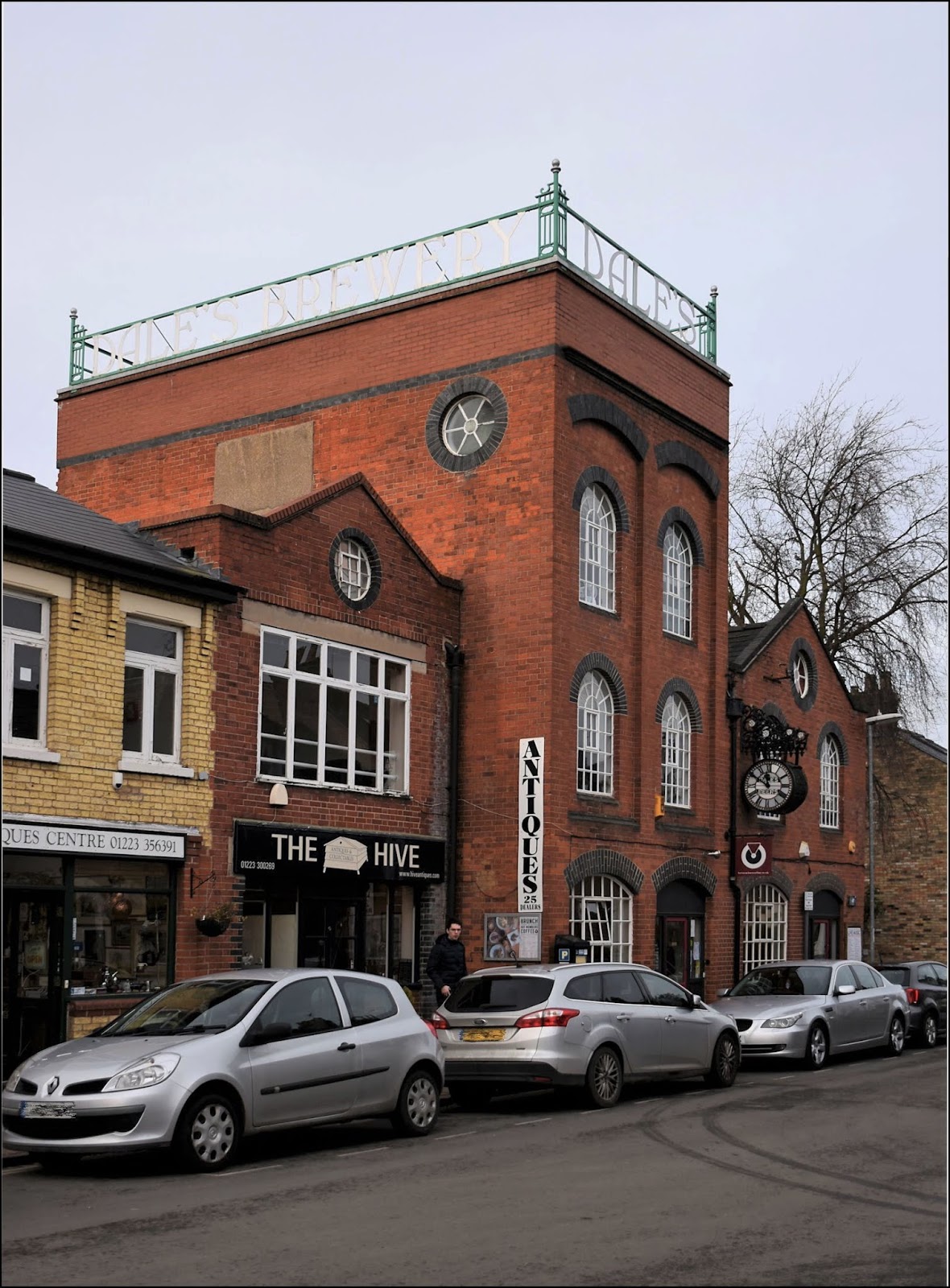
I could go on, for there are many more interesting buildings of similar vintage along the length of Mill Road and its many side turnings. Above is the old Dales Brewery building which seems to be thriving as an antiques shop and a coffee bar. But are there any new buildings being built round here?
Yes, indeed. The golden dome is Cambridge's new mosque which now stands proudly near the far end of Mill Road. You can visit it at any time when prayers are not in progress and I intend to take a tour there later in the year. Take care.
A wander around a graveyard on a gloomy day. You could be forgiven for assuming that I'm in a low mood at the moment, but you'd be wrong. Photography doesn't work like that. Whereas painters project their thoughts on to the canvas and manipulate the light, colour and composition to express their feelings, photographers have to be sensitive to their environment and make pictures from what is there. So here is my response to the melancholy that seemed to pervade this morning's damp, chilly air.
Now lets find some music for what's left of Friday..... The Music Maker Relief Foundation is a US charity which helps ageing and impoverished musicians, finding them gigs, grants and sometimes recording them too. There's a whole batch of videos on YouTube but this is one of my favourites. Here is the laid back Captain Luke accompanied on upside-down left-handed guitar by Cool John Ferguson....
As the good Captain says "YeeeeeaaaaAAH!...…......…...that's it" Take care.
Not six of the best birds you'll ever see - all birds are equal in my estimation (though some might be more equal than others). And certainly not six of the best photos of birds either, but six of the best I could manage yesterday on a visit to the North Norfolk coast. First of all a Little Egret....
If I'd seen this bird as little as thirty years ago I'd have been very excited indeed; you just didn't see them in the UK. I remember a trip down to Hampshire when I saw one of the only two Little Egrets in the country at that time, now I see them all over the place, even within half a mile of my house.
The Egret was central to the forming of the Royal Society for the Protection of Birds (RSPB) as it was the trade in their plumes, for making ladies' hats, that so appalled Emily Williamson and Eliza Phillips that they campaigned against the absurd fashion, leading to the founding of the charity in 1891.
I've always been very fond of ducks, ever since the days when I used to feed them bread when I was about four-years old. That's a male Wigeon you can see above, just one of a vast number of the species that visit our wetlands - in fact anywhere where there's water and grass - every winter. They have a wonderful whistling call which always conjures up memories of wild winter weather in my mind.
Another bird with an evocative call is the Redshank. Old bird guides never fail to mention that it's known as "The Sentinel Of The Marshes". By whom? I'm tempted to ask. Not by the wildfowlers who made a living out on the fens and marshes, I'm sure. Probably by the clergymen/naturalists of the Victorian era. I'm certain the fenmen had a much more colourful name for the bird whose panic-stricken cries would have alerted every bird for miles around to their presence.
This character, boldly strutting along the edge of the water-channel, is a Godwit. We have two closely-related species, the Black-Tailed Godwit and the Bar-Tailed Godwit, and in winter it's not that easy to tell them apart, though I'm pretty certain this is a Black-Tailed Godwit....
...and there's the black tail! I'm sure that if I made my living by walking about in marshes, shoving my nose into the mud to sniff out my food, I'd be pretty much black all over within a very few minutes; I've never really understood how birds keep so clean.
Watching from afar is a tall, proud Curlew. It's another bird with a wonderful voice; I'll put some links at the end of this post so you can hear some of these birds if you want to.
Saving the most colourful till last, these are Teal, male and female. At a distance, in dull light, the drake looks like a greyish bird with a dark brown head; it's only bright sunlight that reveals the details.....
The village of Clothall stands just east of the town of Baldock. It's hardly a village at all, just a handful of houses loosely gathered around a small church. I visited the church a few years ago and wrote about it in a post called "A Special Place". You'll have to follow the link if you want to find out about the church; I was too muddy to go inside today! But I did explore the lanes and paths that criss-cross the nearby fields. They're a bit special too, rather hillier than most places around here and with rather different farming.
Yes, sheep. They are only penned in like this temporarily while they await a quick health-check before being moved to a new pasture.
Believe it or not sheep are calm when crowded in like this and don't even mind having a photo taken!
Soon they're free to carry on with their grazing.
I was determined to show the landscape just like it is - not always pretty and very squelchy and slippery underfoot after all the rain we've been having.
A lot of the rights of way around here are shared by walkers, horse riders and farmers, resulting in glorious amounts of mud.
The church in its churchyard is still just as special as I remember. Despite being quite close to a road, the feeling is still of being in deep countryside.
Some of the gravestones are very old and much obscured by lichens and mosses.
I stopped and sat on a bench for a while before continuing on my way.
The roads around the village, like most roads in England, have a long history, but here they seem to have hardly changed. I didn't meet any vehicles at all.
Just the occasional wanderer from the farmyard.
This little water channel is the remains of an old moat that probably surrounded a farm once upon a time; there was quite a fashion for such moats at one time.
Time to be heading back, I think.
I'll leave it to these two ladies to wish you Goodbye.....