Monday, 12 July 2021

On The Staithe

As we were finishing our packed lunch, after our jaunt along the coast, Les suggested going to Brancaster Staithe. So we did.


"Staithe" is a word which occurs up and down the east coast of England and just means a wharf or dock, a place where ships can load and unload. Nowadays there are more leisure craft than hard-working little boats, and anyone pulling into Harbour Way to buy their crabs or shellfish will only see small sailing boats, floating at anchor at high water or resting on the mud when the tide is out.


But follow this old battered causeway and it'll lead you directly into Brancaster's past and into the heart of its industrial heritage. Back in the eighteenth century this was a much busier place and boasted one of the largest industrial buildings in the land, a huge malthouse capable of supplying the brewing industry with 120 tons of barley malt every week. But by the late nineteenth century much of the trade had moved elsewhere and the harbour was only used by a small fishing fleet, which is how things have remained.


Join me for a photographic tour of this remnant of East Anglia's maritime past....


So, a different kind of beauty from the beach and flowers in the previous post. The charm of this kind of scruffy decay seems to be more appreciated in the modern world, as everything becomes tidied up or at least hidden from view: no problem with that here. Anyone is free to wander through as there's a public footpath leading right between the buildings.


All that remains is to buy your crab and take a little of the taste of the sea back home with you.


Take care.


Saturday, 10 July 2021

Coasting

A gentle stroll along the beach towards Hunstanton cliffs:


The tide along this stretch of coast goes out a long way - it certainly seemed so to my four-year-old legs when I wanted to go for a paddle all those years ago!


There's always plenty of things to look for on the endless sands, even if it's only a strangely patterned rock lying on the ripples left by the departing tide.


Besides the gulls there were a few other seabirds around - Oystercatchers, Curlews, Redshanks, Bar-Tailed Godwits, Ringed Plovers and even an inquisitive Little Egret. But all of them too far away for photographs and some may even have been nesting, high up on the shingle, in a fenced-off area. Terns flew noisily overhead. 


I never tire of seeking out the strange patterns left by the tide.


There was plenty of standing water to splash through as we neared Hunstanton with its lighthouse standing proud on the chalk cliffs. We had thought of going further, but the beach was getting more and more populated. How about an ice-cream?


Luckily there's a place at the edge of Old Hunstanton, down among the beach huts and appropriately named "Old Town Beach Café". A school party was being shown around the lifeboat station.....


So we fled to walk between the beach huts. These little wooden shacks are used by families to store their beach equipment - deckchairs, windbreaks, buckets and spades. They don't look as though they've been used much over the last year and a few were being repainted and repaired. I can spend a long time photographing these colourful little buildings, but not today!


At this time of year there are wild flowers to be enjoyed among the dunes and we can follow the dune-slacks all the way back. One of the beauties of the North Norfolk coastline is that you can often follow either the beach or an alternative route slightly inland.


The little blue flowers are Harebells and that's one of the Hawkweeds shining amongst them like a yellow sun in summer skies. 


This dandy is the caterpillar of the red and black Cinnabar Moth. The caterpillar dines voraciously on Ragwort, a poisonous plant to many creatures. The poison doesn't kill the caterpillar though, but builds up in its tiny body and makes it taste disgusting to any bird that is foolish enough not to be put off by its bright colours. Not only that but the poison remains when the caterpillar turns into the moth, which is likewise protected from predators. The only problem in the Cinnabar Moth's world is that there's a campaign to eradicate Ragwort which happens to also be poisonous to horses.


I somehow neglected to photograph the Pyramidal Orchids but did find this beauty: Marsh Helleborine. It is actually an orchid too and a rather pretty one to my eye.


The path led on through the dunes. Although you only see the occasional insect, if you stop for a moment you realise that there's a constant drone from the little pollinators going about their business.


More Harebells, glowing as they are backlit by the noonday sun.


Orange Hawkbit (or Tawny Hawkweed or Fox-And-Cubs or Flora's Paintbrush or Devil's Paintbrush or Golden Mouse-Ear or Missionary Weed or Red Daisy or Grim-The-Collier) is unmistakeable as it's the only bright orange flower that grows wild in the UK. It's not really native to these shores but has been here for many years.


And this is called Sea Holly, for reasons which should be obvious. I rather like Sea Holly. And now we're nearly back to where we started.


Of course, if you prefer walking on grass to wandering through drifts of wildflowers, you could move a little further inland, pay your subscription and walk here. It's the local golf course. Each to his own.


Take care.


Sunday, 4 July 2021

A Sunlit Meadow

Just to the west of the town of Dunstable there's a small outlier of the Chiltern Hills known as Totternhoe Knolls. We've been there before, a couple of years ago. It's a tiny but very pretty little area with wide-ranging views over the surrounding countryside.


But mostly it's to be enjoyed by dawdling with head down and hands-a-pockets, as there's much to see down at ground level.


This is one of the best places in the country to enjoy wild orchids. Mostly you'll see Common Spotted Orchids like those in the photo above, with a few brightly-coloured Pyramidal Orchids scattered among them.


Here's a Pyramidal Orchid, an easy one to recognise.


There are butterflies too, like this Meadow Brown. But you can also just wander and marvel at the beauty of a traditional English meadow without worrying your head too much about the details.


Although these Spotted Orchids may be called "Common", and here they seem to spring up in the numbers that Dandelions occur elsewhere, such a profusion is rare to find. So enjoy....


Twins!


Marbled White butterflies are here too, but they don't often perch in convenient places and don't stay for long either!


Red Admirals are a bit more approachable.


The reddish-pink flower is known as Restharrow. It doesn't look as though it would cause much trouble, but its roots form a particularly tough tangle and in the days of horse-drawn cultivation they would literally "arrest the harrows" hence the name.


A Ringlet butterfly also put in an appearance.


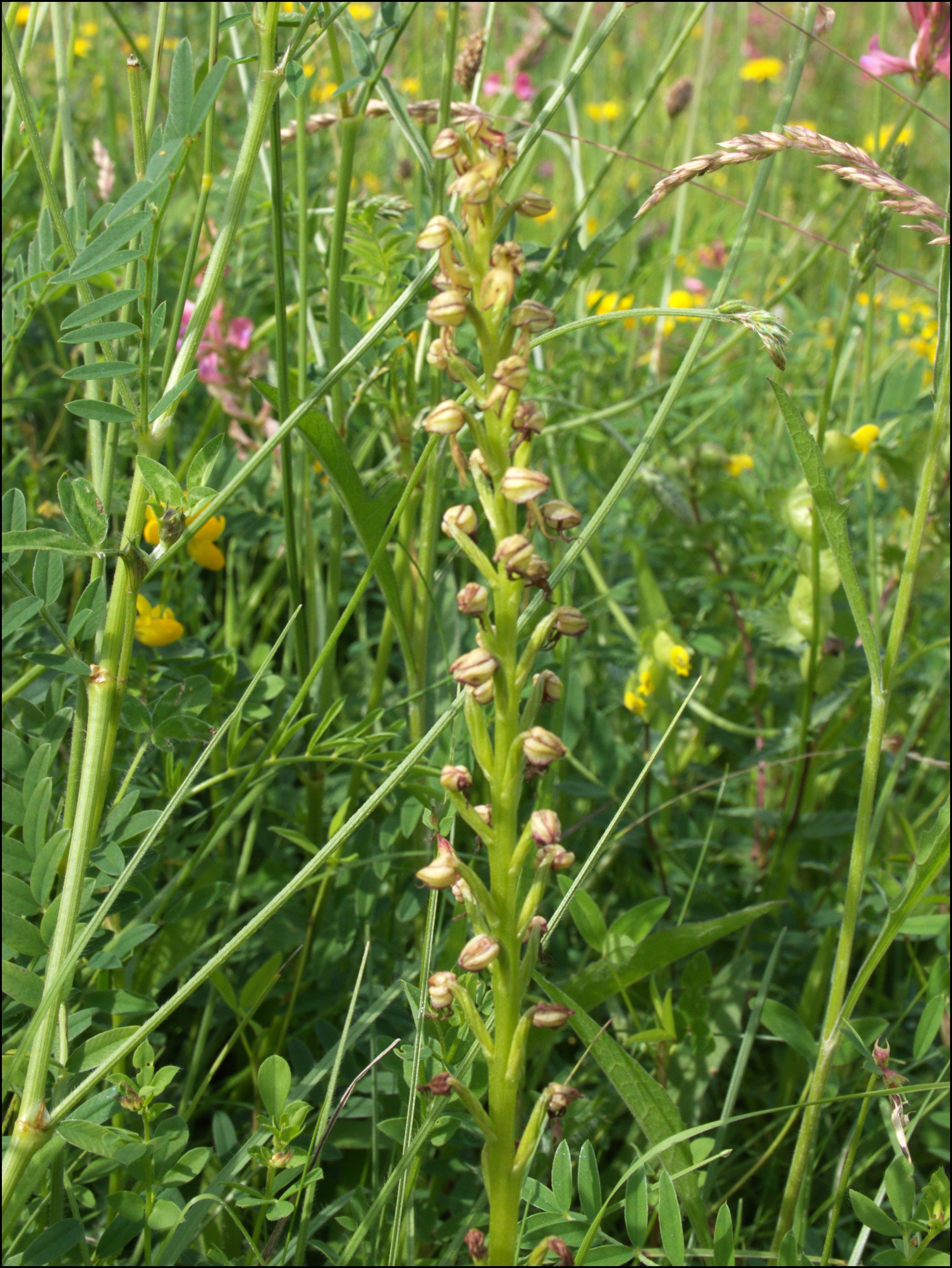
But it's this seemingly insignificant plant that gets the naturalists excited. If I'm not mistaken it's a Man Orchid and though it's perhaps a little past its best it's never an obvious plant. It's also here in tiny numbers and, no, I wouldn't have seen it if a dedicated and sharp-eyed group of volunteers hadn't passed this way recently and planted a small red flag to draw attention to it.

If you look really closely you can just about make out the "man" formed by its flowers....


Nobody really seems to know why these little plants are decreasing in number, despite everything that's being done to encourage them.


At least the Common Spotted Orchids and Pyramidal Orchids seem to be doing as well as ever.


A Speckled Wood butterfly prefers the hedgerows and woodland edges.


One final look at the view. The hill in the background is Ivinghoe Beacon where we were a few weeks ago. And I would guess that, all being well, we'll be back at both places again next summer.


Take care.

Friday, 2 July 2021

When Cows Lie Down

 It wasn't great weather for either walking or taking photographs but I decided to go anyway.


"It's going to rain you know. Everybody knows that"


Down here, under the trees and next to the stream, it's almost dark, despite it being nearly mid-day. Very dark, but very lush and green.


Meadow Cranesbill is flowering in the meadow (where else?).


The grasses are turning to their midsummer hue despite the recent rains.


A fly that's about the size of a bumble bee is busy on the flower heads. It's called a Pellucid Fly and apparently in the right light you can see right through it. It's a fairly common species and I know I've looked up its name before - and promptly forgot it again, of course. In the words of comedian Jimmy Cricket "I'm a fast learner, but an even faster forgetter!" 


An uprooted tree whose base has soon become smothered in ivy, while many small saplings try their luck in the vacated hollow. Ivy can become a major, and mostly unappreciated, presence in the small scraps of woodland around here.


It's so pervasive that it's impossible to ignore. Where some woods have bluebells, wild garlic, or wood anemones spreading between the trees, others have ivy, ivy and ivy. Makes a nice subject to photograph though.


Garden poppies are mostly finished flowering now with seed heads forming, though wild poppies are still on the fields.


A tree I've never noticed before, though I often pass this way.


Roses are looking fantastic in many folk's gardens, though if we get that promised rain I suppose they'll be spoiled.


And it certainly looks like it might. But so far it's stayed dry.


See, it hasn't rained.
"No, but it's going to!"


Take care.