Monday, 8 July 2019

A Jewel In The Town

The National Garden Scheme, whereby interesting private gardens across the country are opened for a day or two in aid of charity, occasionally turns up something completely unexpected. Lets look at a tiny garden which I visited on Sunday.


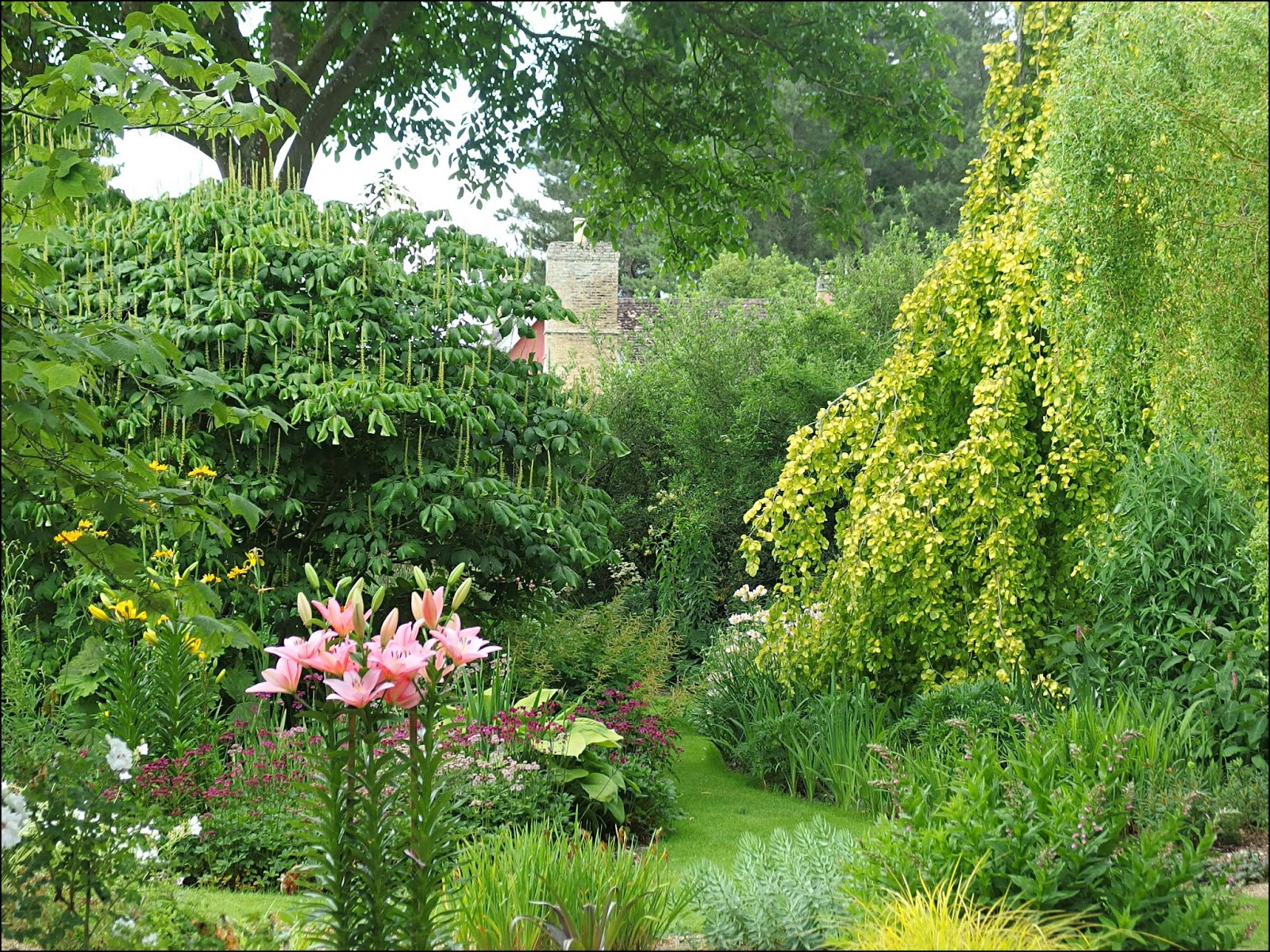
You've already had a sneak preview from the first picture, but as I approached down a narrow Cambridge street I began to wonder if I was in the right place. These terraced homes generally have miniscule plots of land at the back with barely space for a bicycle, a rubbish bin and a scraggy rose bush if you're lucky.


But I knocked at the door anyway and was welcomed in by John and Maurice who live here and have created the garden.


There was a small exhibition of John's stylish paintings, seen above in the wall mirror. But the eye was immediately drawn to the far end of the room where wide doors opened out on to.....


I certainly wasn't expecting that!


The garden acts like a sort of outside room, with a cushioned seat where you can sit and absorb the beauty all around you.


There's the gentle sound of running water in the jewel-like pool.


Last year this garden was placed third in the Gardeners' World national competition, though I imagine it must have been a close-run thing.


Artful use is made of mirrors which give the illusion of a larger space and also reflect sunlight into the shadows.


It's the kind of garden that you feel privileged to be able to visit.


Back inside I was able to look at some of Maurice's bookbinding and enjoy a cup of tea and a piece of cake before departing.


Take care.


Sunday, 7 July 2019

A Quiet Sunday In Cambridge

I don't know how it is where you live, but around here there are just too many outdoor events taking place in July. They want to catch the best of the weather, but must squeeze everything in before families go off on their holidays in August. 


There's a great Sunday market in Cambridge (in fact there's a market every day) and I thought I'd wander around and take some colourful photos.


I can never resist taking a few snaps of the Cambridge bikes and the posters that adorn almost every railing in the centre of town - more events for July! And you might notice the natty pink saddle cover which is advertising....


….the Race For Life, a 10Km charity run for cancer charities. Several people I knew were taking part - and I didn't spot any of them amongst the crowds of runners!


Some were serious runners....


…..others not so serious!


I was making my way to see a very special small garden which is only occasionally open to the general public. (Yes, of course you'll be seeing more later in the week).


Going back through town I noticed a mixed-up reflection of King's College Chapel in the window of a shop selling college rugby tops.


There's been a free music event on Parker's Piece all weekend. On Friday night there was music from Kid Creole and the Coconuts (remember them?) and a firework display to end the evening. On Saturday afternoon and evening there was more music including lots of local bands. And today it was Cambridge Mela, a celebration of all things Indian, Pakistani and Bangladeshi.


A lot of wonderfully colourful dancing...…


…..as well as more modern sounds.


Oh yes, and there was one of the University's gardens open too - one I've been wanting to see for a long while. We'll catch up with most of these events more fully during the next few days. Now I'm going to put my feet up; I reckon I've walked about ten miles today taking in all that lot!


Take care.


Thursday, 4 July 2019

Thank You, Mr Tickner

We're about to embark on a visit to Fullers Mill Garden, a little gem hidden away in rural Suffolk. When Bernard Tickner moved into the cottage in 1958, it came with a few acres of overgrown and derelict land which he set about transforming into the garden we see today.


A series of fulling mills had occupied this site since at least the mid-fifteenth century. Fulling was the process used for cleaning and thickening woollen cloth and the people who did the work were known variously as Fullers, Tuckers or Walkers - so if one of those is your surname then that's what your ancestors got up to. The woollen industry was central to the economy of the area during the Middle Ages.


The River Lark, which passes through the garden, was once navigable up as far as Bury St Edmunds, linking it with the great fenland rivers. Stone for the Abbey, for example, would have passed through the lock-gates here. By 1900 however the waterway had fallen into disuse.


By the time that Bernard and his wife Bess acquired the land it was in a sorry state. The river had eroded through into the pond and had become a swampy area littered with fallen trees.


There is still a sense here that rampant nature is about to take control of the garden once more, as you wind your way along narrow paths between the trees and flower beds, discovering new unexplored areas and unexpected glimpses into the world beyond.


There are many kinds of lily in the garden, one of Mr Tickner's enthusiasms. It always amused him when people complimented him of the colour-scheme of his plantings; he was colour-blind!


On a trip to Crete, Bess Tickner discovered a local form of Iris, Iris cretensis. And, in the Pyrenees, Bernard found a yellow form of Fritillaria pyrenaica, which was subsequently named after him.


In 2013 the assets of the Fullers Mill Trust were transferred to Perennial, a charity supporting those who work in horticulture, and it is they who manage the site today.


Bernard Tickner passed away, aged 93, in 2017, shortly after being awarded the MBE. But not merely for his contribution to horticulture. He had other strings to his bow.


He was also a naturalist and conservationist and it so happened that, while he was developing his garden, the Lark Valley was being exploited for its sand and gravels. Huge pits were being dug to extract the material, with little or no regard to the environmental damage that was being caused.


They soon found they had a formidable adversary in the gardener from Fullers Mill, as he fought many of their proposed schemes in the courts and prevented the destruction of valuable habitats and historic rivers. When the gravel companies left the site he proposed turning it into a nature reserve, Lackford Lakes, where I have spent many a happy hour peering through my binoculars.


The reserve did not only benefit from his energy and determination, he also made considerable monetary donations towards such things as the splendid visitor centre.


But that's not all I have to thank Bernard Tickner for. To understand that we have to travel back a few decades to when I was working on a farm, stacking straw bales every harvest time.


It was hot and dusty work and the only thing that was on my mind during the last hour's labour, as the sun was declining in the western sky, was the thought of walking down to the village pub in the cool of the evening and sinking a couple of pints of Abbot Ale before closing time.


You see, Mr Tickner's day-job was Head Brewer for Greene King Breweries in Bury St Edmunds and Abbot Ale was his creation.


I can't give you a pint of Abbot Ale via the internet, so I'll leave you with a scene from Bernard Tickner's other great creation, Lackford Lakes Nature Reserve.


Take care


Sunday, 30 June 2019

On The Knolls

Lets start off with a little colour.....


A field of poppies on the way to Totternhoe, a village on the edge of the Chiltern Hills in Bedfordshire. These are not a crop, it's what happens when farmers don't kill them off by spraying. One wonders just how much poppy seed there is in the soil.


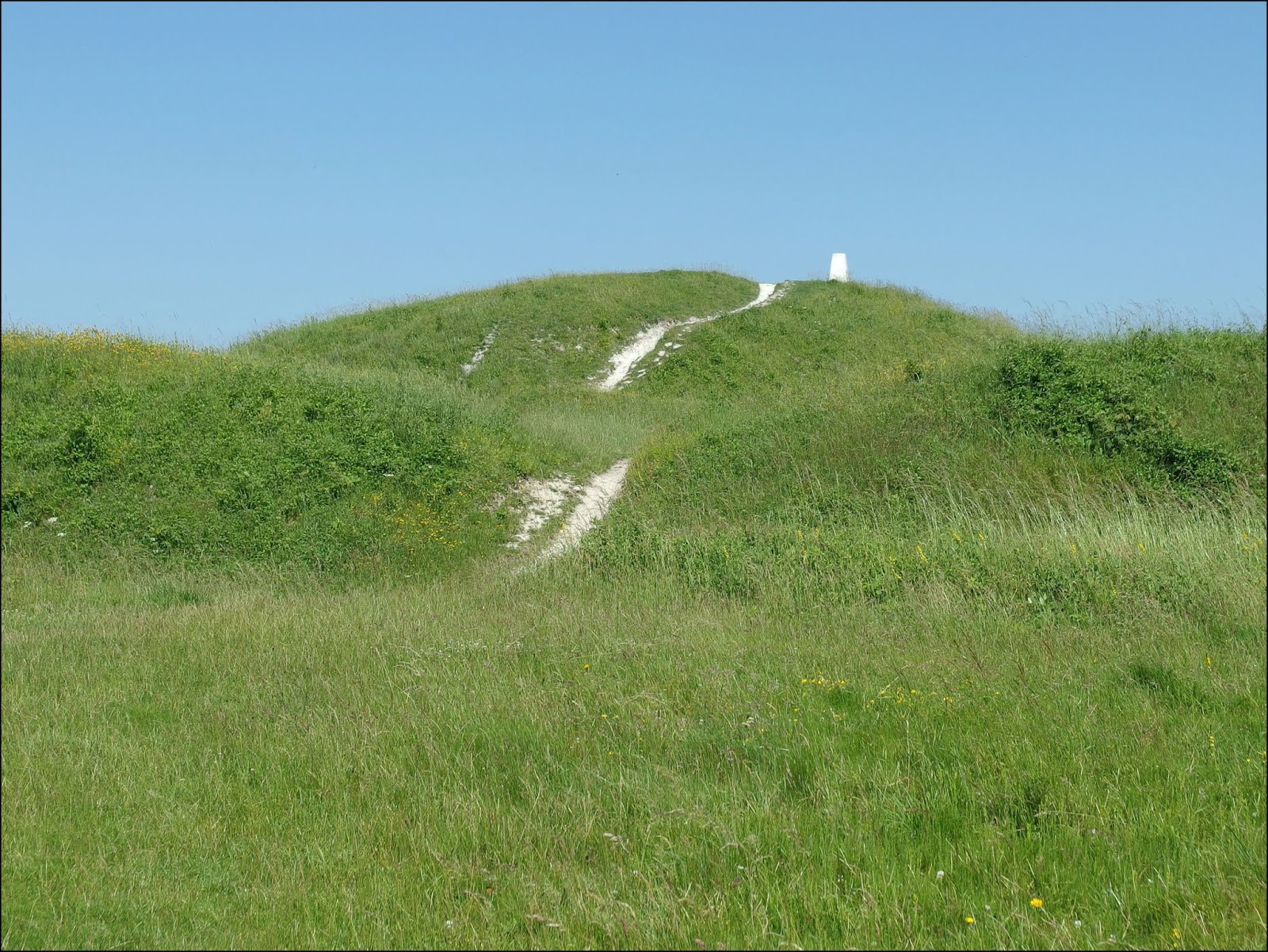
Behind Totternhoe the land rises steeply to form what are known as The Knolls, a strategic outlook known to man for thousands of years. 


On the very top, about nine centuries ago, a mound was raised and a castle was built, with high wooden walls encircled by steep banks and ditches. The palisades and buildings have all disappeared, though enough of the extensive earthworks remain to inspire the imagination. It's the kind of fort known as a Motte and Bailey. The Motte being the central stronghold on the highest point.


The deep ditch above, which still takes a bit of negotiating despite the softening effects of time, surrounds the Bailey or outer defences. Nowadays the Bailey is an area of dreamy meadowland, thick with wildflowers and butterflies.


Marbled Whites and Meadow Browns were everywhere, with occasional Red Admirals, Painted Ladies, Speckled Woods and Brimstones, as well as assorted Blues and Skippers whose restless dance defied closer identification. A dance populated by Red Admirals and Painted Ladies - now there's an image to conjure with!


The thin, chalky soils of this bumpy, difficult terrain have never come under the plough and have merely been used for grazing sheep and cattle. Ideal for orchids then....


And the orchids do not disappoint, with lots of Common Spotted Orchids and Pyramidal Orchids as well as a sprinkling of less common species. Anyone reading this blog recently might be under the impression that the whole country is awash with orchids at this time of year; alas, this is not the case. Although some species turn up in all kinds of unlikely places, others are confined to just a handful of sites. It may well be that most of them have never been all that common; there is very little folklore associated with them, despite their often odd appearance. 


The map of the area north of Totternhoe is crossed by many footpaths which are marked as old roads. These are a relic of the quarrying which used to take place here from Roman times. As well as the digging of chalk to make cement or agricultural lime it is also one of the main sources of Totternhoe Stone, a rock much in demand by medieval church builders. They even constructed tunnels beneath the Motte and Bailey to extract the precious stone.


When the stone is first quarried it is grey in colour and contains a lot of water. As it dries it becomes a soft rock which was relatively easy to carve for the medieval stonemasons. Not only that but when left a little longer it becomes pure white and hard enough to incorporate inside buildings, though not much good as an exterior building stone. You can't enter the tunnels or quarry to see the stone but you can find it in Westminster Abbey and other big churches.


You can explore the whole area on these old quarry tracks, but on a warm day it's thirsty work!


Time to withdraw to the comfort of the village inn, The Cross Keys. You might expect such a perfect retreat to be expensive and no longer anything like a pub on the inside, but you would be greatly mistaken; it still serves a good pint and has a wide-ranging though very reasonably-priced menu. We'll be back!


And there's still time to take a stroll on the Dunstable Downs with its glorious views towards Ivinghoe Beacon. Or you can sit on a bench, enjoy an ice-cream and watch the aerial exploits of the Glider Club.


There's even a view down on to another of those remarkable poppy fields to complete the day.


Take care.