Tuesday, 22 January 2019

January Tree, January Flower

Well, you didn't think Wandering John could go to the Botanic Garden and confine his meanderings to just one small area, did you? No, after I'd photographed the Winter Garden I drifted further afield and formulated an idea: how about if I were to select just one flower and one tree that happen to catch my eye each month? Lets give it a go....


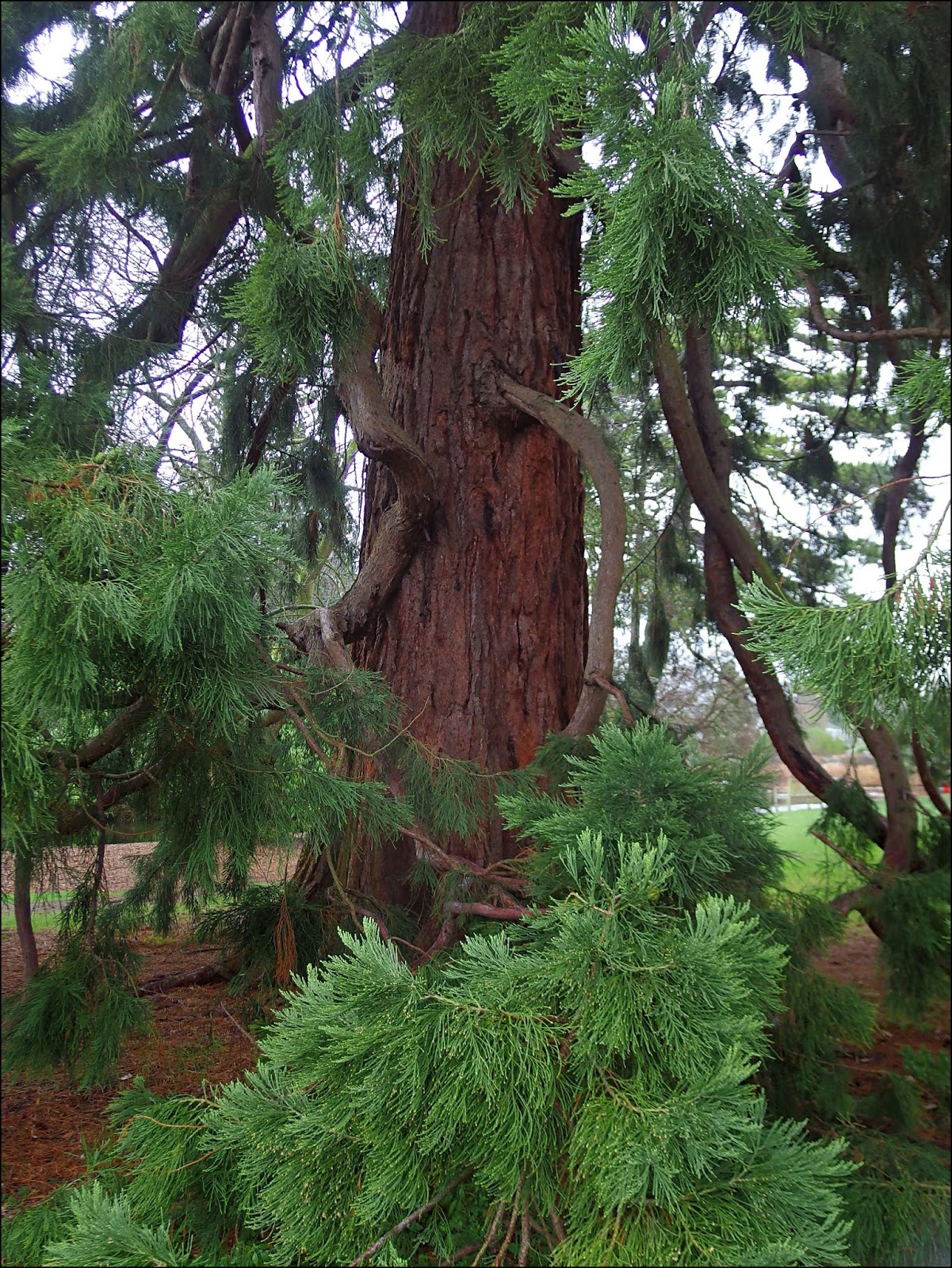
Sierra Redwood - sequoiadendron giganteum


When it comes to catching the eye not much can compete with the Sierra Redwoods as they soar above everything else. These though are just babies, being only just over 160 years old and measuring only 30 metres in height. The biggest one in the world (in California) is over 80 metres high and has been on this earth for 2,500 years!


Even so these are some pretty impressive "babies"! I just had to take a photo like this, as I remember well the first time I stared up in awe at the size and strength of these giants. They must have been a little smaller then, and I was much smaller, being just four years old.


Now some six decades later I'm back once more in this safe, secret space under the tangled, downsweeping branches - and on this rainy day it's quite dry within.


Children are still very welcome here and the University sets about inspiring the gardeners and botanists of the future by scattering bright little signs all round the garden to make a trail for junior explorers.

Here's a picture of William Lobb, who is a figure of great importance to these trees, as he was the Victorian plant-hunter who brought back the first substantial supply of Sequoia cones, from which these very trees were grown. Apparently a portion of one of these historic cones is safely stored away somewhere in the University.


The bark of the main trunk is tough and fibrous but the branches can be exquisitely smooth and patterned, as well as being a rich and varied colour.


Now where can we find a stunning flower to photograph on a dull day in January?


Candelabra Aloe - aloe arborescens


…..in the Glasshouse Range of course! In the section devoted to plants from arid lands.


The Candelabra Aloe i
s native to Southern Africa where it tends to favour cliffs and rocky outcrops, but can grow anywhere from sea level to mountainsides. It used to be grown around kraals (livestock enclosures) as it soon formed a stock-proof barrier of prickly leaves, which were also unpalatable to grazing animals. Apparently the sites of old kraals can be found to this day by the large clumps of aloes that survive.


As well as bearing striking flowers it has been studied for possible medical uses, including treatment of certain cancers, hypertension, diabetes, depression and obesity. It's been used in traditional medicine for centuries.


It's a pity that our climate is too cold for it to grow outdoors, so we'll just have to enjoy it here, with its flowers bent against the roof of the glasshouse.


Take care.


Monday, 21 January 2019

A Touch Frawsty

After the grey, damp, cold weather of recent weeks, it was nice to wake up to a sharp hoar frost with sun breaking through the low mist. The old-timers used to pronounce the word "frost" as "frawst" in my youth, but somehow that old way of talking has slipped away, in this locality at least. I would like it very much if the weather forecasters occasionally said "Tha's a touch frawsty out there s'morning". Here, in ten photos, is what that frawst looked like yesterday.


Did you see the ballet-dancing trees in the third photo?
Incidentally that grey, damp, cold weather of the last few weeks could be described as "rawky", another word for my dream meteorologist!


Take care.


Saturday, 19 January 2019

Cambridgeshire's Lake District


As I've mentioned before Cambridgeshire is too flat to have any real lakes, but the valley of the River Great Ouse does have a rash of flooded gravel pits, a few of which are known as Fen Drayton Lakes and are managed as a bird reserve by the RSPB.


These "lakes" are just part of a chain stretching for miles along the Ouse and its tributaries. None are particularly large bodies of water but there are over a hundred of them in the wider area. Some are managed for nature while others host sailing, fishing and water-skiing. The birds though don't know which are which and can turn up anywhere. 


In order to attract waders the RSPB have made shallow bodies of water (known as "scrapes") and many of the riverside meadows flood naturally during the winter.


When this was all gravel pits it was essential to keep it drained, but the sluice-gates, above, have clearly seen better days.


Someone commented on an earlier post that "River Ouse" was an odd name. It's pronounced "ooze" and there are at least five rivers called the Ouse in England as well as others called Usk, Esk and Exe which may well all derive from the same ancient word. Nobody's quite sure exactly what that word was (!) but this river was first recorded as Usa, well over a thousand years ago. In Scots Gaelic the word survives as Uisge, a word that you're all familiar with, even if you didn't know it. It means "water" and you know it from "the water of life" or uisge beatha, which has been Anglicised as "whisky".


So if Ouse means "water" then it's the "River Water" a tautology that is by no means unique in English place names. The River Avon is the "River River", for example. This doesn't surprise me at all; I lived for years in a riverside village and never heard anyone say "the River Cam", or even "the River Granta", which is its alternative name. No, we all just called it "the river". Incidentally Worcestershire's Bredon Hill translates as Hill-hill Hill!


But I didn't come here to think about gravel extraction or ancient place names - though it is fairly representative of the way that my mind wanders when I walk in quiet places - I came to look for birds.


Large numbers of ducks were out on the water and resting along the grassy banks. The most abundant were flocks of Wigeon which winter here every year, their distinctive whistling calls are the soundtrack to many a chilly wander in the wetlands. There were also plenty of Tufted Ducks and Mallards as well as a few Gadwall - all handsome ducks and worth having a close look at through the binoculars. There were just a handful of Goldeneye, maybe they'll be joined by others as winter progresses.


Dunnocks and Wrens seemed to be everywhere and there were several pairs of Bullfinches too. One species that was rather thin on the ground was Homo Sapiens who must have all been home in the warm. They didn't know what they were missing!


A list of birds seen:  

Wigeon, Cormorant, Mute Swan, Tufted Duck, Gadwall, Coot, Shoveler, Great Crested Grebe, Grey Heron, Little Egret, Black-Headed Gull, Goldeneye, Carrion Crow, Rook, Jackdaw, Magpie, Wood Pigeon, Kestrel, Blackbird, Great Spotted Woodpecker, Goldfinch, Chaffinch, Blue Tit, Great Tit, Long-Tailed Tit, Dunnock, Wren, Robin, Bullfinch, Pheasant.


Take care.


Thursday, 17 January 2019

January's Garden

It's always been a matter of some contention - for me at least - as to whether the The Cambridge University Botanic Garden is singular or plural. For years I've called it the Botanic Gardens, though recently I've noticed that all the signs say "Garden" (singular). However any visitor will see that it contains within it many differently themed gardens, beds and walks. My plan this year is to investigate one of these distinct areas each month in 2019, starting with the Winter Garden, which I leave to introduce itself...


As you can see it was a gloomy, overcast and sometimes drizzly day, though perhaps that's the kind of weather that the Winter Garden is designed to cheer up.


Take care.


Wednesday, 9 January 2019

Fenscapes

We're starting our walk today in the tiny village of Upware. It has a farm called "Far Away Farm" and a pub bearing the name of "Five Miles From Anywhere No Hurry Inn". For a crowded place like Cambridgeshire it's about as remote as you can get.


As you've probably worked out from the title we're in the Fens, that flat, low-lying area in the north of the county which was once mostly under water. And, as you can see from the photo, small parts of it still are. This is Cam Washes - and "washes" is the local name for riverside land left to flood and absorb any excess water.


Another regional term is "lode" and that's Reach Lode above. It's a straight, man-made canal, which may date from Roman times, that's been cut to allow boats to travel to the village and one-time inland port of Reach, as well as drain the surrounding fields. Nowadays it's only used by leisure craft and it's this trade that keeps the riverside pubs in business during the summer. The water is controlled by sluices and locks.


Many of the lodes have paths or tracks running alongside which make good, flat, though sometimes muddy, walking routes. This is Wicken Lode which branches off from Reach Lode and leads up towards Wicken Sedge Fen.


The fen just to the south of Wicken is unique in that it was never drained for agriculture, but was used by the villagers to cut sedge (for thatching) and dig peat (for fuel). Its special qualities have long been realised by biologists from Cambridge University who came to investigate. A young Charles Darwin ventured here collecting beetles, for example.


When sedge cutting and peat-digging ceased, the entomologist Charles Rothschild bought part of the ancient fen and gave it to the National Trust who have managed it as a nature reserve ever since. That crazy building in the above photo is actually a bird-watching hide that gives views out over much of the modern reserve.

                                                
And it was birds that I was looking out for too and today's star performer was a beautiful, silver-grey male Hen Harrier that drifted effortlessly over the fen hunting for his lunch. I'll add a complete list of birds seen at the end of the post.


Since 1999 the National Trust as been engaged in an ambitious plan to re-create a huge area of wetland habitat by snapping up any arable land that comes up for sale and "re-wilding" it. The fens are slowly becoming less and less viable as agricultural land anyway; the fertile peat has shrunk as it's dried out which has resulted in the level of the fields falling below that of the rivers and therefore becoming more expensive to drain. Even more troubling is that the dry, dusty peat is blowing away in places making the land not only lower but also less fertile.


Agriculture's loss has been nature's gain however and many birds are re-establishing themselves here including Short-Eared Owls which hunt here in winter (though I didn't see any). This ever-increasing wetland area is maintained by hard-working teams of Highland Cattle and Konik Ponies which graze the land throughout the year. I saw both on my walk but rather too distant to successfully photograph. 


Though I did see this cute trio observing me as I walked through a farmyard.


This is Cockup Bridge which allows farm vehicles to cross Burwell Lode.


And so we make our way back to Upware to complete a circular walk of around six miles.

Birds seen: Canada Goose, Greylag Goose, Wigeon, Teal, Snipe, Egyptian Goose, Rook, Carrion Crow, Magpie, Jackdaw, Blackbird, Collared Dove, Wood Pigeon, Black-Headed Gull, Buzzard, Marsh Harrier, Hen Harrier, Moorhen, Mute Swan, Cormorant, Little Grebe, Blue Tit, Robin, Grey Heron, Mallard, Gadwall, Fieldfare, Song Thrush, Starling, Stonechat, Reed Bunting, Pied Wagtail, Chaffinch, Red Legged Partridge, Little Egret, Shoveler, Tufted Duck, Pheasant, Kestrel, Lesser Black-Backed Gull, Lapwing. 


Take care.