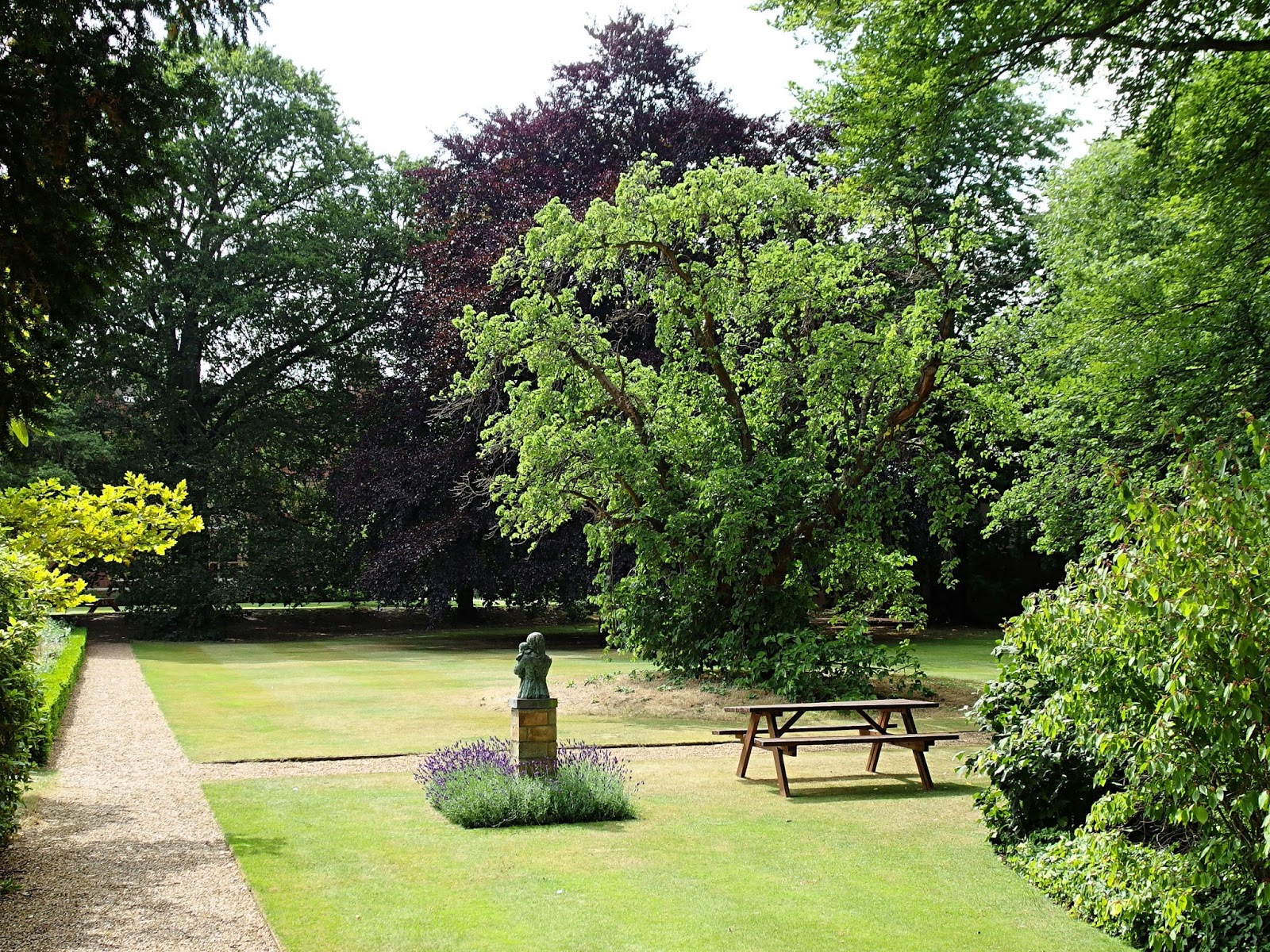
Not many tourists find their way here either, even though it's less than ten minutes walk from Queens' College which is very firmly on their itineraries. So if you're ever on Silver Street bridge just wander away from the city, cross Queens Road and go along Sidgwick Avenue to Newnham College.

On the sunny July afternoon when I visited there were a few elderly ladies making landscape paintings but no other visitors at all. This time of year, after the exams have finished but while the gardens are still at their best, is the ideal time to inspect all the college gardens. Kings Parade was seething with tourist groups but here there were none.

Now, how is it that I used to come here to one of the leading ladies' colleges in the University of Cambridge? No, it's not what you're thinking (unfortunately), it's simply that my mother worked here, cleaning the students' rooms, for a while and as a schoolboy I sometimes came with her in the holidays.

Her boss was a sour-faced old spinster whose only satisfaction in life seemed to be ensuring that the young ladies in her care had as miserable a time as she undoubtedly had. She would have been even more grumpy had she known how many muddy footprints my mother removed from the windowsills every morning!


Land was purchased and buildings erected as the new college expanded. Luckily the architect Basil Chamneys was employed at the outset in 1875 and continued to design further developments for the next thirty-five years. This gives the various buildings a wonderful unity.

Basil Champneys designed buildings in an array of different styles but for Newnham employed what was known as "Queen Anne revival". In other hands this style often became a bizarre parody of itself but at Newnham everything is light, poised and tasteful.


A recent comment on my post about the Sidney Sussex gardens mentioned the great minds who had wandered there through the ages. So here's a list, in no particular order, of the more notable alumnae of Newnham: the primatologist Jane Goodall; the actresses Eleanor Bron, Miriam Margolyes and Emma Thompson; historians Mary Beard and Lisa Jardine; researcher into DNA, Rosalind Franklin; the Suffragettes Clara Rackham and Frances Parker; the feminist writer Germaine Greer; poets Sylvia Plath, Marianne Morris and Elaine Feinstein, mathematician Phillipa Fawcett; broadcasters Joan Bakewell and Claire Balding; political activist Pat Arrowsmith; Rabbi Julia Neuberger; authors Margaret Drabble, Ali Smith, A S Byatt, Josephine Bell and Iris Murdoch; politicians Dianne Abbot, Anne Mallallieu and Patricia Hewitt; Olympic rowing medallist Anna Watkins; Under Secretary-General of the UN Margaret Anstee, (to name but a few!)

Take care.