Take care.
Sunday, 23 October 2011
Saturday, 22 October 2011
The Cottage On The Green
Every old building has a story to tell, but as yet science hasn't found a way to plug in to those ancient timber beams to decipher the sound waves that the wood has absorbed during the centuries. The present-day occupants can only guess at the nature of the lives of those who've trod those uneven floorboards in the past.
Unless that is that the home in question is "The Cottage On The Green" and the inhabitant is Mr Rowland Parker. When he bought the property back in 1946 Rowland Parker also came to possess a bundle of old documents relating to the building. But unravelling the history of the house was not going to prove that easy. It sent the author off on a long journey of discovery, looking through old dusty papers in records offices, gazing at the timbers of the cottage itself, speaking with the oldest inhabitants of the village and even conducting an archaeological dig in his living room!
At the end of his researches he'd uncovered the stories of those who'd lived there for the last 500 years and the changes they'd wrought upon the building to make it suitable for the times in which they lived. He'd found more than enough material to write a slim volume entitled, naturally, "Cottage On The Green" but, more than that, he'd set himself upon the road to researching the history of his home village of Foxton, which eventually gave rise to his best-known book "The Common Stream". Both of these publications are difficult to find now, though both should be classics of English social history, but a search on Amazon may turn up some second-hand copies.
This is not the place to give you the entire story of The Cottage but here are a few glimpses into the book and the history:
~ what we today call cottages are not cottages at all but the homes of moderately well-off yeoman farmers. Cottages were the shacks of the poor, built only to last a few years.
~ the "dig" in the living room unearthed some sheep bones. These were apparently buried to bring good luck to the household, a survival from earlier times when a sacrifice was made to the gods.
~ the long, extremely wordy documents that the writer had to plough through owed their lack of brevity to the simple fact that lawyers could demand higher fees for such papers, especially in days when the majority of people couldn't read.
~ the house originally was a single room, open to the rafters; this was the way people lived back then. The bedrooms are a later refinement. The rather awkward step which the author had to negotiate each time he entered his bedroom, which he at first cursed and then ignored, was the clue which eventually led him to this conclusion.
~ the tiny village of Foxton had once held an annual trading fair, which took place on the green right outside the cottage.
But I've only scratched the surface of the wealth of detail contained in the book. It truly gives an insight into the everyday lives of ordinary people in this part of the world during the last half-millennium.
Take care.
The Cottage On The Green
The farmhouse on The Green
This is not the place to give you the entire story of The Cottage but here are a few glimpses into the book and the history:
~ what we today call cottages are not cottages at all but the homes of moderately well-off yeoman farmers. Cottages were the shacks of the poor, built only to last a few years.
The village pump on The Green
~ the long, extremely wordy documents that the writer had to plough through owed their lack of brevity to the simple fact that lawyers could demand higher fees for such papers, especially in days when the majority of people couldn't read.
Another cottage on The Green
The former malting-house on The Green
View down the road
A window on to history
Friday, 21 October 2011
Lark Rise Farm And The CRT
Somewhere in my mind is a dream landscape. A landscape of small fields and thick hedges. Of lush meadows lying in the valley bottoms and trees with their foliage nibbled off level with the ground by browsing cattle. Skylark song fills the sky while yellowhammers throng in the bushes and linnets peck on the ground for seeds. But in my dream this can be achieved in an economically and environmentally sustainable way in the modern world. Is it just a dream?
If it is a dream then it's one shared by an increasing number of country people. And it's a dream that the Countryside Restoration Trust is seeking to make a reality. I recently took a stroll along Bourn Brook and wandered around some of their land at Lark Rise Farm, in Barton, Cambridgeshire.
I started walking here last winter when a Great Grey Shrike took up residence for a few weeks. I never did catch up with the shrike but I saw enough other wild life to make my visits worthwhile. A Barn Owl was frequently seen patrolling the hedgerows and ditches, a fox crossed my path on a number of occasions and a Red Kite, still an uncommon sight in this part of the county, was also encountered.
I strongly advise anyone with any interest in the Trust to click on the link above to find out more about their work, but if you just want to share a little of the dream then here are some more pictures:
Take care.
Monday, 17 October 2011
The Lighthouse And The Lady
Hunstanton lighthouse
OK, I've been tinkering again, trying to make a straightforward photo look something like a painting. You probably need to click on the image to see it properly.
Meanwhile those of you who read my recent post entitled "Stuff" may recall that I mentioned Aunt Sarah Radford, who gave my mother an antique plate as a gift on her wedding day. In amongst my e-mails yesterday came a photo of Aunt Sarah, sent to me by my cousin, who is the authority on family history. So here is her photo:
Aunt
Sarah
Radford
Take care.
Sunday, 16 October 2011
Saturday, 15 October 2011
A Rural Ride
A gentle afternoon bicycle ride into the neighbouring county of Hertfordshire, to the historic village of Ashwell. The wind was behind me and I was soon in the village of Bassingbourn, which has a scattering of interesting houses including this one with the colonial-style veranda....
Beyond the village the countryside opened up giving views southwards towards the chalk ridge of Therfield Heath.
Then on to Litlington with its beautiful village sign; lots of villages have such signs but this one is amongst my favourites.
The sign records the main features of the parish: the church, its agriculture, its wartime airfield and....what is that strange building at the bottom left?
Before the modern police force was established in 1839 the law was enforced by the church wardens and the unpaid village constable who was appointed by the local manor court to keep the peace. Among his duties was the whipping of vagrants, keeping the parish armour, providing archery butts and assisting the churchwardens in making sure that everyone attended church regularly. Anyone breaking the law could be locked up in the building above, known as The Cage, until the courts were able to deal with them. The steps at the side led to the parish pump where people came to collect their water before the advent of a piped water supply.
Out into the countryside again passing the memorial to the British, American, Canadian, Australian and New Zealand airmen who lost their lives in the Second World War while flying from the local airfield. The autumn colours were beginning to be picked out by the declining sun as I neared Steeple Morden.
No prizes for guessing from where Steeple Morden gets the first part of its name. The light was exactly where you don't normally want it - shining straight into the camera - but this shot seems to work....
....and a more conventional shot of this unusual church....
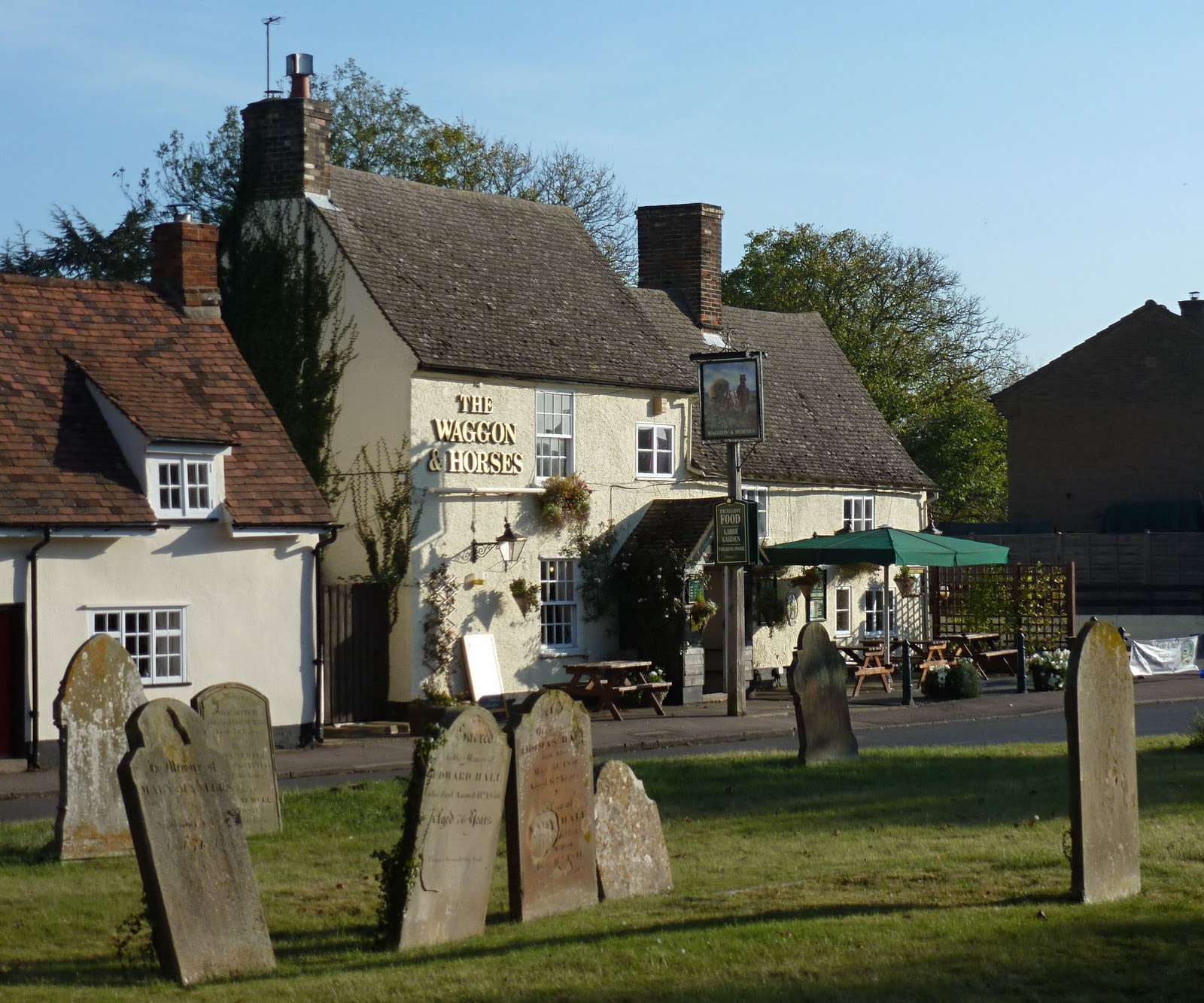
....opposite the church stands the village pub....
....and near the church there's a sign that tells an unlikely tale. You can read about it for yourself....
....considering that the church stands around 200 yards from the site of the well it must have been a mighty blast that gave rise to the well - or a mighty imagination!
Then it was out into the agricultural land again to pedal the last couple of miles to Ashwell. In the early medieval period Ashwell was a flourishing market town, and though the market faded away long ago there is a wealth of ancient architecture in the heart of the village, a fine church and the natural springs which are the source of the River Cam.
A helpful sign informed me that the name Ashwell derives from two Anglo-Saxon words; aesc, meaning an ash tree, and wellan which means a well. So Ashwell actually means Ash-well. Well, well, well.....
The church, with its distinctive tower, dominates the village....
....and could be seen poking up above the horizon as I pedalled away
But before leaving I took a lot of pictures of the centre of Ashwell, which I'll show you next time.
Take care.
Thursday, 13 October 2011
Stuff
We all collect lots of stuff on our passage through life. Most of it is useless junk that we could easily do without. But, oh, it's so hard to part with any of it! Amongst it all there are just a few items which have value beyond usefulness, beyond monetary worth and really beyond all logical evaluation. For these are items which carry memories, a story or connect us with our past.
When the last cart left the harvest field adorned with the "horkey branch" it was a sign that the harvest was over for another year - but was it? For the end of the men's labour was also the start of the gleaning season for the womenfolk. Young girls and women could then go out into the fields to collect any grain which had been left behind. The two vases above were bought by my great-grandmother from money earned in this way when she was a girl. Somehow they caught her eye and she just had to have them. They must be at least 120 years old, probably of no great value, but they charm everyone who sees them, just as they must have charmed a young girl all those years ago.
The old copper kettle was unearthed in the wood by my grandmother. She spent hours polishing it up, as has my own mother (and I must have spent an hour or two on it myself). When I was a boy the back of it was black from being heated on the fire but gradually even that part has become shiny. Dad always thought that his mother had probably thrown it out there herself years before but then thought better of it and retrieved it from its grave.
Sixty years ago my mother got married, an old lady turned up at the wedding that my mother had never seen before. She later learned that it was Dad's aunt, Aunt Sarah Radford as he always referred to her. The old lady told my mother that she made a beautiful bride then went home. She returned later with the plate above saying that she wanted my parents to have it as a wedding present. I have no idea of its age though it certainly looks ancient.
My mother's family came from London where my grandfather had a coal-delivery business. The photo shows the family on their way to a show in the inter-war years. My grandfather's horses often won prizes at such shows. He lost his father at an early age and had to deliver coal before going to school each morning, with the result that he often fell asleep at his desk. Despite being born and bred in the heart of the city he was something of a country man at heart. After the war he moved out of London and took over a country inn. Sadly he died before he had much time to enjoy it. He was only 49.
My dad's old penknife. He carried it in his back pocket for years. The blade used to get sharpened on any handy wall or post. It reminds me of the time we worked together on the
farm.
Take care.
farm.
Take care.
Subscribe to:
Posts (Atom)