Sunday, 9 July 2023

Chasing Dragons

This time of year is not always the best for watching birds - some are on nests, some hidden away with their youngsters, some moulting and only a few non-breeding migrants returning just yet. But it is the time to go searching for other treasures of nature.


They won't all be rare, of course, but who could ignore the fiery flash of a Red Admiral butterfly skittering among the thistles?


And who could pass by the poise of a Banded Demoiselle? And the photo reveals that this particular demoiselle has notably hairy legs!


There are still some birds to be found at the two reserves my brother and I visited last week. A watchful Grey Heron poses in one of the shallow pools of the reedbed. Nothing escapes that piercing yellow eye.


Great Mullein is a plant of roadsides, railway lines and waste places. It's impressively tall but only a small section of its flower spike is in bloom at any one time. When you look closely it's rather pretty; I've seen a lot less showy plants that are tended lovingly by gardeners.


Here's what I was really hunting for - dragons! Well, dragonflies anyway. This is the female, or perhaps an immature male, of the Ruddy Darter. 


Here's the male, which looks quite different. They are a common species around the reedbeds, flooded gravel pits and slow-moving rivers that feature heavily on our local nature reserves.


What's the collective noun for a group of Seven-Spot Ladybirds? 4 x 7 = 28! though there were actually far more of them than the picture shows.


A Painted Lady butterfly. The first one I've had a chance to photograph this year. They fly here from mainland Europe most summers and every few years we get a sizeable influx. I'll not tell you how many pictures I took before it agreed to turn to the right position.


While I was busy photographing the insects a young Muntjac deer tiptoed across the marshy ground. Even if the lack of little horns didn't give away that it was a very young individual, its complete innocence and heedlessness would have betrayed its youthful naivety. 


Damselflies everywhere! Two Common Blues and a Blue-Tailed Damselfly soak up the morning sun.


This is the Maiden Pink, a speciality of the sandy soils of Breckland - but a very uncommon one these days. It is threatened by both over-grazing and under-grazing of the heathland. Too much grazing and the plants are devoured by sheep, too little grazing and scrub encroaches, overwhelming the tiny flowers. These were growing in a small garden of native plants near the visitor centre at Lakenheath Fen RSPB reserve.


Back to the dragonflies. A Four-Spotted Chaser perches on its favourite reed. The dark spots on the wings give it its name. There are two spots on each of the four wings, 2 x 4 =  4 ? Hmmm...


One little yellow triangle just behind the wings though definitely equals a Norfolk Hawker. These were once restricted to the Norfolk Broads but, happily, they have now spread to other places - though they are still a threatened species and I always feel privileged to see one. And, indeed, all the other treasures found on my rambles.


Take care.


Thursday, 6 July 2023

More Blooms

I seem to have led you on a merry dance, chronologically speaking, in the last few posts and now we'll complete the circle by seeing the rest of the photos from the Blooms' garden at Bressingham.


That very weird pointy tree, spiralling up in the distance, has often intrigued me. This time I noticed a small sign next to it saying that it's an example of picea omorika pendula bruns, an unusual form of Serbian Spruce, planted in memory of one of the Bloom family who was killed in a car crash.


And this last photo is for my many cousins who read this blog, some of whom will remember our own dear Aunt May. Its understated beauty seems to recall my aunt's quiet, kind ways.


Take care

Tuesday, 4 July 2023

The Oddest Elephant You Ever Did See

When visiting Bressingham the other week we arrived with plenty of time to spare. However in England, wherever you are, there's always something else to see if you know where to look. And so it was that we set off to hunt for quirky big game in the village of South Lopham.


While naturalists might look elsewhere, followers of this blog may well have already guessed that I'd go searching in the parish church. The first thing that strikes you as you make your way across the churchyard is that massive tower. But we'll ignore that particular "elephant in the room" for a moment to investigate a tiny stone angel in the bottom right of the above photo.


This tiny gravestone commemorates the short life of a little girl who passed away, aged just nine, in 1930.


Now to that tower. Something about it looks all wrong; more like a castle than a church perhaps. And it's not only its massive bulk. The influence of Gothic architecture on our churches is so strong that those round-headed arches take us by surprise. Interestingly there is a more normal pointed window low down in the tower - that must be a later insertion, because this tower is solidly Norman, built in 1100 AD. The other arches were never openings but were entirely decorative - apart from those at the top were left open to allow the bells to be heard.


Around the back of the church is a Norman door that has since been infilled.


Inside you can see the two mighty arches that support the weight of the tower. If you stopped to think about it - arches nearly 1,000 years old holding up tons of stone - you'd never venture beneath them to view the chancel, but of course that's exactly where we're going next.


It's a rather unusual chancel, lighter than many and with more bare stonework than fancy carving. The large, plain glass east window gives an entirely different feel from the more usual stained glass. I can't see any elephants yet!


There's only one coloured window and it's a very nice example, though more modern than most of this ancient church, dating from the late 1800s.


It was this odd little square window that caught my eye. Someone else agrees as they've embroidered its likeness on a kneeler.


Cricking my neck to examine the roof I find what looks like medieval carving on the roof supports. Still no elephants, but getting a bit warmer.....


Aha! This looks more likely. The carved bench-ends of old pews and choir-stalls are often home to a whole menagerie of extraordinary beasts. We need to have a closer look.


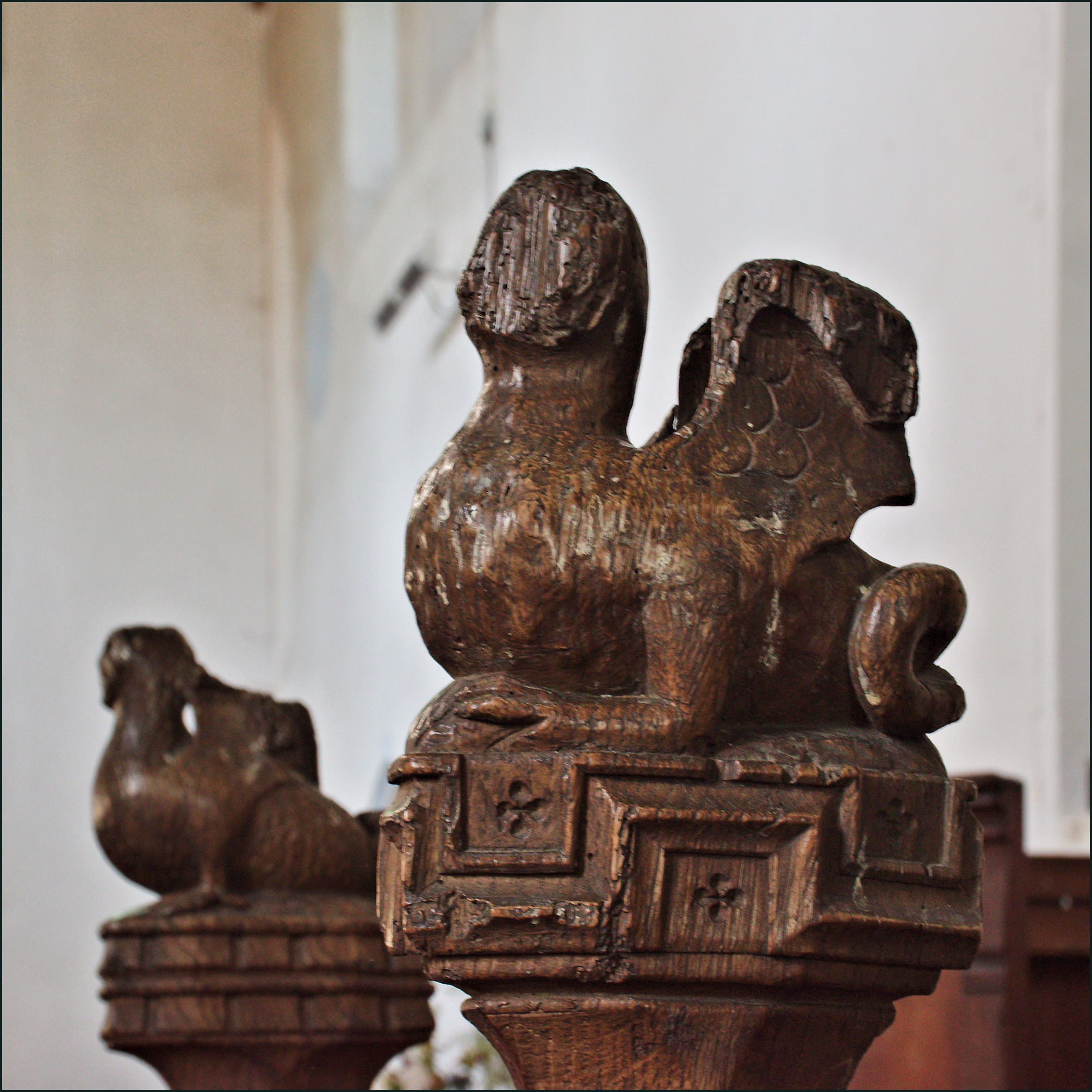
These look like dragons to me - though obviously neither I, nor the medieval mind that imagined them, had ever seen one. They've taken a battering over the years, as you can see.


This looks like a dog which is holding a rabbit or hare. Animals catching or devouring prey are frequently depicted in such carvings - I don't think anyone knows why.


Here's another favourite subject - "a pelican in her piety". As everyone in medieval times knew, a pelican uses her beak to spear her breast to draw blood to feed her offspring. What kind of imagination came up with a "fact" like that?* This poor old pelican has also been deprived of her head at some stage.


And this, believe it or not, is South Lopham's very own eccentric elephant! If the artist had ever seen one then he clearly hadn't looked too closely. My own feeling (for what it's worth) is that someone had seen an elephant - a few had been brought to England and were exhibited at fairs - and had drawn a sketch for the carver. But the wood-carver looked at it and couldn't believe what he saw. Surely those feet must be wrong and it must have hooves like a horse. And what is that long thing where the nose ought to be? I know, it's a beak! It's such a pity that the ears have broken off, who knows what was there: donkey ears, horns, antlers?


And that's how we wasted a little time till Bressingham Gardens were open to the public.


Take care.


* I know some of you will want to know how the pelican story originated. You could start by looking here:


Sunday, 2 July 2023

Landscaping

Today we shall be walking across countryside that has been altered by three of Britain's most energetic landscape transformers - "Capability" Brown, Humphry Repton and Tarmac UK!


Panshanger Park, near Hertford, was once parkland surrounding a large country house and was designed first by Brown, then by Repton. In recent years the land has been exploited for its gravel deposits by the giant building firm, Tarmac UK, who are now returning the land to nature. A  five mile walk around the park should reveal some pastoral views and uncover some of the tangled history.


If you want to visit Panshanger House today - you're too late! The site is fenced around and there's an illustration of the house to aid your efforts at a mental reconstruction. The house was built in 1806 for Earl Cowper, to replace an earlier building, but was demolished around 1953 when no buyer could be found.


The great Orangery, however, does survive (just). Unfortunately it has been allowed to deteriorate over the decades and is now fenced off for the safety of all. It still manages to suggest the opulence of the demolished property.


Persistent nosey-parkers, or those who've strayed from their intended route, might come across these odd remains. I suspect they are the furnaces that heated the Orangery in winter. The block walls seem to have been inserted to support the arches in recent years.


The area which would once have been formal gardens is now woodland, but with many surviving trees and bushes from earlier times. This oak tree, known as The Great Oak, is around 450 years old and was reputedly planted by Elizabeth I.


Most of the estate was not set out as formal gardens but was open parkland with clumps of trees and ornamental lakes. Repton was consulted about these changes but, unlike his more famous predecessor "Capability" Brown, he did not himself arrange for the plantings and excavation to be done. 


Before either of these celebrated fellows got to implement their ideas, the River Mimram had been slowly fashioning a gentle valley and watermeadows for thousands of years. The river's patient work certainly gave them a wonderful starting point for their designs.


Alongside the river are a series of small lakes which are popular with fishing folk and, in winter, with many ducks and other water birds.


Much of the lake shore, and almost all of the riverbank, is inaccessible to humans, making it ideal for nesting birds. The river also supports a large number of water voles.


I've never been entirely clear whether these lakes were the work of the landscape gardeners or the quarrying company. Whoever was responsible for their creation, nature has ensured that they now blend seamlessly into the scene.


One of the glories of today's walk was the abundance of flowers in the meadowlands.


We were probably a week too late to see the Ox-Eye Daisies at their best, but Knapweed, Lady's Bedstraw, Field Scabious and various vetches made a wondrous sight.


I spotted an unusual white Knapweed flower and just as I was about to take a photograph a bee alighted on it to complete the picture.


The flowers here are said to be getting more numerous every year thanks to the grazing of a small herd of English Longhorn cattle which trample and graze the coarse grasses and shrubs. We spoke to a woman who was born in the area, who showed us a photo on her phone of an orchid - the first one she'd ever seen growing here.


Humphry Repton reckoned that no parkland was complete without a herd of English Longhorns. He may not have just been thinking about their scenic value either. From what he wrote elsewhere he seems to have had some understanding and interest in how the landscape might be maintained by natural methods. 


They are also a very placid breed and even old "Bully" here did not object to people walking and cycling through the pasture - though I wasn't anything like as close as the picture might suggest!


A little further along there was a show of wild Chicory.


The plant has been grown in gardens since at least the sixteenth century, when it was called "succory". It also has a whole host of folk names including "blue daisy", "ragged sailors" and "bunk".


We made our way back via Riverside Cottage which, surprisingly perhaps, is a Grade II Listed Building. It was built originally as part of "Capability" Brown's design and was then modified in Repton's time. It may have been a fishing lodge or a gamekeepers' cottage. Today the many vans and machines around it lead me to think it might be a base for those concerned with upkeep of the park.


Despite being set in a highly populated part of Hertfordshire, between the towns of Hertford and Welwyn Garden City, Panshanger Park retains a feeling of being in deep countryside. I imagine it must get a lot busier at weekends and I know there was a Park Run event just last Sunday. I'm not sure whether I need to thank the park maintenance service or the well-behaved visitors, but I found only one piece of litter in the whole five miles that we walked (and that's not there any more!).


Take care.