Tuesday, 12 April 2022

Natural Healing

When large charities such as the RSPB or the National Trust take over a site you can be sure they'll build a car park for visitors. The Wildlife Trusts, on the other hand, seem to have other priorities.


And so it is that those calling at Amwell Nature Reserve in the Lea Valley find themselves parking beside a narrow lane with disintegrating tarmac edges, alongside some of the scruffiest landscape imaginable.


As we cross the footbridge over the River Lea I try to imagine it as the working river it once was, carrying goods from the fertile fields of Hertfordshire to the insatiable appetite of the rapidly growing city of London. Since those grimy days the river has slowly healed, till now it must be approaching the wonderful fishing river that was praised by Izaak Walton in earlier times.


Here on the other side of the bridge we look out over the nature reserve, created from the flooded gravel pits that were once ruthlessly exploited for sand and aggregate to build the houses and factories of good old London town.


Conservationists might like to kid themselves that this is all their work, but the truth is that nature had already given them a head-start and wildlife had found these wetlands long before the area was declared a nature reserve.


Migrating birds are also attracted to this strip of reclaimed land, which is why we'd chosen to visit (though we were also on our way somewhere else in the afternoon - more of that next time). The only migrating bird spotted on the day was a single Little Ringed Plover, and we managed to miss it. Maybe you would like to see one, in which case I can oblige as I photographed one only last week as it toddled along the concrete dam at Grafham Water reservoir. Here it is....


Back to the present: rather disgusted with our lack of success in finding any migrants we decided to take a stroll along the Amwell Walkway.


This path follows the line of an old railway and so continues our theme of heavily used land being returned to a more natural state and being enjoyed for recreation.


And what could be more healing than the sight of trees springing into leaf, seen against the light of the early April sunshine. Walkers, bird-watchers, boat people, anglers, cyclists and joggers all come here these days, for some respite from the noise and chaos of the cities.


A man might stand for hours and search for songbirds perched high in the branches. We could certainly hear them. The unmistakable two-note song of the Chiffchaff. Robins seemed to be in almost every bush, There's the Wren, surprisingly loud for a tiny bird, with that characteristic trill in the middle of its brief song. The Blackbird, a musical maestro, tries a few notes. 


Willow Warblers have been heard already this spring, but not here, not now. We were however rewarded in our searches by some Blackcap, a fine, fine singer when in full flow. But this was not one Blackcap, but about a dozen of them, all in a small area of scrub. So, instead of having a single bird loudly proclaiming that this was his territory, we had the excitement of a few hastily sung notes before a rival chased the singer off on a mad race through the branches, till another bird started singing from elsewhere before the squabbling recommenced. There was one female Blackcap mixed up in all this and presumably adding to the battles among the boys.


Where the old railway travelled through a shallow cutting this gnarled tree clings on desperately. There are fiendish faces in there for the imaginative observer.


Other trees take on such vibrant colours at this time of year....


Winter strips off the leaves and storms break the branches, but every year fresh growth appears and heals the damage.


There's just the faintest tinge of green at the bottom of the reedbeds.


Yes, Mr Goose, you're looking splendid too!


Down beside the River Lea the Marsh Marigolds (or Kingcups) are lighting up the scene. I was asked in a comment on one of my posts to look out for some of these, so here they are, for everyone to enjoy. 


And now we're off to poke about in the woods and see what we can find there.


Take care.


Wednesday, 30 March 2022

Spring In March

I've been on several bird-watching walks recently (more accurately "bird-searching", as we didn't necessarily find what we were looking for), but it was mostly in places that I know well, so didn't yield many photos - just a few from around Paxton Pits and along the Great Ouse river. I also treated myself to a new lens for my camera, one that lets me get very close to small subjects, and I've taken a few trial pictures with that. So I'll share those pictures here, all mixed up and intermingled, to give you an idea of how spring is progressing hereabouts:


Looking across Hayling Lake at Paxton Pits nature reserve.

A tiny daisy on the churchyard wall.

Celandine in the meadow.

Weeping willows coming into leaf along the Great Ouse.

Blackthorn blossom.

Geese flying above, geese swimming below
 - and sandwiched in between
 Cormorants perched, and in some cases nesting, in the trees.

A dandelion happily growing in a crack in a wall.

And another daisy on the churchyard wall.


The floodplain of the Ouse.


The tiny flowers of Herb Robert growing on the wall at Topcliffe Mill.


Take care.


Wednesday, 23 March 2022

Thriplow Gold

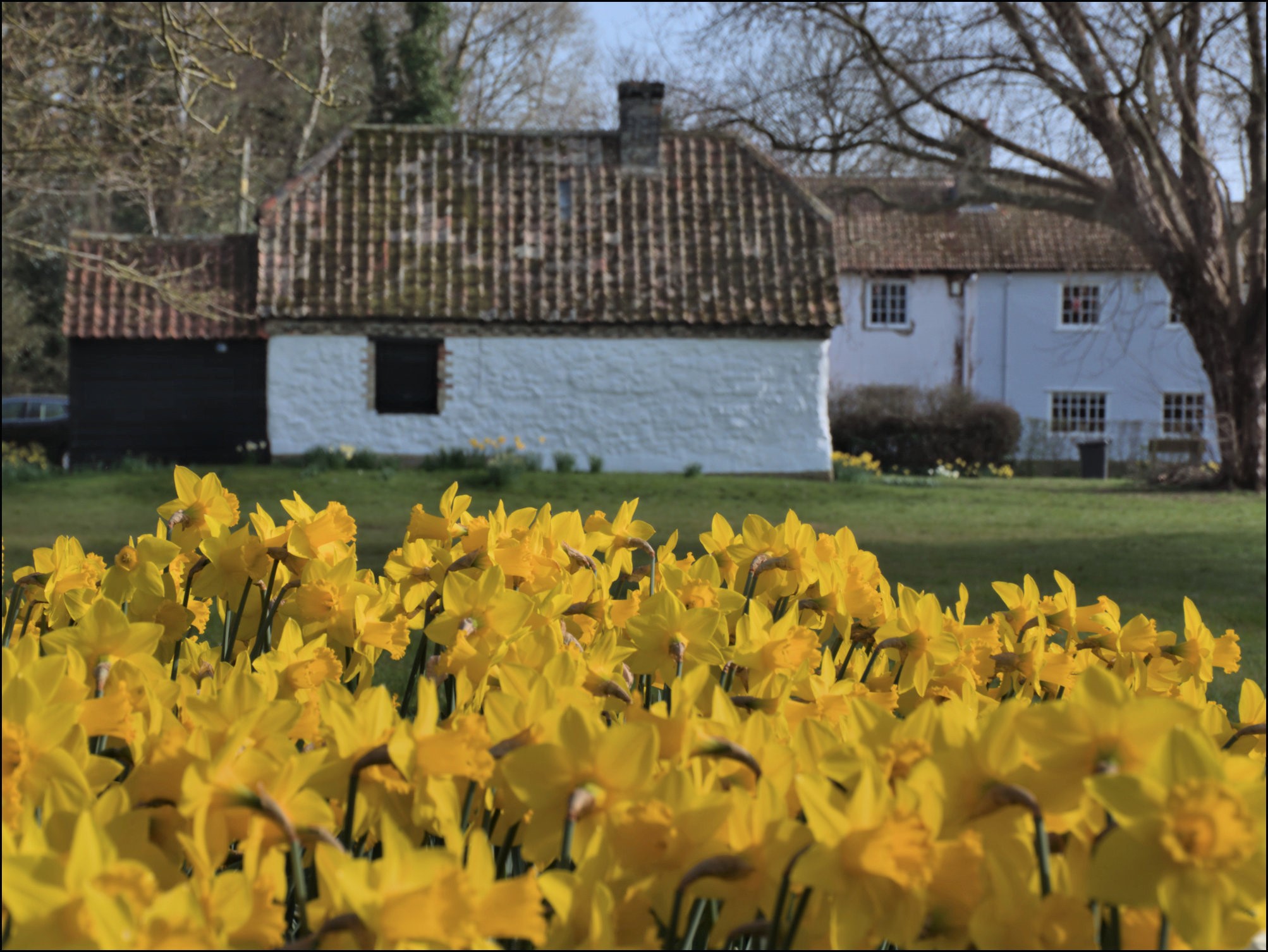
The people of Thriplow like their daffodils. There are thousands of them all over the village, from the grandest of gardens to humblest of verges and hedgerows. Since the late 1960s they've held a Daffodil Weekend to raise money for local charities, but if you want to really enjoy the flowers then go on a day in mid-week and avoid the crowds - though even then you'll not be alone.

There's still some bunting and the information caravan left over from last weekend's event. So won't you join me for an hour or so's gentle wander around this lovely Cambridgeshire village on a perfect spring afternoon?


There are said to be well over a hundred different varieties of daffs growing here, including "Thriplow Gold" which is named after the village. Who knew there were so many kinds?


Take care.


Sunday, 20 March 2022

Remnants Of Past Glories

Have you ever wondered what it would be like if the idea of the seaside had never caught on? How about if people never came with buckets and spades, or wealthy city folk didn't come to live in the country? What if the countryside had just been left unchanged for the last century or two? Come and take a stroll around Waxham, it might be as near as you ever get to an un-tampered-with coastal village.


This is the Hall, nowadays a rather over-sized farmhouse, but once home to the wealthy Woodhouse and Calthorpe dynasties. It dates from about 1570 and still retains the grandeur of a garden wall with octagonal corner turrets. There's even a gatehouse, but the opening is blocked up and the whole is submerged beneath a dense blanket of ivy.


Some of the once state-of-the-art farm buildings have also deteriorated considerably. That's how much of East Anglia might have looked after one of the periodic agricultural slumps.


But what is that rather grand gable-end seen behind the old tractor?


At around the same time that they were building the Hall, Sir Henry Woodhouse decided he needed a big barn - that's one end of it in the photo above. And when he said "big" he meant BIG. It's 178 feet long (54 metres) with flint walls and a thatched roof. It was built just after the Dissolution of the Monasteries and may well contain materials salvaged from these religious buildings - one of those buttresses seen above looks like it might come from there.


It's the biggest ancient barn in East Anglia and was probably built as a "vanity project" meant to compete with (and ruthlessly defeat) barns built by other landowners in the district. But he also had reason to invest in such a huge structure; his family had become wealthy by supplying food for the army and navy. However Sir Henry liked spending money so much that he "utterly consumed the estate" and his son had to rebuild the family fortune from scratch.


By the 1990s the wealthy families had long left the scene, the barn was in desperate need of repair and was purchased by the county council who restored it. You can clearly see where some of the beams have been replaced. The barn is now used as a venue for weddings, but is open for public perusal at all other times. One of the associated buildings now houses a café. There were several people sitting outside the café, but no one else took the opportunity to take a look inside this Grade I listed building. Sad.


Tucked away in a dusty corner of the barn, with no explanatory notice, was this elderly piece of equipment which, unless I'm greatly mistaken, is a hand-turned quern of the type used in farmhouse kitchens for grinding flour.


Time to step outside again and continue our stroll around this tiny village.


This end of the barn is walled off internally from the rest of the building and I suspect it may have been used as a granary. Those slits in the gable wall are to allow air to circulate and the central round holes are to let owls enter and leave; they were vital for vermin control in old barns.


St John's Church dates in part from the twelfth century, but has been patched up and added to, with varying degrees of success, over the years. Photos I've seen online show a nicely dilapidated interior which hasn't been ruined by the heavy-handed restoration of the Victorian era. Unfortunately the building was locked - perhaps they open it in summer when more people are about.


This ivy-clad, or perhaps we should say "ivy-swamped", chunk of wall is all that remains of the church's chancel. It's been unused for centuries and you can still clearly see how the chancel-arch has been infilled.


Gorse is becoming a recurring theme in this blog lately, and it shone brightly against the cold grey stone of the church tower.


What else is there to see? Well, just a handful of houses scattered around an irregular quadrangle of narrow roads. In high summer these roads get clogged up with parked cars - people have discovered that they can park here for free and find their way down to an uncommercialised stretch of beach.


Oh, and you can buy half-a-dozen eggs, just pop your money in the honesty box.


Take care.