Sunday, 12 July 2020

Farmland

I can't help it! I lived my childhood beside a big field, Dad was a farm-worker and tractors and trailers passed our back gate.


So it's no surprise that I like to be out there in an agricultural landscape, especially at this time of year. The trouble is it's all been looking a bit gloomy lately or, as the weather-man has it, "A series of low-pressure systems has been daisychaining west to east across the country". Very grey and grubby daisy chains though!


But then, one morning, it will suddenly look a lot brighter, tempting me to get the bike out of the shed and pedal off in search of some photographs.


Very flat, Cambridgeshire - and even Hertfordshire which will be on the skyline during most of this ride. But, hey, if the Dutch can have fine landscape painters then I can at least try my hand at showing you the "level hills" of East Anglia. Lots of sky will assist in these endeavours. And I'll probably find some oddities along the way too.


As you may have noticed from the photos you've seen already, the crops are ripening in the fields. No use expecting this chap to help with harvest though, it's just a "scarecrow" made for a festival of such characters in the village of Litlington - just one way to keep families entertained during lockdown.


Litlington is one of the few villages I've seen that has a one-way system to get you around its narrow streets.


Sometimes this landscape almost has the feel of the Praries. Those three huts are on the site of the wartime airbase at Steeple Morden.


Difficult as this landscape is to turn into pictures, it's the kind of landscape with which I have a deep connection. It means something to me despite the concerted efforts of art galleries and photographic competitions who try to convince me that I ought to be snapping spectacular mountains and silky-soft waterfalls. Yes, I know they're pretty but....


....I also know that Hollywood stars are photogenic. But they don't mean as much to me as the real people I grew up with - or even the odd crazy scarecrow. I used to make things like that when I was a child. It's all tied up with memories.


I'm also aware of some of the faults of this way of land management; it's often regarded as an environmental disaster. But it's a constantly encouraging to see how much it can be improved by just a few simple changes like allowing hedges to grow up, planting small woodlands and leaving field edges to do their own thing. These ideas are slowly taking hold.


I like to see into working farmyards. I saw quite a few elderly tractors on my travels - and I think I know why and I'll probably tell you next time.


Plenty of people were out exercising on their bikes. They all sped past me, of course. I hope they glanced up from time to time to see where they were.


There are some idyllic homes scattered about this countryside, many of them are former farmhouses. They are no longer required as farms amalgamate into bigger and bigger enterprises, but there are always plenty of people with large wallets willing to snap them up. Which is just as well because otherwise much of our rural heritage would soon become derelict. 


This is what happens when farmers don't cultivate the edges of their fields - wildflower gardens! No one's planted these, the seed is there in the soil just waiting for its chance.


It's just like Dick Gaughan and Robbie Burns told us in my last post:

 ....waving grain, wild o'er the plain
Delights the weary farmer

And with that thought I'll make my weary way back home and put the bike back in the shed.


Take care


Friday, 10 July 2020

The Fields In View

One evening last week I found myself wandering along a footpath through a field of barley when the words of a song came drifting into my mind. The sky is blue, the fields in view
all fading green and yellow. I knew immediately which song it was and, with a bit of mental delving, I found I had most of the words stored away somewhere. I first heard it sung by Scottish singer Dick Gaughan on his album "Handful Of Earth" in the 1980s. Since then it's been sung by countless others - even the woman who was my line manager at work! It was written by Robbie Burns.


Now Westlin Winds 
or
Song Composed In August
(R Burns)


Now westlin winds and slaughtering guns
Bring autumn's pleasant weather
The moorcock springs on whirring wings
Amang the blooming heather
Now waving grain, wild o'er the plain
Delights the weary farmer
And the moon shines bright when I rove at night
To muse upon my charmer.

The partridge loves the fruitful fells
The plover loves the mountains
The woodcock haunts the lonely dells
The soaring hern the fountains
Through lofty groves the cushat roves
The path of man to shun it
The hazel bush o'erhangs the thrush
The spreading thorn the linnet

Thus every kind their pleasure find
The savage and the tender
Some social join and leagues combine
Some solitary wander
Avaunt away! the cruel sway
Tyrannic man's dominion
The sportsman's joy, the murdering cry
The fluttering gory pinion

But Peggy dear, the evening's clear
Swift flies the skimming swallow
The sky is blue, the fields in view
All fading green and yellow
Come let us stray our gladsome way
And view the charms of nature
The rustling corn, the fruited thorn
And every happy creature

We'll gently walk and sweetly talk
Till the silent moon shines clearly
I'll grasp thy waist and, fondly pressed,
Swear how I love thee dearly
Not vernal showers to budding flowers
Not autumn to the farmer
So dear can be as thou to me
My fair, and lovely charmer.

Burns wrote the song in 1775 when he was just sixteen, for Peggy Thompson, a 13-year-old he'd fallen in love with.

Here's a glossary for those struggling with some of the words:
Westlin = westerly.  Moorcock = the male red grouse, a gamebird.  Amang = among.  Partridge, plover, woodcock, hern (heron), cushat (wood pigeon), thrush and linnet are all birds of various kinds.  Avaunt = go away.  Swift = this is what Gaughan sings though Burns wrote "Thick flies the skimming swallow" unless that's just a mistake that's been copied all over the internet. I also suspect that he sings something other than "Not vernal showers to budding flowers" but I can't make it out.


Take care.


Wednesday, 8 July 2020

Back To Fen Drayton Lakes

On Tuesday my brother and I paid a visit to the RSPB's Fen Drayton Lakes bird reserve, the nearest reserve to Les's home.


The RSPB are re-opening their sites, though places like Fen Drayton Lakes have never really been completely closed as most of it is accessible by public footpath anyway, and these have been open all the time. The hides are still closed off, which persuaded us to take a different route from our usual circuit.


The area was once exploited for its sand and gravel, like much of the valley of the River Great Ouse. The flooded pits were discovered by passing birds long before the RSPB took over the site, and I used to come here in those days, walking in by footpaths and along the abandoned railway from Swavesey or St Ives.


I think these "lock gates" were put here so they could be closed when the river level rose to stop the floodwaters inundating the gravel workings, but I've never found out whether barges were ever used to move the quarried materials away. Whatever their original purpose they seem no longer "up for the fight".


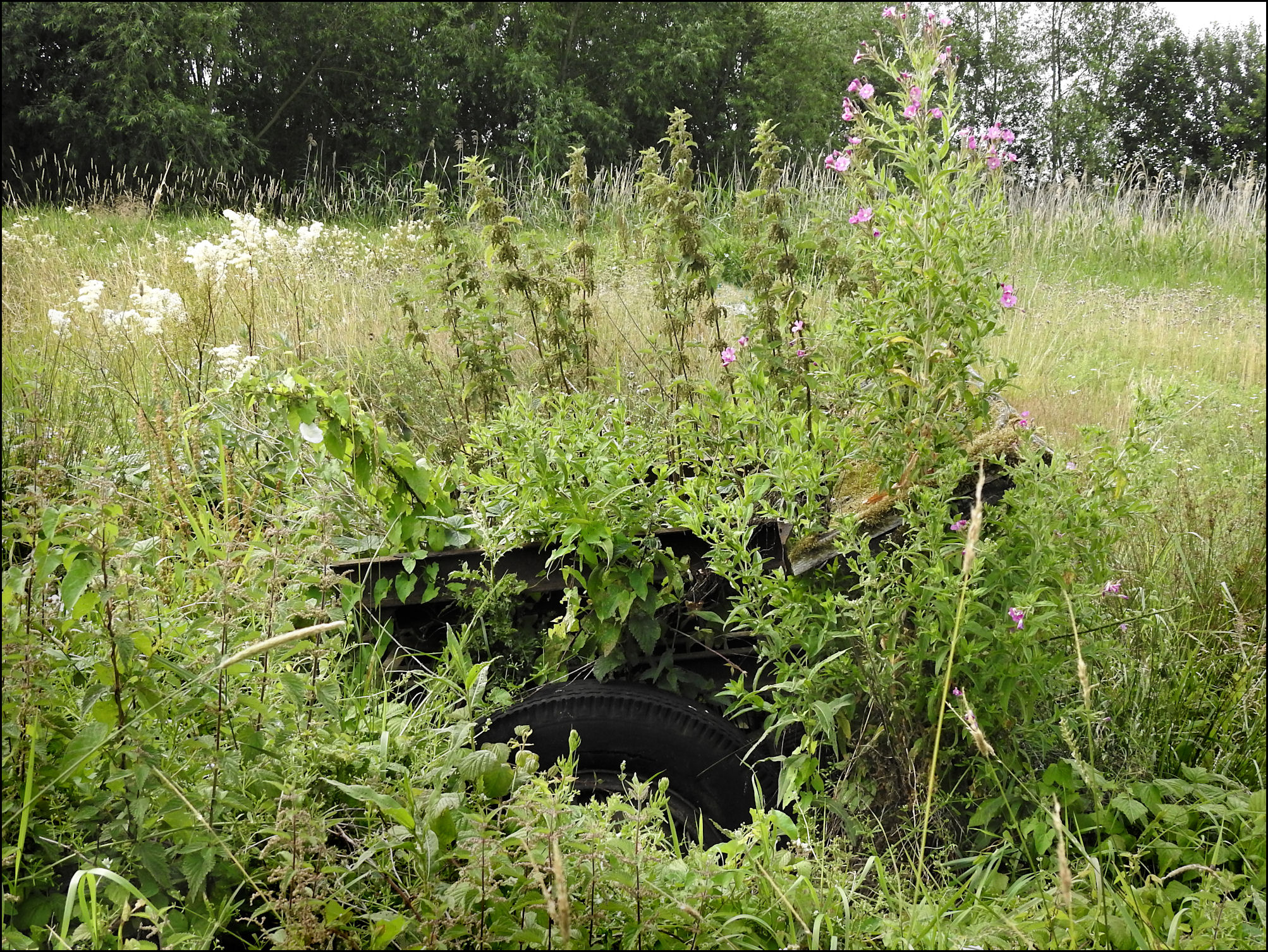
.....neither, by the look of it, is this old abandoned trailer which is almost submerged by the wild flowers and weeds.


The plant pictured above is Purple Salsify, which was originally brought into the country as a garden flower. Its root can also be eaten as a vegetable. Although it is, I suppose, an invasive species, it's one that's been here long enough to be regarded as a native plant by most people. Like its close relation, Goat's Beard, the flowers open up in the morning and close again around mid day, giving both plants the country name of "Jack-go-to-bed-at-noon".


Every inch of the earth banks is a rich medley of plants at this time of year; this is actually alongside the "Busway", a special dedicated route for buses which now occupies the line of the old railway.


I think these are Limousin cattle which are kept primarily for beef, though this was once an important area for dairying.  


It was very dry here earlier in the year and some of the plants and grasses are now a fine blend of sepia. Of course, now that it should be high summer, endless grey clouds are rolling in from the west. 


Under cloudy skies the lakes shine like silver, especially on a still day.


The pink flower goes by the name of Great Hairy Willowherb, which sounds like you could use it as an insult - "What did you do that for, you great hairy willowherb!"


And the pinkish-purple flowers in the distance are Rosebay Willowherb, which sounds much more poetic to my ear.

For those interested in such things here's a bird list from our morning: 
Great Tit, Blue Tit, Long-Tailed Tit, Greenfinch, Yellowhammer, Collared Dove, Wood Pigeon, Stock Dove, Turtle Dove, Reed Warbler, Whitethroat, Dunnock, Robin, Song Thrush, Blackbird, Carrion Crow, Jackdaw, Magpie, Swallow, Starling, Chiffchaff, Common Tern, Cormorant, Black-Headed Gull, Mallard, Great Crested Grebe, Great Spotted Woodpecker, Green Woodpecker, Lapwing, Mute Swan, Greylag Goose, Egyptian Goose, Canada Goose, Coot, Moorhen, Reed Bunting, Sedge Warbler, Oystercatcher, Grey Heron.


Take care.


Friday, 3 July 2020

Wandering On

Last time, if you remember, you left my brother and I sitting on a log on the outskirts of a wood in the Brecklands of Norfolk. The man we were talking to got in his truck and drove off and we continued our walk.


Part of the wood looked like a plantation, but most of it is an ancient woodland known as Emily's Wood. Nobody is quite sure who Emily was, but local legend has it that she was witch who lived here. Don't be scared though, she was a good witch who helped the village people when they were ill and her speciality was said to be a potion to improve male virility, though, as the village website drily notes, it can't have been too effective as the population of the village stayed the same for several centuries!


We found this track leading off to the left, but we were looking for a path on the right which was more elusive.


Much of the wood was fairly open so we decided to make our way through the trees following a roughly southerly direction. It's only a small wood so there was no real danger of becoming seriously misplaced. It would have been nice to find that path though!


OK, there is no path! It's unusual for the excellent maps of the Ordnance Survey to mislead you and I suppose that the path has just become overgrown through lack of use. We could have done with some of Emily's witchcraft to open a trail for us! Thinking about witchcraft, it seems likely that most of the so-called witches were women like Emily, just women who learned the medicinal uses of plants from their mothers and grandmothers. Men of science or religion didn't understand them and, with no one to defend them, the unfortunate women became easy scapegoats for any unexplained happenings.


No one knows how old this wood is, but planting of woodlands, woodland belts and lines of trees as windbreaks has a long history in Breckland. It seems difficult to believe now, but early travel-writers tell that parts of the area were reduced to dust bowls, and sandstorms were frequent on this open country. Most famously the area known as Wangford Warren became such a desert that in 1668 much of its sandy soil was blown to Santon Downham where it buried the church up to two-thirds of the way up its tower and destroyed several farms.


We eventually picked up some kind of track but by this time we were almost alongside the main road which flanks one side of the wood.


I must admit I enjoyed making my way through this small woodland; we have little enough of it in England. It's just a pity that there are so few decent tracks leading through it, though that probably appeals to the wildlife that reside within.


The photo above may look like a forest track, but in fact it's a tree-lined road leading through agricultural land towards a small farm. This incongruously grand avenue probably means that it's a survival from the days of Weeting Hall, a very grand country home that once stood near here. 


We found ourselves sharing our walk with a small flock of Guinea Fowl. These are kept by some farms so we guessed we were getting close to human habitation.


And there it is, tucked in among the tees. Maybe this was also once part of the Weeting estate. It looks a nice place to live.


We made our way back towards Weeting village through arable fields. Online aerial maps show this bit of land was recently occupied by outdoor pigs, presumably making the land more fertile. Outdoor pig-rearing has become a lot more widespread in recent decades, mainly because it is a lot easier to comply with animal welfare laws by keeping them this way as opposed to housing them in industrial, high-density buildings. The pigs probably approve too.


The last leg of our journey was along village roads, though as you can see these were not without occasional riots of colour.


By taking a wrong turning as we entered the village (How often does that happen; I cease consulting the fine detail of the map when I think I'm back?) I found this row of thatched cottages. At ten dwellings long it's said to be the longest terrace of thatched buildings in the land. Despite its obvious charm it's not really a very bright idea as a house fire in any one could be disastrous for all.

Now to make our way to the car and drive back to my house for dinner.

*******
A short piece of music for a Friday, from the Joscho Stephan Trio:


No, my brother's driving was not as frantic as that!


Take care. 


Wednesday, 1 July 2020

On A Wander From Weeting

Smack dab in the middle of East Anglia is a strange, ancient landscape known as Breckland. We're going on a five-mile stroll through this area and I'll tell you a bit about it as we go. We'll start off beside an unmade farm road in the village of Weeting, just on the Norfolk side of that county's border with Suffolk.


And on the bank bordering the dusty track is a fine show of wildflowers. Although this is not the most traditionally scenic landscape in Britain it is not without its charms and, as is true almost everywhere, much of its character is ultimately down to the underlying geology and how we've exploited it over the centuries.


Raise your eyes from the flowery display and you'll see one of East Anglia's hundreds of interesting village churches. This one was largely rebuilt in the nineteenth century but with a traditional round tower. Round towers are a feature of churches around here and probably were built this way because there's a lack of local stone suitable for constructing the corners of such a high building. Of course there are all kinds of folk explanations, including making no corners in which the devil might hide and, even more preposterously, that they were in fact the linings of old wells before the surrounding soil blew away!


This is the stone that we do have to build with - flint. It is of course the material that was favoured for making axes and tools back in the stone age, but it has its limitations as a building stone. You can see that some of the stones have been "knapped", or split, showing the dark, shiny interior. I think flint walls are full of interest, texture and colour - very beautiful in their own way.


Perching innocently on an old gravestone is a just-fledged Robin, as yet unaware of the dangers in the world.


Right next to the church are these old ruins which are known as "Weeting Castle", though what we actually have here are the remains of a twelfth century manor house, built to impress but never fortified. It even had a moat, but again this was just for show. You can see why it was long thought to be a castle though. We'd better start walking if we intend to get anywhere today!


Just behind the farm are some buildings of a very different kind: these are "arks" used for outdoor pig-keeping. I rather liked the repeating shapes and mix of colours and textures - beauty in unexpected places!


The ground here, being sandy and free-draining, is ideal for free-range pigs and there are many herds throughout Breckland. Pigs can turn any other type of ground into an endless mudhole which, though they enjoy it, is ultimately bad for their health and makes farming impossible. They also naturally enhance the fertility of this poor soil! If you peer into the distance of this and the next shot you'll see that this is a regular Pig City, but they all look incredibly healthy animals.


The soil here was wrecked back in the Neolithic Age as early farmers found these soils easy to work and totally exhausted them. That's the meaning of the term "Breckland" - broken or impoverished land.


We carried on past more farms and smallholdings, making a living in every way they can.


I rather like traversing this kind of countryside, probably because the village where I first saw the light of day was like this; every household seemed to have a few pigs, chickens, geese, rabbits, goats - you name it!


Maybe my brother Les was thinking something similar; he certainly looks lost in thought as he walks along the sandy track. On his right is what looks like a field of corn, an unusual crop here as the growing season is only just long enough for it to ripen and only then if it's a warm, dry summer. I suspect that if it fails to ripen it will be fed to pigs anyway, as pigs are perhaps the only animal that is truly omnivorous - when I worked on a farm they certainly once ate the boss's jacket, including his pipe and tobacco tin!


On the other side of the track is a show of the wildflower Viper's Bugloss, which is something of a speciality of the Breckland.


We made an early stop for a cup of hot chocolate just inside the wood, where there was a handy fallen tree trunk for a seat. A man in a pick-up truck drew up beside us and got out to see what we were doing. When he saw that we were armed only with binoculars and cameras rather than rifles we had a friendly chat during which he told us that he'd just spotted some ash trees that were being affected by ash die-back disease and also that Goshawks had been seen nesting in the wood recently. Surprisingly perhaps this land which has been exploited and abused for a few millennia and recently swamped with commercial forestry is home to several species which are rare elsewhere - Woodlarks, Stone Curlews, Nightjars and indeed the mighty Goshawk.

And there we'll leave us chatting away and sipping our hot chocolate. I'll be back with the rest of the walk in the next post.


Take care.