There are two places called Welwyn. The larger one is a new town founded by Ebenezer Howard and planned along similar lines to nearby Letchworth. The inhabitants don't like it being called a new town though; they prefer the sound of Welwyn Garden City which is its official name (even though it's not really a city). About a mile away stands the original settlement, sometimes called Old Welwyn - but not by those who live there; they prefer Welwyn Village.
So it was at the railway station in Welwyn Garden City that my walk began, through a flowery park.
Soon I descended into a leafy track known as Ayot Greenway, which follows the course of a former railway line. Dog-walkers, joggers, cyclists and even horse riders were enjoying the sunny morning.
Into the rural idyll of Ayot Green. What once used to be a poor rural hamlet is now a home to prosperous community and what were once sub-standard dwellings are now listed buildings and highly desirable residences; the previous inhabitants having moved out to more modern accommodation in Welwyn Garden City. Like it or not it's what's happened in many villages across England.
If change had not happened then these buildings may well have become derelict and been lost forever. I count myself very fortunate in that I've always managed to find housing and employment away from the bustle of our towns and cities. Three years at college in London was plenty for me.
Ironically, of course, it was in the big city that I learned about the evolution of our countryside! These wooded footpaths and minor roads hide the deep history of our rural past. The sign above incidentally does not refer to a "little green lane"; it's a lane leading towards a place called Ayot Little Green
Then, on a sharp bend in the road, there's an old graveyard. This is where Ayot St Peter's church stood before the church we saw in the last post was built half a mile to the south.
There were a succession of churches on this site over the centuries, one of which must have been a striking building indeed; it's recorded as having been octagonal and having a tower which stood on the opposite side of the churchyard. I'm told that in early spring snowdrops and wild daffodils dance among the gravestones.
You often see sights like this - farm implements left in gateways to prevent unwanted intrusions on to agricultural land.
There are still plenty of five-bar gates around, though this one doesn't look as though it gets much use these days. Shortly afterwards I made a diversion which involved walking beside busy roads - you'll find out why in the next post - before returning to quieter paths.
My progress across the fields was being monitored closely by a pair of equine eyes. He looked kind of lonely in such a big paddock.
A metal kiss-gate and a wooden sign mark the path across farmland. I know it's a niche obsession but I love it when the harvest is gathered and the fields are ploughed and harrowed, laying bare the subtle colours of the soil.
An inquisitive herd of Aberdeen Angus cattle come over to check out the unexpected visitor to their field.
Niche obsession time once more. The soils of Hertfordshire vary from tan through to beige and even pink or white where the underlying chalk comes close to the surface. I then walked on through some woodland, then a quiet lane led me to Welwyn North station.
Welwyn North isn't in either Welwyn Garden City or Welwyn Village. It's in Digswell, but don't ask me why!
Walkers log:
Start: Welwyn Garden City railway station 09:30
Finish: Welwyn North railway station: 15:10
Distance walked: 9.1 miles (14.6 Km)
Churches: Ayot St Peter - open for Heritage Open Weekend
Notable birds: Buzzard, Red Kite, Jay, lots of Rooks and Wood Pigeons on the freshly tilled fields
Animals: Muntjac, Grey Squirrel, Rabbits
Walkers: a few dog walkers on the Ayot Greenway, but just three others during the day
Cyclists: four on the way and two who were looking around the church at the same time as me.
Horse riders: three
Take care.
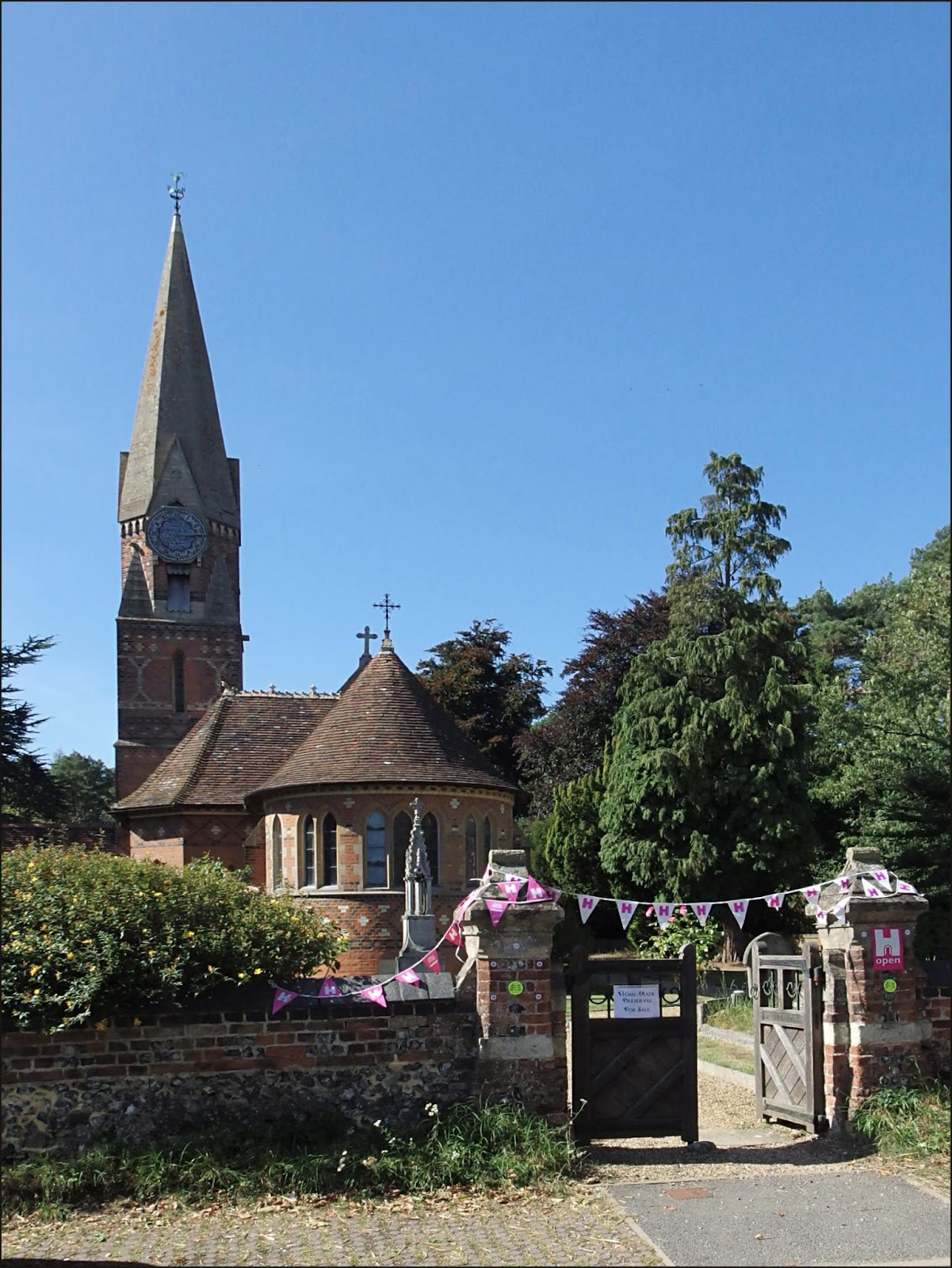
Back in August 2015 I was pedalling my bicycle down one of Hertfordshire's minor backroads when I spotted "one of the prettiest little churches I've ever seen". That's what I said then and another viewing hasn't changed my opinion. Yesterday though the door of the church in Ayot St Peter was unlocked for the national Heritage Open Days weekend.
As English churches go it has no great age, it was built as recently as 1875, the previous church having been struck by lightning and burned down the previous year. The architect was J P Seddon who also oversaw most of the internal fittings and decoration too. There have been a few additions since but all in keeping with the original concept and carried out to the highest standard.
What we see today is one of the most complete small churches built in the Arts and Crafts style of the Victorian era.
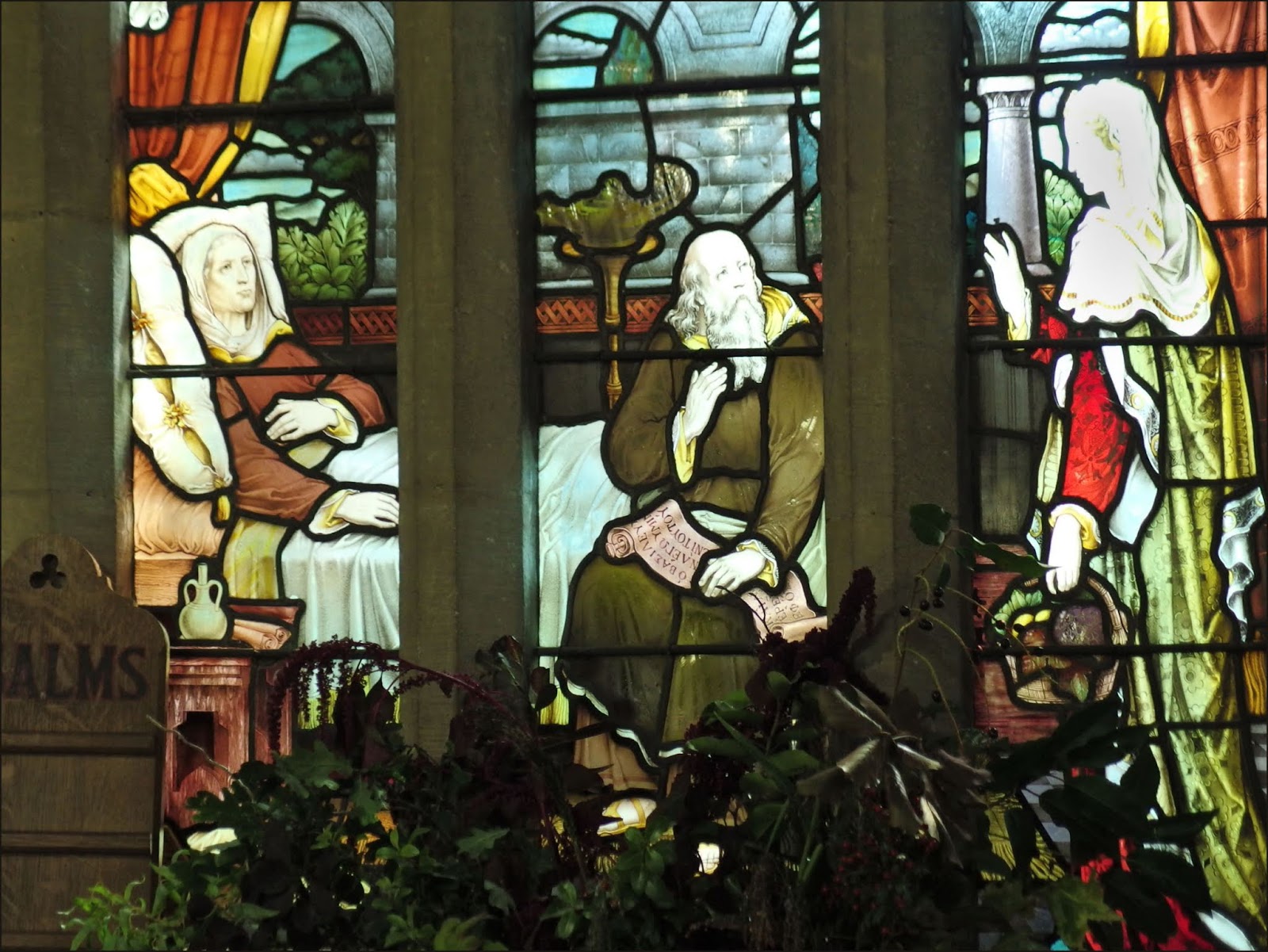
As a special bonus this weekend it's been skilfully and colourfully adorned in readiness for Harvest Festival.
The Arts and Crafts movement grew up in England in response to the rapid industrialisation of the country. Many artists and intellectuals despaired at what they saw as a decline in craftsmanship in the face of mass production and sought a return to traditional values.
There was also a movement within the Church of England to return to what they saw as a golden age of church building before the Reformation. Churches then had been much more colourful and elaborate.
Although the buildings constructed in this style are undoubtedly dazzling, the insistence on craftsmanship and materials of the highest order made them unbelievably expensive. Many a landowner was reduced to poverty by building in this style. Here there must have been several wealthy backers to finance the building of such a fine church. The ongoing cost of maintaining it must also place a heavy burden on the parish.
I've refrained from giving you too much detail about the individual items in the church, but if you want to find out more the village has an excellent website which will provide you with the full details about their beautiful church.
There was just one more thing I wanted to see......
….. a small glass case displays this lump of misshapen metal which comes from the bells of the previous church, melted by that fateful lightning strike in 1874.
Ayot St Peter is in a pleasant bit of countryside just west of Welwyn Garden City. I'll show you a few shots of the walk I took to get there in the next post. What I won't be sharing is the jar of home-made jam made by a local resident and on sale in the church; I'm having that all myself!
Take care.
It's full name is the Haddenham Steam Rally And Heavy Horse Show, so I'd better show you a few pictures of our weighty equine companions.
They are all turned out beautifully for the show which takes place in a corner of the huge field, away from the noise of the machines and the bustle of the crowd.
I know these stocky, short-legged chesnut horses are Suffolk Punches, a breed well-suited for farm work on the heavy soils of East Anglia, so it's fitting that they should be here alongside the steam engines and tractors who followed them in doing the hard graft of agriculture.
I believe the dappled grey is a Percheron; most Percherons are that colour. They came originally from Western France and were first bred as war-horses in much the same way as our English Shire Horses are descended from the Great Horse which was developed to carry armoured knights.
There were special classes for mares with their foals. The gentleman in black is one of the competition judges while tweeds and flat caps are usually favoured by horse-people of both sexes.
Even quite small horsemen can be seen wearing caps.
It's necessary to keep ones strength up with a quick snack of hay.
The parading and judging seemed to go on throughout the day, though it was easier to take pictures while they were awaiting their turn in the ring.
I'm sure that horses understand exactly what is required when they pose for a photo. And just to finish off here are some beautifully carved wooden horses on the carousel.
Take care.
A fine day with patches of sunlight drifting over the flat fen towards the Isle of Ely. Also floating on the wind were wisps of smoke, the scent of steam coal and the sounds of a friendly and informative country voice carried from the public address system....."a foine owd tractor that, owned by a chap lives just down the road. Probbly built about 1958, somewhere round that toime. "
Yes, we're at the annual Haddenham Steam Rally, just south of Ely. There are of course a large number of steam traction-engines present, but even more tractors of various vintages, some restored to look as though they've just rolled off the production line, others in what might be called "farmyard condition". I've often wondered what happened to all the old rusty tractors that used to stand, covered in nettles and ivy, behind every shed in the fens. I think I may have found my answer.
Here they are, fully functional and spruced up enough to win cups.
Here's a bean drill that lacks a steering wheel but is controlled by a bar which can be moved left and right. But we'd better have a look at the steam engines...
....like this showman's engine that would have been used to tow fairground rides from town to town and then to power the roundabouts and big wheels.
There's an awful lot of cleaning and polishing involved in keeping such huge machines in tip-top condition. There were also some smaller representatives of the brotherhood of steam....
These are often home-built by enthusiasts who may spend years on a project. They work just like the real thing and are correct in every detail. Some are even based on plans of machines that have not survived the intervening decades.
Where to next?
Commercial vehicles from the past are well represented. There were also plenty of vintage cars and motorcycles on display.
All this shininess is hard for the photographer to resist, even if some onlookers think you're crazy!
Fish and chips are difficult to pass by too, especially when served from a converted London Transport bus. You can even go upstairs to eat if you want.
After eating you might like to wander around some of the stalls...
…..where all that rustiness calls out to be photographed, if not purchased.
It's amazing what some people will sell - and buy!
These stylish figures were part of one of the fairground organs that were pumping out their jolly music across the site. I always get home wishing I'd taken more close-ups of these ornate creations, maybe one day I will.
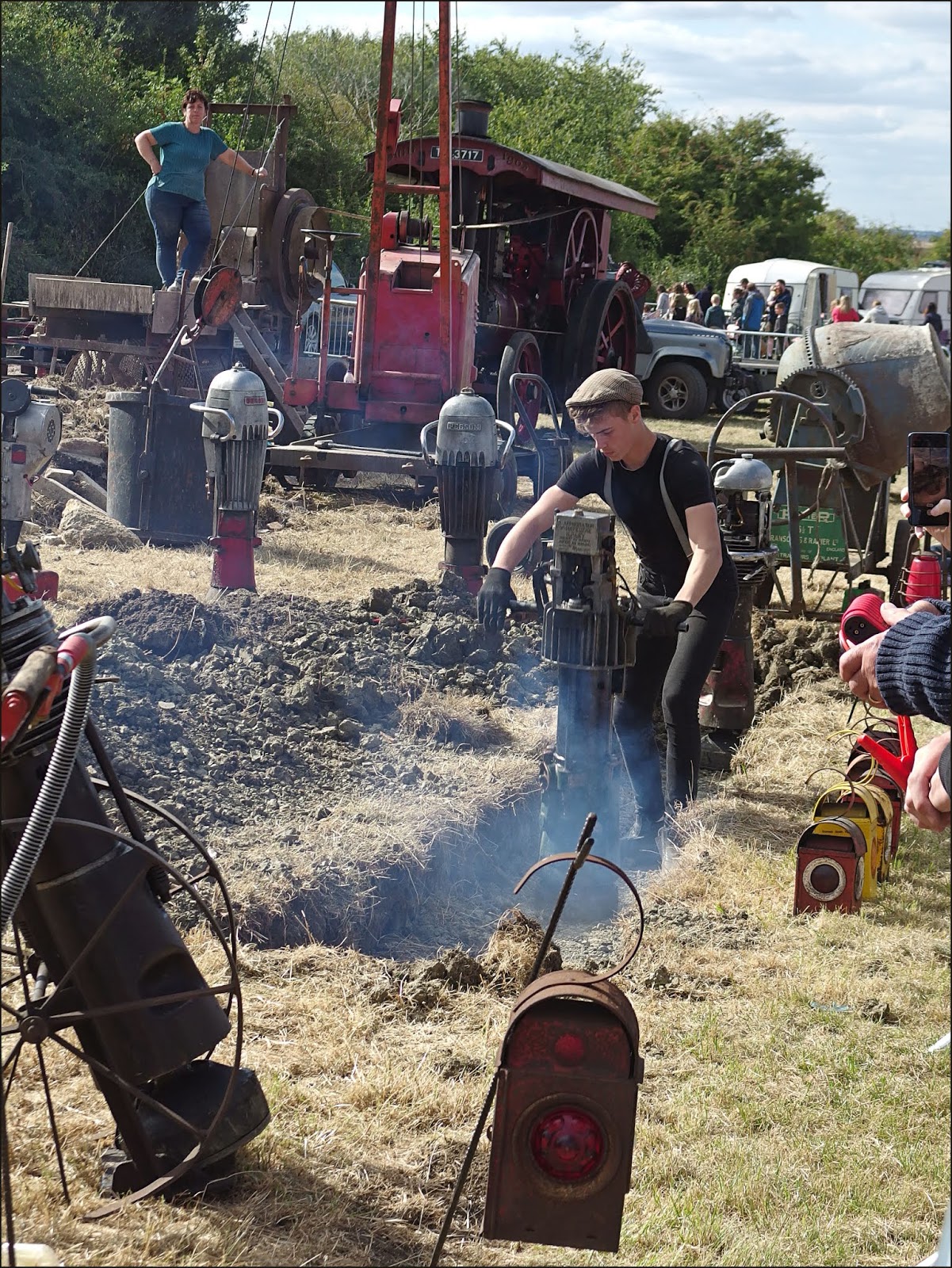
Over in one corner of the showground there was a demonstration of road-making machinery, some of the workers labouring much harder than others.
Abel's World Wide Furniture Removals brought several vehicles of differing ages, but I was rather taken with this splendid bicycle - though I'm not sure how much furniture you could move world-wide with such a machine!
Take care.
(there were also lots of heavy horses there, but nobody wants to see them, do they?) 😉