Thursday, 14 June 2018

A Garden In June

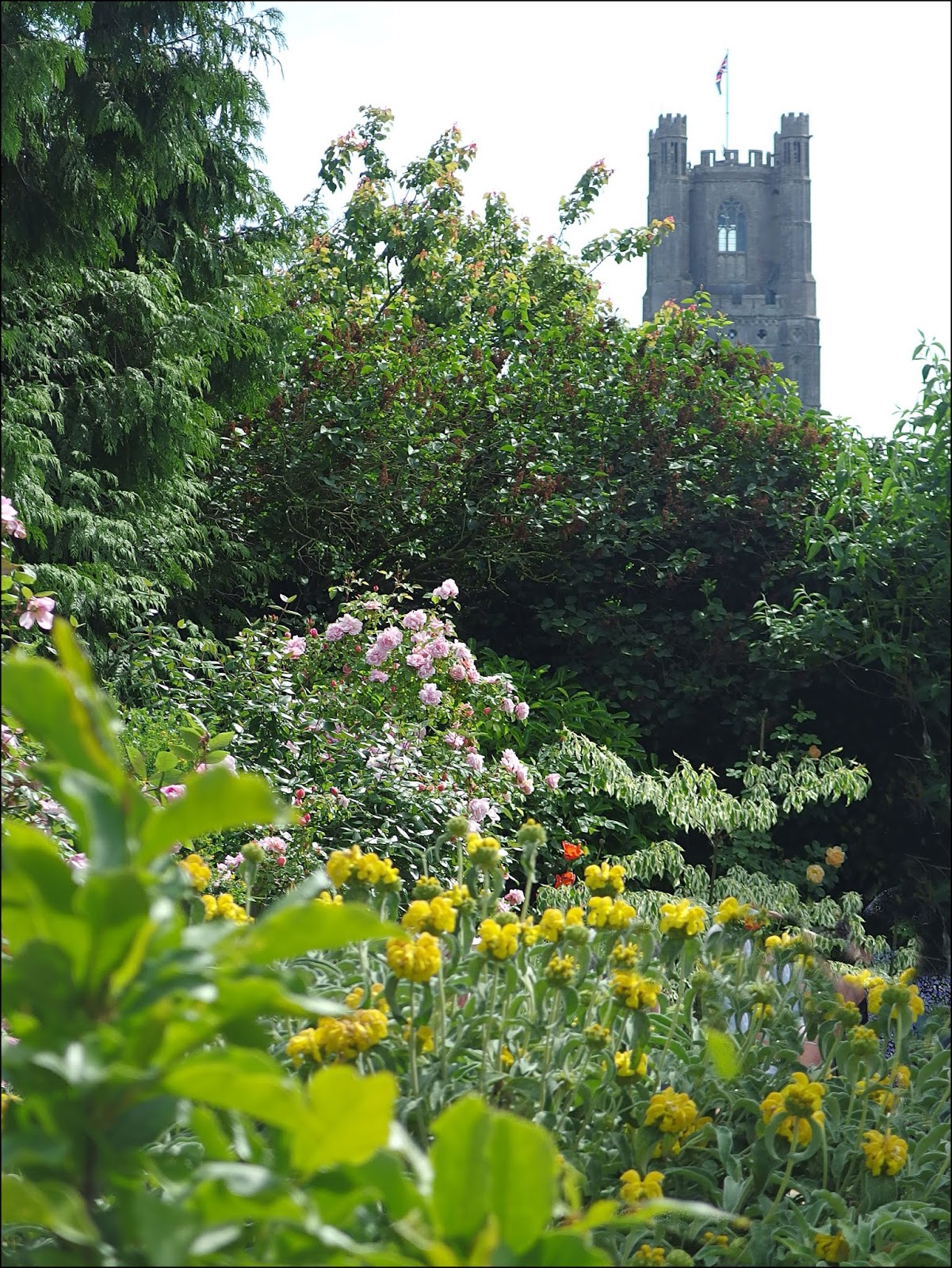
Time for our monthly trip to Cambridge University Botanic Garden. I seem to have done rather better at remembering to photograph the little identifying labels this time. Sometimes I like to know what I'm looking at, but other times I just want to absorb the beauty without worrying about the names. Anyway this is what caught my eye as I wandered around....


Hypericum olympicum (Mount Olympus St. John's wort)


A few waterlilies are appearing just now.


I don't know what this is called.
Maybe someone will tell me.


The main "lake" seen from the rockery
with the lawn and many fine trees beyond.


Cistus ladanifer Gum Rockrose
photographed along with one of the many varieties of Cranesbill


A glimpse of the fountain
through the flowers and grasses.
This part of the garden is actually a lot more formal
than this shot makes it appear.


Echeveria secunda (?)
These were growing in the Systematic Beds
where plants are grouped together in their families for teaching purposes.
I find these Beds fascinating,
 though of course many of the plants are similar to their neighbours.
But every so often a complete surprise turns up -
a plant that looks nothing like the rest of a group.


Santolina chamaecyparissus Cotton Lavender


Drosanthemum candens


Aloe polyphylla  Spiral Aloe


The wetland vegetation is flourishing alongside the stream.


Four of the many varieties of roses on display.


Take care.


Tuesday, 12 June 2018

Nature's Notebook

If you're interested in nature it's best to take notes when you're out and about.
Nowadays, especially since the advent of digital cameras,
it's easier and often more helpful to take pictures
 rather than carry about a notebook and pencil. 
Sometimes you just want to remember what you've seen,
but often you need to get out the reference books when you get home
to figure out exactly what species you've encountered.

Silverweed

This was the first flower I learned to identify. Lots of it grew alongside the path in
the garden of the house where I grew up. I suppose
I was attracted then by its silvery leaves, as I still am.
I asked the name and was told it was called Silverweed. 
I must have been about four or five years old.


Sainfoin 

Sainfoin used to be used as a forage crop for working horses
 and is supposed to have several health-giving properties.


Speckled Wood

If you spot a butterfly flitting about in the dappled sunlight beneath trees
 it's nearly always a Speckled Wood. Other butterflies much prefer to be in the sun.


Red Campion

It's not really red, is it? But it brightens up many a woodland and wayside,
coming into flower just as the bluebells are dying off.
Sometimes there's a super-colourful overlap of the two.


White Campion

And Red Campion also has a white cousin
not quite as showy but still an attractive addition to many roadside verges.


Musk Beetle
 or more likely a female thick legged flower beetle
(see Louise's comment below)

There are quite a few metallic-green beetles,
some of which aren't in my book -
that's my excuse anyway!


Orchid

It's always exciting to find wild orchids in flower,
even when they're in places where you expect to find them!
They can also be tricky to identify as some are quite similar
and, just to add to the confusion, they hybridise with each other.


Scarce Chaser

Scarce Chasers are so called because they are, well, scarce.
It would be nice to say that I knew what I was photographing
but I didn't realise what I'd got till I saw the photo on the screen.


Yellow Rattle

When our hay fields were full of wild flowers
 the one the farmers really wanted to get rid of was Yellow Rattle.
Nowadays when conservationists are trying to recreate wild flower meadows
the first thing they reintroduce is Yellow Rattle.
How so?
Yellow Rattle is semi-parasitic on grasses and diminishes the yield of hay
which is why farmers hated it so.
But if you kill of some of the grass, that leaves space for other wildflowers to grow,
so it's invaluable when trying to make a flowery meadow.


Azure Damselfly

Pretty common, but uncommonly pretty.
Come on, insects are not supposed to be that beautiful.
Exquisite.


White Bryony (bryonia dionica) 

One of those flowers which it's so easy to pass by,
though its bright red berries are very eye-catching later in the year. 
For this reason some people call it Red Bryony.
Confusingly there's a closely related species bryonia alba, which
translates as "white bryony", the name by which it is known in N America,
and that has black berries.
And, wouldn't you just know it, we have a Black Bryony too
which also has red berries!

I hope you're taking notes!


Take care.


Sunday, 10 June 2018

Three Gardens In Ely

Several gardens in Ely were opened today as part of the National Gardens Scheme, where gardens not normally accessible to the public are opened for the day for charity. Here are three of the best....

The Bishop's House


Chapel Street


The Bishop Of Huntingdon's Garden


And there was just time to listen to the Kings Lynn Town Band playing in the Jubilee Gardens.


Take care.


Saturday, 9 June 2018

Pastoral Scenes

A stroll along the upper reaches of the River Ivel (and back again) yielded a batch of photos that look as though they were taken far from the madding crowds. In fact we're on the Hertfordshire/Bedfordshire border, not far from the A1 road and a busy train line. But this little corner is overlooked and forgotten, like a little sleep left in the corner of a bright and wakeful eye.


And nothing is brighter than the lone poppy shining at the edge of the wheatfield. They always seem wide-awake and cheerful to me despite every folkloric association being with death and sleep, a reference to the opium poppy no doubt.


Norton Mill overhangs the narrow public road. It is the first, as one travels down the river, of many watermills that once ground wheat and barley ("corn" as all grains would be known in England). Nowadays the mills are converted to desirable residences, though once they were the throbbing heart of the economy.


The many horses around here also have a much less active life than they would have done in times past.


The tiny village of Radwell has a suitably small church that sits in a perfect setting. It's a very old church though much restored in the Victorian era. Inside there's an interesting monument to Mary Plomer who died in 1605 that we might see another time.


Someone in the village has a garden that backs down on to the river. 


Radwell has a very large millpond with assorted wildfowl on its waters. While taking a few pictures I witnessed some bird behaviour (or rather misbehaviour!) that I've never seen before. Suddenly a swan took exception to a Greylag Goose and attacked it, forcing it under the water as though attempting to drown the unfortunate bird. Not a bit of it, the goose then swam underwater for ten yards or so, passing beneath some other swans. It then began to bite the feet of these swans who were but innocent bystanders.


All farms, wherever they are, seem to use equipment till it breaks then forget all about it for years. Most of it becomes an eyesore but occasionally something demands to be part of a picture.


Ox-eye Daisies are having one of their periodic good years when they seem to bloom more densely than ever on every field margin and roadside verge.


The River Ivel just outside Stotfold slides between trees and rushes. This view can be had from what is still called "New Bridge" on the map, though it's no longer in general use having been deemed not sufficiently strong to carry modern traffic. 


While tramping along the rather overgrown riverside path it was quite a surprise to suddenly cross this magnificent tree lined track which leads down to the Mill House.


My route passed through flowery meadows with isolated oak trees. Single oaks like this used to exist in the landscape to provide beams for houses and barns. The spreading branches provided conveniently curved timbers for cruck construction, where wall posts bend inwards and continue as roof beams. Builders of the time knew that nothing compared for strength with what nature designed.


The perfect rural hideaway perhaps. Many of those who live in these parts work in the city and come home to live like peasants at weekends - very well-dressed peasants with smartphones and four wheel drive cars, it's true, 


Just outside Baldock there's a beautiful flowery meadow, probably restored and managed for maximum flowering. I wandered around twice before leaving.


And finally........


In the midst of all this beauty I couldn't resist a little tongue-in-cheek satire....."Preparing today's children for life's challenges". Yes, indeed.


Take care.