Friday, 15 April 2016

Meet Peter

Peter is quite small and very old, very old indeed. Peter can be found in Cambridge and has a reputation of being a bit old-fashioned and set in his ways. Lately though he's been doing his best to move with the times.


Those of you who remember me introducing you to Sidney and Selwyn might suspect that there's more to Peter than first meets the eye. And indeed there is , for while Sidney and Selwyn turned out to be Sidney Sussex College and Selwyn College, Peter is actually Cambridge's oldest college - Peterhouse (1284).


Peterhouse (not Peterhouse College, you'll notice) has an unusual layout for a Cambridge college. There is no fortress-like gatehouse and it's the Chapel that takes centre-stage, connected to both sides of the quadrangle by attractive, though not very functional, collonades.  


The doors to the Chapel, which was built in 1628, are usually shut but a gentle push soon reveals that they are seldom locked and you are free to go in and look around.
 

The carving behind the altar dates from the 15th century and shows the Virgin Mary cradling the dead Christ.


Back outside again and on into the second courtyard (there are only two at Peterhouse) which is less interesting both historically and architecturally than the first, though I'm rather fond of the corner pictured above with its exotic greenery.


Lets return to the main courtyard then. Dominating the southern side of the court is the Hall, the oldest part of the college, dating from the 13th century. It's said to be the oldest building in Cambridge which is still used for its original purpose, in this case a dining hall. Not much of the original structure is visible as several restorations have taken place over its lifetime, the most recent of which was in the Arts and Crafts style in the 1860s.
 

The door was open, no one was about and there was no sign saying "private" so in I went, though half-expecting some college functionary to come, huffing and puffing, to ask me to leave.
 

So that's the High Table, situated next to the great window, where the senior members of the college partake of their meal. 
 

On the walls is what you might first take to be wallpaper but which is actually stencilled paintwork designed by William Morris.


Once more into the courtyard to admire the graceful proportions of the Chapel, flanked by its collonades. A handful of other tourists had now appeared, the first I'd seen in Peterhouse. It often amazes me how little-known some of the city's attractions are, even to residents. As you'll see in my next post there are also other unsuspected delights here too.


Just as I was leaving a rather red-faced man appeared, huffing and puffing, from the Porters' Lodge; "Excuse me, sir, but have you viewed the Chapel; a lot of people don't realise that it's open". 


Take care.


Tuesday, 12 April 2016

Interred Intelligence

Just off one of the busier roads on the outskirts of Cambridge there's a little burial ground. To get there you walk down a gravelled lane and soon you see a rather undistinguished little Victorian chapel that you first glimpse through the ivy-clad trees and bushes.


Not the kind of place you'd expect anyone of note to be buried then. But you'd be wrong. This is the final resting place of many of the finest minds of the last 150 years, including no less than three Nobel Prize winners and innumerable professors and academics.


These graves tell the recent history of Cambridge University and include many people of other faiths, many of no faith at all and also several women who have made their mark on the intellectual development of the world.


Tucked away, appropriately enough, in a distant, dark shadowy corner is the grave of John Couch Adams, the astronomer who first suspected the existence of the planet Uranus. He is unique in that he also has another memorial in Westminster Abbey.                                                                                                                                                                                                                                                                                                                                                                                                                                                


Perhaps the grave which attracts most visitors is that of the philosopher Ludwig Wittgenstein. He was pronounced as a genius by Bertrand Russell no less, though I'm not sure that anyone else understood what he was on about; that's what Wittgenstein himself believed anyway. Typically of the man, the slab on his grave just bears his name and dates, the bare facts which he could be sure were irrefutable.    

The many admirers who visit the grave rather mess up the stark simplicity of the stone by leaving flowers and other tokens.                                                                                                                                                                                                                                  
There are several descendants of Charles Darwin interred here including the poet Frances Cornford. Never heard of her? Here's one of her odd but appealing poems.....

The Guitarist Tunes Up

With what attentive courtesy he bent

Over his instrument;
Not as a lordly conqueror who could
Command both wire and wood,
But as a man with a loved woman might,
Inquiring with delight
What slight essential things she had to say
Before they started, he and she, to play.                                                                                                                                                                                                                                                                                                                                                                                                                                                                                                                                                 
If you are old enough you may recall the name of John Bascombe Lock, the writer of Mathematics text books. They were certainly still in use when I went to school. His grave however seems rather forgotten and neglected, though his books are still in print some 100 years after they were written. Here's what Rev J B Lock had to say:
                                           
                                                                       Poetry!                                                                                                                                                               

A C Benson was the son of an Archbishop of Canterbury and himself became Master of Magdalene College. He is mainly remembered as the man who wrote the words of Land Of Hope And Glory. He was also famous in his day as a writer of ghost stories. Everything he did in life was successful: in death he is remembered by one of the ugliest tombstones I've ever set eyes on.

                                                                                                                                                                                                                                               
Amongst all these academic heavyweights we find George Smee, a mere solicitor. However, as if to make up for this, he and his wife lie beneath a memorial designed and carved by Jacob Epstein which ensures that their grave is not passed by.


We could go on searching for the monuments to Nobel Prize winners like the nuclear physicist Sir John Cockcroft, or Max Perutz, the molecular biologist. And countless classicists, astronomers, historians, diplomats, scientists, philosophers, poets.......as well as many less celebrated former citizens of Cambridge.


Or we might just wander back towards the chapel and take a quick peek inside the door....


It's now the studio of American-born lettering artist Eric Marland, some examples of whose work can be found in the burial ground, including another poem by Frances Cornford.


Take care.


Friday, 8 April 2016

30 By The Roadside

There's never a chance that I'll exceed the thirty-mile-per-hour speed limit as I pedal my bike through the lanes of East Anglia, seeking out interesting items to tell you about. It seems that these posts, featuring random snippets of curious information from odd corners of our history and landscape, are always popular with readers. Some have demanded that I come up with more of this stuff, though unfortunately it's not always as easy as that.

However this is now the thirtieth such post - hence the roadsign on the left. If you click on the 30 at the end of this post you can read all of these should you want to see the pearls of wisdom that you've missed.


The Royal Arms


In the village church at Therfield I discovered this royal coat of arms. As I've mentioned before every church in the country is supposed to display the royal arms of the current monarch who is, nominally at least, the head of the Church of England. In most cases the churches fail miserably at this; many have no royal crests on display while others are hopelessly out of date. This only makes it even more fun to look for them.

You can tell the date by the changing designs of the arms. This one seems to come from the time of James I (1603-1625), though these particular arms were revived by Charles II after the restoration of the monarchy, and were again used by Queen Anne. Despite the intricate carving of the arms there is, unusually, a spelling mistake on the garter - "PEИES" rather than "PENSE" just below the unicorns hoof.


Will Kempe


A while ago I told you the extraordinary tale of the Shakespearean actor Will Kempe who Morris danced his way from London to Norwich back in 1600. I said that I didn't know if he'd done it for a bet or out of sheer exuberance. It turns out, according to a report on a local BBC TV programme, that the truth is even more remarkable. He did it in a fit of pique after - wait for it - an argument with William Shakespeare about the lack of funny bits in Hamlet !

You see, Kempe was a member of Shakespeare's theatre troupe and was famous for portraying Sir John Falstaff and other comic characters. His fame was such that he felt people came to watch him rather than listen to the bard's versifying. He was so put out that no comic role existed in Hamlet that he left the company and, in an attempt at self-publicity, embarked on his epic dance to Norwich.

Even in those days before social media, or any sort of media for that matter, he attracted huge interest and, although he called his trip The Nine Day's Wonder, it took him rather longer than that. He found there were many excellent inns and pretty serving-maids between London and Norwich and these understandably delayed his progress.


Hodson's Bathing Temple


This odd-looking building (or is it just part of a building) stands beside the River Cam on the outskirts of Cambridge. I remember glancing at it as I punted past in my youth but never knew what it was, or cared what it was if I'm honest. However, recently it was proposed to knock it down which inspired someone to create an on-line petition which I, and lots of other people, signed. It's still there so maybe it's been reprieved. 

In fact it should have been knocked down years ago or should never have been allowed to be built in the first place. The land on which it stands was annexed from a piece of common land by the local builder, John Hodson, in 1887. He enclosed the area with a high wall, which still stands, and built the summer-house above which bears his coat-of-arms. From here he could supervise his daughters swimming in the river.  

Hodson lost most of his money when the railway speculator, Whittaker Wright, fled to America taking the cash with him.


Tough, Rugged Polar Explorer


No, not the old chap with the whiskers, that's just me showing you how small the boat is. It's the boat that's the star.

The exploits of the Antarctic explorer, Ernest Shackleton, are rather eclipsed in the English-speaking world by the legend of Scott's tragic expedition. Once Amundsen had reached the South Pole, Shackleton set his sights on crossing Antarctica via the pole. Shackleton's ship, Endurance, became stuck in pack ice and it was decided that the only course of action was to wait till the ice thawed in the following spring.

When the ice began to break up it exerted so much pressure on the ship that it began to sink. The crew set up camp on a large ice floe and hoped it would drift towards Paulet Island where they knew that supplies had been cached. However the ice floe began to disintegrate and the men took to the three lifeboats and began a five day journey to Elephant Island where the exhausted men set up camp.

Here the ship's carpenter made some modifications to one of the lifeboats and six men were selected to attempt to get help. They travelled 800 miles through mountainous seas and hurricane force winds in their little lifeboat - yes, just like the one above - and somehow navigated their way to the island of South Georgia. The three fittest men then had to cross 36 miles of mountains to the whaling station to get help. How they achieved this in their exhausted state, with nothing but a length of rope and a carpenter's adze to serve as an ice axe, I don't know, but achieve it they did. Eventually all the men from the expedition were saved.


Name That Parson

Back to Therfield Church and one of those boards that list all the former vicars, reaching back to Medieval times. For some reason you can't help but stand and read some of the names. There's no point whatever in this exercise - it's hardly likely that you knew any of them after all! However some do have unlikely names, so I leave you in the pastoral care of:

Almeric Shylond
though he dates back to the 1300s when you'd expect names to be a little different.

But even within the last hundred years we find the economically named
Humphrey Humphreys

as well as the extravagantly monickerred 
Harlovin Harwood ffolliott Eliot
one would have liked to have known him 
even if he turned out to be a lot more staid and conventional than his name suggests.


Click on the number below if you want to read all the "snippets" posts 


Take care.


Saturday, 2 April 2016

Would You Care For Another Dance?

A little while back I shared with you some videos of English traditional dances which are being kept alive (and kicking) by enthusiasts across the country, and elsewhere. Here are a  few more such dances gleaned from the vaults of YouTube. 

Stepping With Percy

Last summer I visited the East Anglian Traditional Music Day at Stowmarket and showed you some videos of the step-dancing. One of the dancers paid tribute to Percy West who had recently passed away. I've managed to find a short video of Mr West doing his inimitable thing......


.....this was filmed by Amanda Frost who has many videos of step-dancing and other entertainment to be seen in The Swan pub at Worlingworth.

 
Dancers From The Wild West

The wild west of England that is. Border Morris flourished along the English-Welsh border counties and was always thought to be a little wild and primitive. Beltane Border Morris seek to celebrate the dance's pagan roots.....


......borrowed from Douglas Latham's YouTube channel which includes lots of excellent videos of Border Morris dancing.


An Old Broom Sweeps Clean

Dancing with a broom turns up in all sorts of places, though it's difficult to see why anyone should have ever thought of it in the first place - and if you can dance with a broom why not with shovels or rakes? This example is more energetic and gymnastic than many....


.....from Judith Proctor's many fine videos of Morris dance related subjects. 


And Finally....

Many of you were very taken with the clog dancing of Hannah James, so here's another video showing us a close-up view of her amazing footwork.....


.....originally posted by lesley1607 who has a huge number of videos of mostly English folk singers and bands in concert.


 Take care.
 (And take the time to go and see traditional dancing if you get the chance). 

Wednesday, 30 March 2016

Time For Some Tulips

I've managed to get to the Cambridge University's Botanic Gardens in each month so far this year and hope to continue this throughout 2016, whether I make it or not remains to be seen - I'm not the greatest at sticking to my plans and tend to veer off in unexpected directions. 

Anyway here's March's instalment in the life of the Gardens, focussing particularly on the display of tulips in the glasshouses.


Of course, I wandered around outside too and I might just find some more pictures in a day or two......


Take care.

Sunday, 27 March 2016

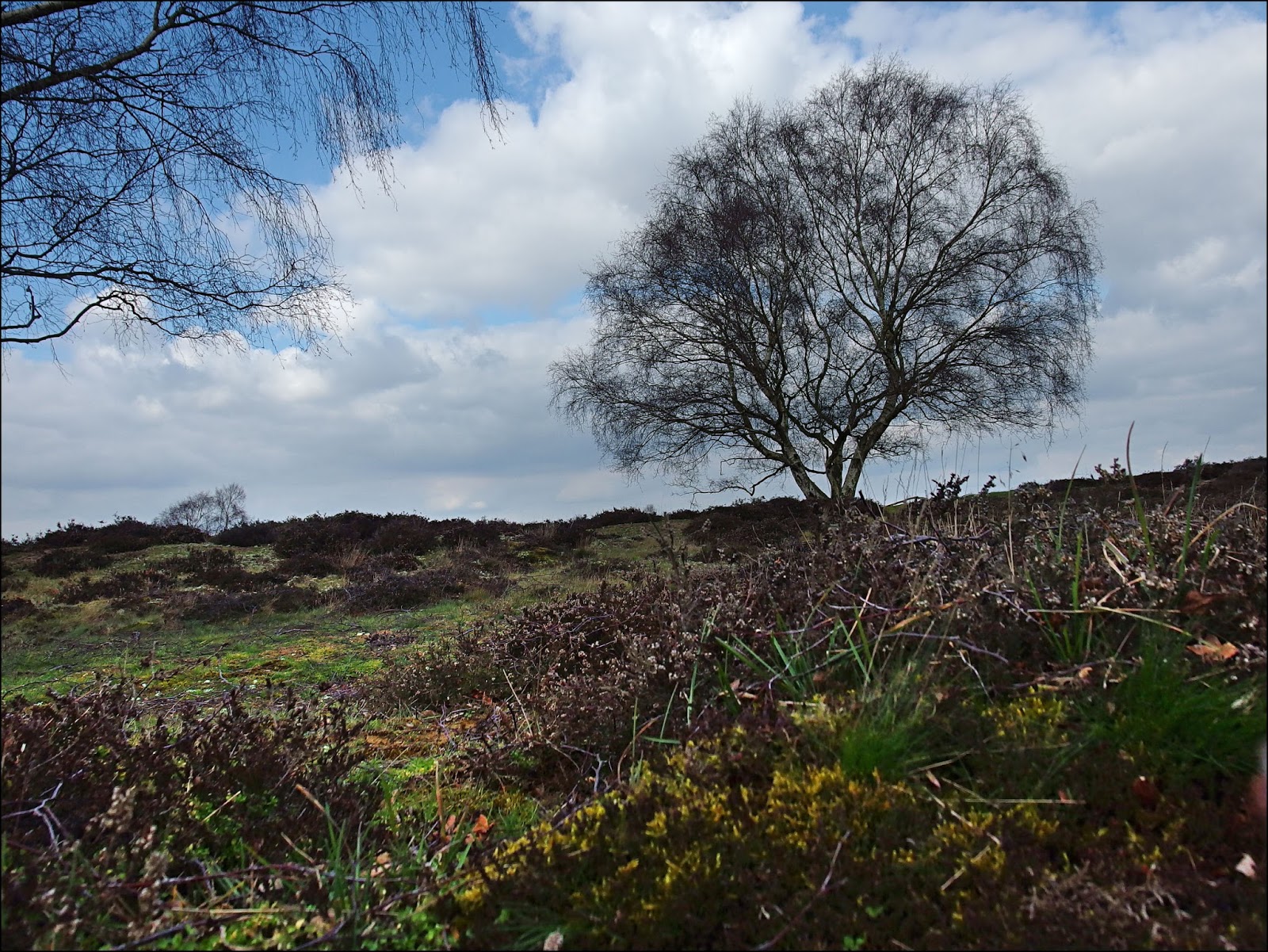
An Afternoon Stroll - Cavenham Heath


Cavenham Heath or Tuddenham Heath? It's certainly nearer to the village of Tuddenham and it's called Tuddenham Heath on my map, though Natural England, who care for the site, are adamant that it's Cavenham Heath. An odd situation.


This is the Breckland. It's an odd sort of place and not the kind of landscape you'd expect to find in the middle of East Anglia most of which is made up of fertile, productive and intensively farmed arable land; something seems to have gone terribly wrong here.


And it started going wrong as long ago as the Neolithic age when farming was already exhausting the dry, sandy soils and the land became broken or breck-land. The land, grazed by sheep, became wide heathlands. The area was still important to early man however; flint was mined here and, as every schoolboy knows, that's what axes and other tools were made from.


From Norman times onwards rabbits were farmed here and there are lots of place-names that incorporate the word "warren". There is still a lot of land under agriculture here though the soils are very difficult to farm. It is also good for open-air pig farming as the land drains easily preventing the pigs turning everything into a huge mud-hole. 


If grazing ceases then birch woods quickly establish themselves and eventually, if left alone, it's thought that oak would take over. Down by the River Lark a different wetland landscape is found.


During the 1920s and 30s, with agriculture and the general economy at a low ebb, the recently-formed Forestry Commission acquired large blocks of this unproductive sandy land and planted huge coniferous forests. Since it offered a chance of employment it was welcomed by the local community. 


Much of the land which escaped being planted with trees was used by the military for training areas and remained as heathland. Cavenham Heath remained untouched because it was used as an military airfield for a time. A few old military buildings remain.


Nowadays the value of land for nature and for breeding birds is recognised and the land is managed by Natural England, a government agency charged with preserving the natural habitat.


In fact, as we have seen, the landscape here is far from natural having been managed, and mismanaged, by mankind for centuries giving rise to the traditional Breckland landscape. The present position is to preserve a balance of all the components of the scenery which are rich in wildlife and of scenic value.


Photo borrowed from the internet.
Oh yes, the interesting and unusual bird 
that I promised you last time. Every March the Stone Curlews return to the Breckland. There aren't many of them but two or three pairs usually nest on Cavenham Heath. They are queer birds: they are not Curlews at all though their calls are reminiscent of the other bird. They are classed as waders, but they don't go near water. They have huge eyes which allow them to be nocturnal though they are also to be seen in the daytime. 

I don't think we'd have ever spotted them if it were not for a couple of birders with a powerful scope who'd seen them at pretty much the same location in other years. 


Take care.