Well, I could hardly fail to spot such an individual structure, but you're probably wondering what on earth it could be. Nikolaus Pevsner in his guides to British architecture describes it as one of the strangest Gothic churches in England. Usually known as The Red Mount Chapel, it was built in 1485 just outside the town walls and was a wayside chapel for pilgrims making their way to the shrine at Walsingham. According to my learned friend it was placed outside the walls for the benefit of those arriving after nightfall when the town gates would be locked. Gates like this....

Another building which was pointed out to me was the huge church of St Margaret. It was founded originally as part of a Priory which amassed great wealth during medieval times when King's Lynn was a major port.

It's so huge that many visitors call it "the cathedral" though in fact it's just a parish church, albeit a very big one! I'd had a look inside earlier....

I know we're supposed to be talking about towers and steeples, but there's some nice stained glass to be seen....


....and some rather fine wood carving....

But you can't see any towers and steeples from inside the church. Well, you could have done if you'd been here at mid-day on the 8th of September 1741, for a storm brought the steeple crashing through the roof and into the nave. Wisely, perhaps, it was decided not to replace the spire. But just down the road.....
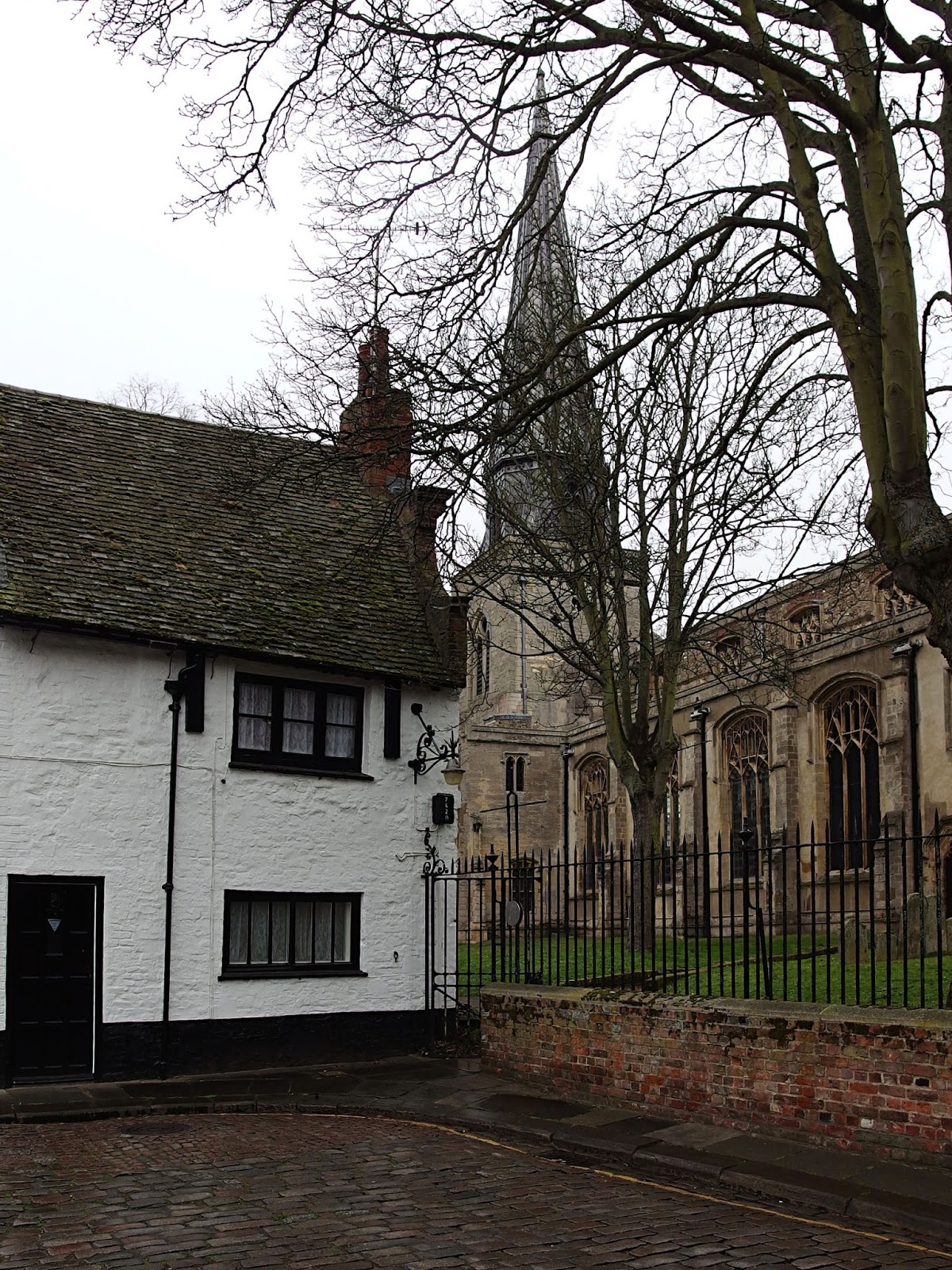
....the same storm brought down the spire of St Nicholas's but fortunately it fell into the churchyard. This one was replaced which may sound foolhardy in the light of what had happened at St Margaret's. But there was a good reason for it as we shall soon see.

This odd-looking structure is all that remains of Greyfriars Priory, the rest of the building having been destroyed after the dissolution of the monasteries. It seems a strange oversight on the part of the demolition squad - but again there is a good reason. In fact it's the same reason as for the rebuilding of the spire. Both were 'landmarks' in the original meaning of the word, which is that sight of them enabled sailors to work out their exact position at sea, in this case to navigate the channel into King's Lynn harbour.
My informant also mentioned All Saints' Church, which he was very enthusiastic about though he didn't say why. I set out to search for it but even though I knew roughly where it was I failed miserably to locate it. All I could find was some very unattractive housing, but eventually after much perseverance....

As you can see it has no tower and is surrounded by a 1970s housing development. I stepped inside and was met by the vicar who was busy lighting candles, not for me of course but for some noisy six-year-olds who were about to descend on this oasis of tranquillity. "Suffer the little children...." I reminded him. "'Suffer' is the word I'm afraid," he replied, "but there's just time for you to view our most notable feature."

He led me to the beautiful chancel and pointed to the door that you can see in the picture. It leads to a small room which once served as an Anchorhold. Nothing to do with ships this time but the residence of an anchoress or anchorite, a woman or man who withdrew from society for a life of abstinence, contemplation and prayer.

There is a small window through which the recluse could see the church service...

Apparently you can observe a service from the anchorhold if you want to. I understand they let you out afterwards!
As children's voices approached I spotted this screen....

The vicar confirmed that it was very old, probably dating from the fifteenth century, but had been boarded up from view for centuries which had preserved the colour. What gave the clue to its age were the scratched out faces, defaced (quite literally) during the Reformation.

The children entered and, if not quite little angels, were every bit as friendly and helpful as the older residents of the town.
Take care.