Sunday, 11 March 2012

In Town And Around

Another collection of ageing and engaging snippets to entertain and delight the passer-by, impeding their progress through this busy world.

At Last....A Staddle Stone


Many posts ago, possibly before many of you had encountered this blog, I mentioned "staddle stones". These mushroom shaped stones, standing about two feet (0.6m) high, were used to support the floor-timbers of small granaries which stood in every farmyard. Their purpose was simply to prevent mice and rats entering the grain store. I said that you often see them these days standing on the roadside and I would photograph one for you "soon". I found an old granary at Barley but the individual stones proved to be as elusive as any inanimate lump of rock could possibly be. But eventually I cornered one at Ashdon and I present this hard-won trophy above!


Watergate....The True Story!


Between the green common of Coe Fen and Peterhouse College is a wall which includes this ancient structure, a low, blocked gate, dating from the fifteenth century, which seems to have no purpose. Above it is the coat of arms of the Bishop Of Ely. The clue to its existence is in the name of the common, Coe Fen, for that is exactly what it was, a fen or marsh, till it was drained for public health reasons in the early twentieth century. A branch of the river formerly flowed close to the wall and a small "canal" allowed boats to enter the college grounds by way of the water-gate.


A Light-Show


From the old and seemingly indestructible to the fleeting and ephemeral. Over the Christmas period an iconic Cambridge landmark was lit up as never before. The light show, entitled "Foster's Mill Firmament" was the work of artist David Ward. Although temporary in nature it was based on things more ancient and eternal, namely the fan-vaulting of the ceiling of King's College Chapel and the night sky.


Well I Never....


At the edge of a piece of common land in the Cambridgeshire village of Haslingfield stands this odd little building; one old brick wall and three more modern wooden ones. An old illustration shows the brick wall was once more elaborate, sporting a Dutch gable. The wall dates from the seventeenth century, the time when Sir Thomas Wendy, physician to Henry VIII, Edward VI, Mary and Elizabeth I, was extending the nearby hall. The building is a well-house and it seems likely that the brick wall was designed to give this humble building a grand aspect when seen from the approach to the hall. The wooden walls are a recent replacement for older timbers.


An Odd Bridge


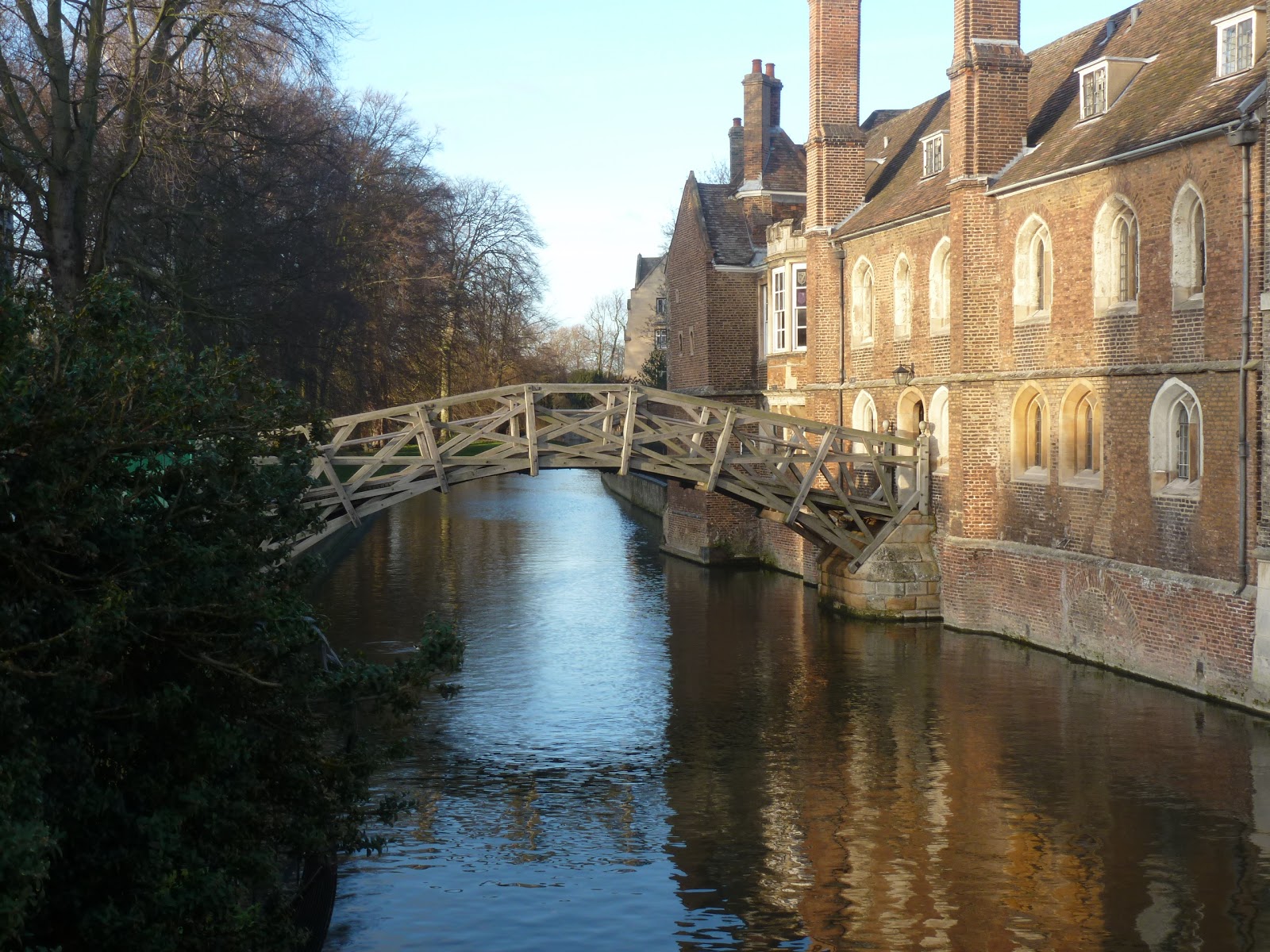
If you've been to Cambridge you've probably seen this queer-looking bridge. It's the kind of structure that seems to inspire stories. The college authorities refer to it as "The Wooden Bridge" but everyone else calls it the "Mathematical Bridge". Some say it was designed by Isaac Newton but in fact it was the work of an undergraduate named W. Etheridge in 1749. Disappointing but true. Then you may hear that it was originally held together without the need for nails or bolts. That may be true but wooden dowels were probably used instead. The last tale, and the one I really wish was true, is that the iron bolts were put in because inebriated students returning after a night in the local alehouses could not resist the temptation to dismantle the bridge. Then of course, in the cold light of day, they found it was much harder to put back together again. But sadly there's no evidence for that story either.


And Finally....


At this time of year I can rarely pass by these beauties without stopping for a closer look.

Take care.

Friday, 9 March 2012

Rough Country

Scraps of Skylark song carried on a ragged wind. Lifting the cold iron gate. An overcoat tied up with baler twine. Rainbow puddles in the mud under the diesel tank. Cracked and calloused hands. Scraped knuckles.


Rat holes and poison under the asbestos sheets. Nettles grow up through the wire. Rusty buckets with broken handles. Bent and buckled oil drums full of dirty water. Chickens scratch and cackle and skitter over the muck heap.


Click-click goes the electric fencing around the pig field. Old sows grovel up everything in the trough. Snort and splutter in appreciation. Rough bristles under the hand. 


Tools for the job: club hammer, rip saw, crowbar, tin snips, mole grips, WD40 and the big adjustable.


Tractor ruts filled with hardcore. Thistles push up through the cracks in the concrete road. Sparrows feed on the hedgerow berries. Bert's new gate won't shut properly. "Blow me, boy, reckon I wuz thinkin' in metric!"


Hoppers and silos. Grain augers and driers. Dusty cobwebs in every corner. Hessian sacks hung over draughty windows. Noise of motors and machinery.


Bale strings hung from a nail. Bags neatly stacked. An old radio on top of the wall. Crackles into life if you tap it. The shipping forecast. Next to it a calendar from years ago - "Beautiful Britain". 


Spent cartridges lie near the spinney. A chain saw sings in the distance. Crows fly over cawing darkly. Time to finish in half an hour. Hundreds of starlings sail across the setting sun. Red sky burns behind the bare trees. Should be another fine day tomorrow.


Take care.

Tuesday, 6 March 2012

Ones That Got Away

......being some pictures of Cambridge that I've just discovered lurking in the shadows of an external hard-drive.


Peterhouse College

Bike on Mill Road

Pembroke Chapel

Peeling paint

Love song

The Old Schools Building at twilight.
 Take care.

Sunday, 4 March 2012

All Along The Hedgerow

The popular image of the English countryside is a land of small fields, thick hedges and majestic oaks. It still exists in some parts of the country but scenery changes according to the agricultural practices of the day, landscapes are lost and new landscapes evolve. But sometimes, in the words of Joni Mitchell, "You don't know what you've got till it's gone".


A few months back I posted a picture of a piece of hedge laying and Jack, of "Hartford Daily Photo" fame, suggested that I might do a post about English hedges. Actually, Jack, whole books have been written on the subject but this post will have to do for now. Others may follow later in the year.


The main purpose of a hedge these days is to keep animals within a confined grazing area. Wooden fences and stone walls are also used but both are more expensive to build and maintain. In the more mountainous and rocky parts of the country stone walls are common but around here hedges of hawthorn and other trees and bushes are the norm.

A hawthorn hedge can quickly be established, in fact hawthorn is also known as quick-thorn. But the problem with any kind of hedge is that the constituent plants have no ambition to make a nice hedge. They don't want to grow cheek-by-jowl with their neighbour, intertwine their branches just above ground level, stay at a manageable height and just grow laterally. They want to spread their branches in all directions, cut out the light from their neighbours, grow up towards the sun and be trees!


If you want a hedge to remain as a hedge then you've got to do something about it; and that something is "laying" your hedge. Put simply this involves cutting part way through the wood near to ground level, bending each stem over at an angle and weaving them in and out of the remaining uprights. Sounds easy enough till you try! The result is a stock proof barrier.


Here in East Anglia farming became more and more arable with very few animals being kept. Why bother with hedges? Waste of space. Knock 'em down. Set fire to them. Have bigger and bigger fields for bigger and bigger machines. Forget Little Stargoose, Parson's Mead and The Backland. Lets plough and sow the Hundred-Acre. One species loved it - the hare. They adapted to the wide open spaces and yesterday were in full Mad-March-Hare mode, chasing one another and engaging in occasional bouts of boxing. But all so distant that my little camera had to be pushed to the limit to get anything at all.


But things are changing. Slowly we're realising what has been lost and hedges are being reinstated. Catkins are blowing in the breeze and buds are forming.


Join me again soon for another ramble - all along the hedgerow.

Take care.

Saturday, 3 March 2012

You Never Know....

You never know what you'll encounter next in Cambridge. Wandering past Gonville and Caius playing field I heard the sound of insistent drumming. Some kind of music or dance going on? A sudden female squeal. People chanting in a strange tongue. A shrill whistle. I rounded the corner to find the cause of the excitement - a soccer match being played by 22 Koreans with a largely Korean crowd of supporters.


In fact it was a match between the Korean Societies of Oxford and Cambridge Universities, a Varsity match of a kind I suppose. I'm used to seeing some rough, tough matches but surely university-educated Koreans would behave impeccably. Wrong. Tackles were flying in from all directions and Oxford seemed to be having the worst of it.


Injured players were helped from the field. A scrap broke out amongst the teams. Penalties were awarded and players booked. The drummer bashed his drum and the crowd of onlookers got very excited.


I'm not sure what the final score was as I left before the end but I'm fairly certain Cambridge would have been victorious since they were much the better side, scored the only goal that I saw and had the happier set of supporters.


Take care.

Friday, 2 March 2012

A Trip To Trinity

Off to Trinity College, Cambridge, today and to the Great Court in particular. The Great Court either is, or isn't, the scene of the run by Harold Abrahams in the film "Chariots Of Fire". But more of that conundrum later. First of all lets have a look at the College's back gate, the famous Backs of the colleges where the fine buildings, lawns and gardens back on to the river. This was once known as the colleges' "backsides", but for some reason they changed the name!


At this time of year there's a fine display of early spring flowers, lighting up the scene before the trees start bursting into leaf. And the runners come out of hibernation too - but more of them later.


But if you want to see the Great Court you can't walk straight through the college but have to walk around to the main gate, so lets do just that.


There. not too far was it? And once through the gate you're immediately in the Great Court and what a magnificent space it appears as you enter from the crowded streets of the old part of town. 


Now, "Chariots Of Fire" and the Great Court Run. The point of the run is to complete the entire circuit of the Court in the 43 or so seconds it takes the college clock to strike twelve, actually 24 chimes for some reason. It was first achieved in 1927 by Lord Burghley, otherwise known as David Cecil. He went on to become an Olympic champion and a Conservative MP, distinctions which he shares with the other person to complete the run Sebastian (Lord) Coe who ran the race for charity in 1988. Coe's time is disputed by some and, of course, there is no video evidence of the earlier time.


In fact quibbling about the record is almost as much a sport as the run itself!

It has been achieved more recently than Coe's effort but the course has been shortened. Does that count? Coe only achieved the feat if you take into account that the sound of the last chime had not completely faded away. Will you allow that? The time taken for the chimes to sound varies depending on when the clock was last wound as well as the meteorological conditions of the day. So what time do you actually have to do the run? You might as well use the sundial!


Lord Burghley, who set the original record, would not allow his name to be used in the film "Chariots Of Fire" because of historical inaccuracies. There certainly were a few:
  •  Aubrey Montague was depicted as a student at Cambridge; he went to Oxford.
  • Lord Andrew Lindsay's character based on Burghley who did go to Cambridge but not at the same time as Harold Abrahams.
  • Harold Abrahams achieves the Great Court Run in the film, but not in reality.
  • Montague is said to be alive at the time of Abrahams' death; he'd been dead for 30 years.
And there were many other discrepancies too. Just to confuse the issue still further the Great Court run in the film was actually filmed, not at Trinity at all, but at Eton. 


But, unlike Coe and Burghley, we've got time to look at some of the buildings as we amble around the Court. The front of the Great Gate has already been seen (third picture of this post) and its rather poor statue of Henry VIII has been shown along with an amusing anecdote in an earlier post. The theme of crudely carved statues is continued on the Court side of the gatehouse with representations of James I and his Queen and son. The architectural writer Nickolaus Pevsner is understandably horrified, "One would have thought the King's mason might have tried to do better for a Trinity College commission".


King Edward's Tower (above) was built in 1428-32 but stood some 70 feet further south. It was re-erected on its present site in 1600 by Dr Thomas Nevile, Master of Trinity and favourite of Queen Elizabeth I, as part of his vision of the Great Court.


Nevile was responsible for the building of the Hall, which he financed out of his own pocket.


There's also a third gatehouse, the Queen's Gate which has a statue of Elizabeth I.


The feature which catches the eye of most visitors however must be the fountain, seen here with the Chapel behind it. The Chapel is a fine building though on a much smaller scale than King's Chapel, of course. It holds a fine collection of marble statues of some of the great men who have studied at Trinity including Roubiliac's Sir Isaac Newton....


....Francis Bacon....


....and Tennyson. 


As I was leaving I came across the following entertaining scene...


...one of the college porters was trying to explain to a group of foreign tourists that "according to rules you're in too big a group. If you go out and re-enter as two smaller groups that will be within the regulations!" He was clearly not making himself understood and they seemed to think he was part of the show and stood taking his picture.

Take care.


Tuesday, 28 February 2012

"Wheyoop, Buh!"

"Hello", "Hi", "How do you do?"

But while out walking a few days ago a strange and half-forgotten word came into my mind. A word my father used nearly every day when I met him about the farm where we both worked. I never gave it a second thought at the time but now it sounds anachronistic and odd. So let me greet you with a hearty "Wheyoop!". It means, roughly translated, "Hello, how are you, I'm delighted and perhaps a little surprised  to see you here at this time". Or, more succinctly, "Wheyoop!"

My old dad with some old pigs

In the neighbouring village of Bourn the farm-workers were even more economical with their breath as they shortened it to "Whoop!", a habit noted by two boys at my school who set about making it the fashionable greeting in the playground, much to the annoyance of the teachers. In Childerley they wasted no breath at all and just made a small sideways movement of the head in acknowledgement as they cycled past one another.

They addressed pretty much every male person as "Boy" (usually pronounced "Bor" or "Buh") regardless of their age. This became more complicated since they used "old" as a term of endearment as well as a description of a person's age. So this could give rise to such impenetrable information as this:
   " I saw old Bob the other day, nice old boy. Anyhow he were movin' some of his pigs and he only had his old boy helpin' him. They were havin' all sorts of trouble, but then the old boy come and give 'em a hand."
 
And everyone would understand that the first old boy was Bob himself, being helped by the second old boy who was Bob's son, while the final old boy who gave extra assistance was Bob's father. Slight changes of emphasis made it clear to those in the know. To make things worse they were all called Bob!

Of course you will have realised by now that in the caption to the photograph above - My old Dad with some old pigs - "My old dad" means "My dear father" while "some old pigs" means "some despicable swine". You've got that, haven't you?

It was all crystal clear to anyone in the village. As one old man (and I mean that he was getting on in years, not that he was dear to me, or despicable) told me quite seriously, "People down in London talk funny, and up north they got a funny haccent, but round 'ere we in't got no haccent at all!"

Take care.