Saturday, 3 February 2018

Scattered Gold

Just a few little nuggets of history waiting to be discovered by those who care to investigate England's village churches. Some of these buildings are grand and justly famous while others are more modest and consequently unappreciated by many.


While I was struggling through the undergrowth to find the hidden holy well next to the vanished church, St Helen's Oratory, recently, I started thinking whether I knew of any existing churches which stand near to holy wells. I could only think of two near to my home. One of them was easy as it's in the village of Holywell - bit of a giveaway that - while the other is St Michael's church in Longstanton.


St Michael's is a rather quaint old building with a thatched roof but is no longer used for services as there is a much larger church just down the road (more of that later). I would have liked to have peeped inside but unfortunately the key-holder had just gone out so that will have to wait for another day. But the well is of course outside...


And here it is. It stands just inside the churchyard and used to be used for baptisms apparently. 


There's a neat little cross-shaped window and lots of ferns growing though I couldn't see any actual water. Lets move on....


...to the rather grander All Saints church, standing in the winter sunshine, just a short walk along the village street. One of the highlights here is the memorial to Sir Thomas Hatton, who died in 1658, and his wife Lady Mary. Sir Thomas was an MP and for a time the Ambassador to France.


The whole thing is beautifully carved and it's a surprise to learn, from a small plaque at the base of the tomb, that it was discovered damaged and neglected by descendants of the family who paid to have it restored.


The clothes are very ornate and particularly well detailed and defined. Not only Sir Thomas and Lady Mary are depicted; at their feet lie their favourite dogs and around the base are their six children.


There's also an impressive stained-glass window commemorating the RAF Seventh Squadron, Bomber Command, who operated out of nearby Oakington airfield during WWII.


And it's at Oakington church that we find our next curiosity...


It's a fine church to find in such a small village with picturesque cottages standing opposite.


But the really fascinating feature is not in the church or even in the churchyard. Through two little gates and along a narrow zigzag path you find three historic graves.


Here, side by side, lie three non-conformist Congregationalist vicars from the seventeenth and eighteenth centuries. The seventeenth century was a time when many different ideas about how to worship were being discussed and practised. Cambridgeshire became a hotbed of non-conformism and this was countered by forcing the ministers to swear an oath of allegiance to the church. Those who didn't were thrown out of their livings and had to preach secretly in the woods. Many were also put in prison but, as the gaolers were often dissenters too, they were sometimes let out of gaol so they could preach. When they died they were buried in unconsecrated ground.

The three interred here, Rev Francis Holcroft, Rev James Oddy and Rev Henry Osland, were active throughout the county and founded thirty new churches despite the persecution that they suffered. Rev Oddy began his career in my home village of Meldreth.


Take care.

Thursday, 1 February 2018

Muriels

I knew it would happen: I recently commented on someone else's blog that we don't find many murals in England. Of course I started seeing them everywhere! And every time I see one I think of dear old Hilda Ogden, a character on British TV programme, Coronation Street. She had a particularly tasteless mountain scene covering one of the walls in her back room. She always lovingly referred to it as her "muriel". 


So here's a "muriel" from a children's play area in Letchworth.


The tree above, a community arts project also in Letchworth, doesn't look too remarkable till you get up close and realise....


....that it's composed of painted pebbles that have somehow been glued to the wall.

On a farm shed in Longstanton I found....


.....it appears to be entirely constructed from spanners, chains, cogs and such like.

Not quite a mural, though definitely a painting on the wall, is this re-creation of twentieth century advertising on a pub in Histon...


The whole pub is covered in similar painting and may well one day feature in its own post.

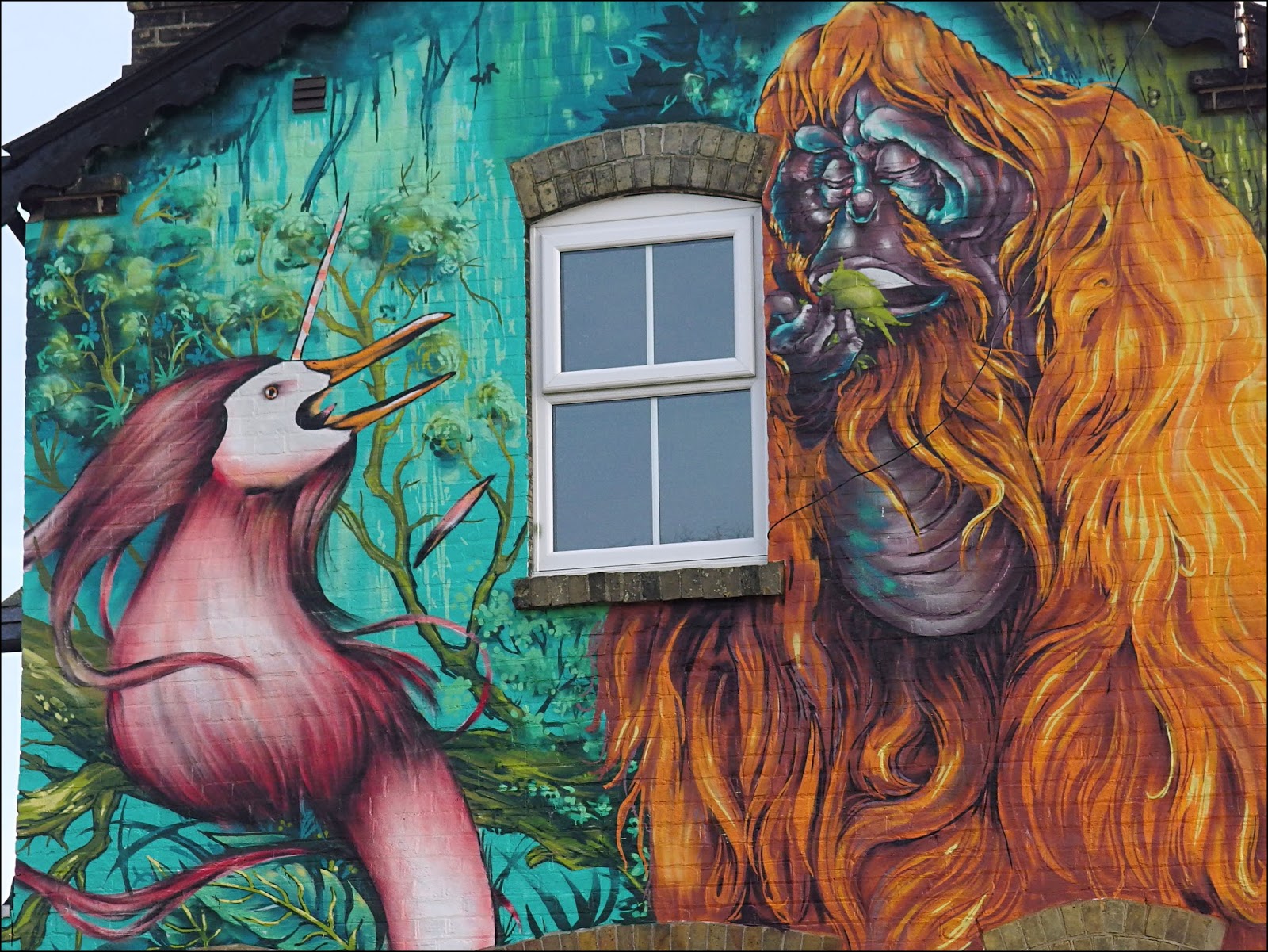
But I've been saving the best till last...


It stands right next to the Cambridge Guided Busway and was once an old railway station. It's the work of two artists known as Mattheus Bailon (from Brazil) and Dr Zadok. Got to be worth a close-up..


Take care.


Wednesday, 31 January 2018

Three Ways To Achieve Lasting Fame In An English Village

The village in question is Histon and Impington, just outside Cambridge. OK, I know, that's two villages, but two that are so conjoined and intermingled that most of those who live there don't know where one ends and the other begins, or even which one they live in.


Elizabeth Woodcock


If you travel the new busway from Cambridge you may spy, as I did, this simple memorial standing in a field just outside Histon. When I got home I did a bit of research which unearthed this remarkable tale:

On February 2nd 1799 Mrs Elizabeth Woodcock went to Cambridge Market to sell her eggs and butter. On her way home it was snowing heavily and she stopped at the Three Tuns Inn and refilled her flask with brandy. When she was almost home she was thrown from her horse and was unable to remount. Shaken and cold she had the good sense to seek shelter by a hedge but the snow drifted and buried her. In the morning she made a hole in the snow above her and fashioned a flag from her red handkerchief to try to attract attention. It was not seen till eight days later when at last she was rescued.

The story spread rapidly and Mrs Woodcock's ordeal became the subject of a broadside ballad:


For she was all froze in with frost,
Eight days and nights, poor soul!
But when they gave her up for lost,
They found her down a hole.
Ah, well-a-day

Sadly she only lived for a few more months and some sources believe that her death may have been hastened by the amount of brandy sent by well-wishers. Her cottage stands to this day.

Elizabeth Woodcock's cottage today, complete with straw pigs on the roof-ridge. 


Moses Carter (1801-1860)

Like many villages around here Histon has a village sign which stands by the green.


It features, amongst other things, the silhouette of a man wearing a top hat who looks as if he's about to brain you with a huge rock held above his head. That's Moses Carter. If you'd met him in the flesh you'd be even more concerned for he stood just under seven feet (2.13 m) tall and weighed in at around 23 stone (322 lbs or 146 Kg). But you needn't have been worried, for Moses, who was also known as the Histon Giant, was a kindly man who was much loved by the local children.


The rock, which he is depicted holding above his head, he carried across the village for a bet and left outside The Boot pub where it remained for many years. The rock has now been moved to the back of the pub....


When not engaged in carrying huge boulders Moses lived a simple life in a hut in the village. He grew vegetables which he sold from a barrow. He was said to have dragged a set of harrows over his field - "I don't need no hoss", he told his astonished neighbours. There is also a story that he once visited Stourbridge Fair where there was a boxing booth. He soon defeated all the men there and then set about the proprietor when he refused to give him the promised prize money!

Moses was buried in Histon churchyard, a stone of similar shape to the one he once carried for a wager bearing a small commemorative plaque.


Moses Carter's top hat and huge boots can still be seen exhibited in the Cambridge Museum.


Tony Hillier (d. 2014)

When Tony Hillier retired from his post as a University Lecturer in Physiology he started making his iron sculptures which accumulated in his front garden which he called Histon Sculpture Park.


People are welcome to wander around, take as many pictures as they like and are not asked to contribute towards anything, charitable or otherwise. Children are especially welcome and are encouraged to climb on the backs of some of the animals. 


The record for the number of children on the pig is eleven, including one boy on the tail!


None of these works is for sale, though he donated many works to local schools and playgrounds.


Since his death in 2014 the garden has been kept open in his memory.


If anyone had ever been appointed as Children's Sculpture Laureate it should have been Dr Tony Hillier.


More pictures and information can be found on Tony Hillier's website.


Take care.


Tuesday, 30 January 2018

Doodles On The Dockside

The riverside at Ely used to be a dock area with boats bringing goods into the city from far and wide. Nowadays it provides moorings for pleasure boats, though I noticed that one was advertising itself as a "hotel barge". While waiting for the dancing to commence on Saturday (see here if you missed the last post) I wandered up and down taking a few photos of the boats, rather like I used to draw little doodles in my exercise books while awaiting the beginning of school lessons. 


Take care.


Sunday, 28 January 2018

Molly Goes To Ely

(You will see that some of the dancers depicted in the post have blacked-up faces. This was done historically as a form of disguise so that people would not know who it was begging for money. There was never any real attempt to imitate black people; the ears, neck and hands are never blacked-up. Many modern dance sides are aware of possible misunderstanding and have changed their facial make-up, to bright colours, strange designs or just a few smears to make them look more like Victorian chimney-sweeps. One or two sides are determined to stick to the traditional black faces. 
I hope this explanation will be accepted, but also apologise to anyone who may be upset by the inclusion of these pictures here).


And I went to Ely too. Here's what I went to see...

Ouse Washes Molly Dancers 
The Ouse Washes were the hosts yesterday to the Mark Jones Day of Dance in and around Ely. It's held every year in memory of one of their past members and is attended by many Molly dancing sides, the traditional dance of Cambridgeshire and the fen country. I caught up with them outside the Cutter Inn in the morning, they then went on to other pubs in the area - and I went home to get warmed up! Here are the host side kicking off the day...

Good Easter Molly Gang
Good Easter look a lot more like the farm workers who traditionally performed these dances in winter. At least one of these dancers would dress as a woman while another would be referred to as the Lord and might wear a top hat. Maybe they were mimicking the local aristocracy, if so that might explain the blacked up faces which would help to disguise them. The Good Easter Gang don't take themselves too seriously - the man with the splendid beard in the bottom photo is wearing a badge on his hat which reads, "For maximum attention nothing beats a good mistake!" 


Gog Magog Molly
These were the first Molly dancers I ever saw and they're probably still my favourites. Their style is joyful, playful and definitely colourful! Their dances are lively and quite complex...


Old Glory
At first glance these menacing, unsmiling men are about as far removed from the Gogs as you can get. They stomp about in hobnailed boots - the footwear of choice for farm workers until the arrival of rubber Wellington boots. (The Gog Magog dancers wear brightly coloured Doc Martens and that's all you need to know about the differences in their dancing styles! Incidentally I've tried DMs for farm work - absolutely useless!) Although the Old Glory dancers are all men - though one is a highly unconvincing female - their musicians are women. Their dances are slyly entertaining and humorous....


The Norwich Kitwitches
There's something of the Pantomime dame about the Kitwitches - over-the-top, outrageous and larger than life. Maybe that's what traditional dancers were like too; the inventors of the Panto must have got the idea from somewhere....


Seven Champions
The Champions - and yes there are a lot more than seven of them these days - are something different again. They often perform to a single musician or unaccompanied singing with their precise stepping adding the rhythm. Yesterday I saw them dance to an accapella version of "Fever" - yes, the old Peggy Lee song - and then a traditional English song, but one from Northumberland....it didn't ought to work but it does....

Misfit Molly
Back to the exaggerated absurdity and crazy dress-sense of Misfit Molly...

Mepal Molly
Based in the little village of Mepal, just a few miles from Ely, they always seem to me to be closer to what traditional dancers must have been like - but of course I may be wrong....

Oxblood Molly Dancers
Last and by no means the least colourful are Oxblood Molly Dancers who come from Suffolk. As you can see there's no shortage of originality and variety in the wild world of Molly dancing.....


Take care.

I didn't take any videos but you can find most if not all of the people above if you look on YouTube.