Monday, 22 August 2011

Come All Me Young Darlings

A song I wrote some years ago for drunks and drinkers everywhere. That misunderstood breed of men - rogues and romantics, idlers and idealists, pugilists and poets, philanderers and philosophers, scoundrels and sages - but mostly good-hearted fellows, victims of the uncertainties of this cruel world. Here's to them all!


Come All Me Young Darlings

Come all me young darlings and listen awhile
For an old fool's about to address you
And I see from the way that you snigger and smile
That the prospect does not much impress you;
Though a drunken old tosspot I now might appear
It was not always so, I assure you, my dears,
So come gather round closely these words for to hear
Then I'll bid you goodnight and God bless you.

Well, once long ago there were dreams to be dreamed
for the world it seemed ready for changes,
There were bright golden days up ahead so it seemed,
We knew nothing of hardships and dangers,
And we sang our songs loud in the still of the night
And stood shoulder to shoulder to fight the good fight,
But some soon changed sides and then others took flight
Until now I'm left singing to strangers.

For time takes its toll and love takes its leave
And then loneliness soon takes to drinking,
To the telling of stories that no one believes
And to sitting in silence and thinking,
For I'm thinking of those that I once loved and knew,
And I'm thinking of things that I once thought were true,
And I'm thinking there's nothing at all I can do
As I wait for the sun to go sinking.

But hidden away in the back of my brain
There's a foolish yet beautiful notion,
I remember those islands once glimpsed from a plane
Like jewels in the grey northern ocean,
For the green fields of England shone gloriously
And just for one moment I thought I could see
That land fit for heroes where men could be free
From all troubles and pain and commotion.

So all you young darlings here with me tonight
Pay no heed to these tired words of warning,
If you know good from bad
                                                       if you know wrong from right
Maybe all will be well in the morning,
But for me the distinction's becoming unclear
For my eyes have grown bloodshot and dim with the years;
They've been dazzled by beauty
and blinded by tears.
So now goodnight,
and God bless you,
my darlings.


Take care.


Sunday, 21 August 2011

Worth Getting Off The Bike For

A few more oddities collected as I trundled my push-bike along the back-roads of East Anglia.

A Wall


If you want a long wall you normally need some sort of buttresses to support it. But here's another solution. It's not just a drunken bricklayer; it delights in the wonderful name of a "crinkle-crankle wall". You sometimes see them on large estate walls but this one's the boundary of a private garden.


Decorative Plaster-work


This art-form, known as "pargetting", is particularly common on old buildings around the village/small town of Clare in Suffolk. I warn you, it's easy to become hooked on searching for such buildings! (You might need to click on the image to enlarge it).


A Flowery Border


I recently cycled past this attractive sight. Farmers are encouraged to leave the edges of their fields to provide a home for wildlife. This year I've seen some really beautiful shows of ox-eye daisies in particular. But this is Borage which does occur naturally but is also grown as a crop, mostly for its seed oil. Presumably borage had been grown here the previous year and it self-sowed.


An Old Sign


Old roadsigns always used to read HALT rather than STOP. The problem was that foreign drivers did not always know the word "halt" with obvious and unhappy consequences. This one's on a very minor road and seems to have been forgotten. 


An Old Granary


The building above is almost certainly an old granary. At first sight it may appear rather puzzling to the uninitiated. The brickwork at the bottom is newer than the building it supports. How on earth did they do that? Old granaries (grain stores) used to be raised off the ground on stone supports known as "staddle-stones", mushroom-shaped stones that you still find on country roadsides (I'll look out for one for you!). This was to prevent rats and mice getting into the building. In this case I would suppose that the structure was becoming unsound so the brickwork was inserted to give extra support. The older brickwork in the end-wall has been infilled between the timbers and is known as "brick-nogging", it's replacing the original lath and plaster walls. 


And Finally.....


A rough but rather amusing piece of chain-saw sculpture. An old tree stump has been carved into something resembling the Easter Island statues. It must have seemed like a good idea at the time!

For readers of yesterday's post about elm trees here's a link to an article which may be of interest.

Take care.

Saturday, 20 August 2011

"Friends Re-united", or "A Blog Goes Home".

You know how it is when you meet an old friend? One you haven't seen for many years and thought you'd never see again?  Well, today I met such a friend again, after many years apart. Rumours of her demise were obviously premature.

Lolworth Church

I set off from Bar Hill and walked towards the village of Lolworth. The sun was shining and the harvest was being gathered in. There was not much in Lolworth to delay my progress (not much in Lolworth at all, to be honest) so I continued on to Boxworth, or "Boxer" as the old farmhands used to call it.

Cottages in Boxworth

As you near Boxworth it's clear that there are more trees than are present in most Cambridgeshire villages nowadays. In the late 60's Dutch Elm Disease began to kill off all the elm trees right across Britain, changing the landscape for ever. Within a decade 20 million elm trees had succumbed. I'd grown up living next to a small strip of woodland which was nearly all elm, I'd climbed them and felt their rough bark and coarse foliage. All across England the elms died.

Old friends!

Everywhere except Boxworth that is! Somehow the trees here have survived. It could be that they have some magical resistance to the fungus which causes the problem, or maybe they do not attract the beetle which spreads the fungus. The nature writer Richard Mabey believes we should be replanting with elms derived from these resistant trees. Whether that could ever happen I don't know, but it was certainly good to be re-united with this long-lost friend once again and feel the roughness of the leaves between my fingers.

In Overhall Grove

From Boxworth I walked on to the village of Knapwell and another interesting piece of woodland, Overhall Grove, which is managed by the Wildlife Trust is a Site of Special Scientific Interest due to its structural maturity and large oxlip population. The elms here were badly affected by elm disease but are making a comeback. There are however some fairly impressive oak and ash trees.

The moat

The wood covers the site of a medieval manor house and the remains of the associated moat can be seen amongst the trees. The moat also contains a well-established badger sett. The red berries of 'Lords-and-ladies' shone brightly from the shady undergrowth.

Lords-and-ladies or Cuckoo Pint

A narrow lane led to Knapwell church. 

A wooden cross in the graveyard

I wandered through the village then turned down a grassy track to walk through to Childerley. Childerley is not a village at all; there were two small villages here in the past, called Great and Little Childerley but the houses were cleared to make way for a deer park and gardens around the Hall in the reign of Charles I. During the last century the estate has been managed as a large farm employing the most modern farming practices.

The site of Great Childerley village

So what we see today is a curious amalgam of agri-business and well-preserved reminders of its past history. Huge fields are worked by modern machinery, but small paddocks around the farm retain the original medieval ridge-and-furrow markings.


The heart of the modern farm

The old cart-shed


Childerley is only a few miles from the farm where I worked and we used to cart straw from there each year, it's also the site of the field known as Stargoose, so the blog felt quite at home too.


From Childerley it was across the fields.....

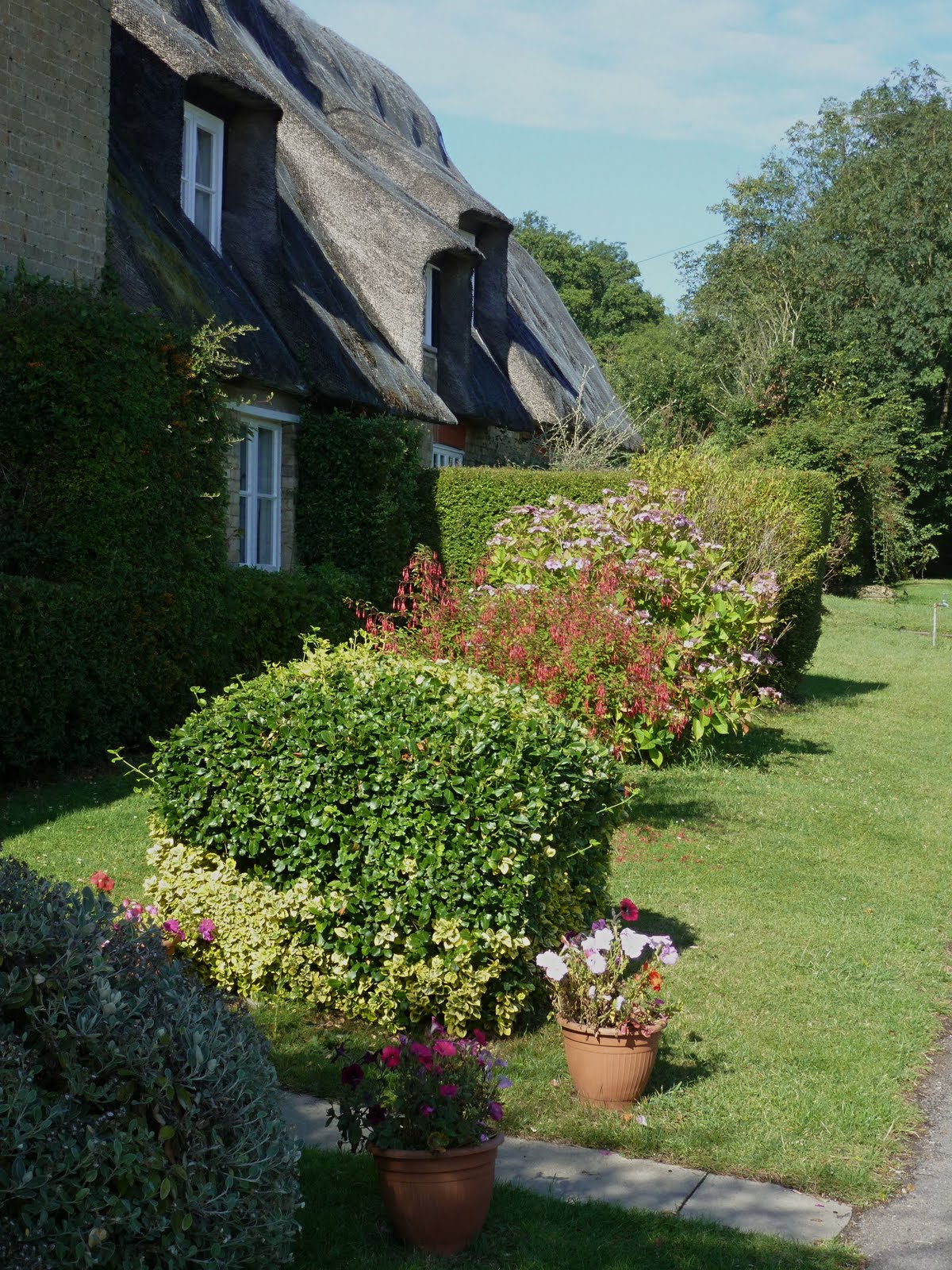
Thatched cottages in Dry Drayton

....to Dry Drayton. It's been suggested that its odd name derives from the fact that the original inhabitants may have occupied this site chiefly during the winter months when the fens were flooded. There is certainly a village on the fen edge known as Fen Drayton which seems to support this idea. From there it was just a short stroll back to Bar Hill to catch the bus back to town.

Take care.

Friday, 19 August 2011

Children And Animals

Home Farm at Wimpole is a fun place for kids to see what happens down on the farm.


And last but by no means least...


Take care.

Thursday, 18 August 2011

Wimpole Hall

I've walked through the grounds. I've visited the gardens. I've watched birds in the wood behind the house. I've cycled through the estate. I've taken children around the farm. I've photographed the outside of the house. But I'd never been inside Wimpole Hall till recently. Shocking but true!


The present house was begun in about 1640 for Thomas Chicheley who was the local Member of Parliament. He was a Royalist and associate of Charles II. He lived extravagantly and soon managed to spend more on the building than he actually had, forcing him to sell the estate which had belonged to his family for over 200 years.


The house has its own chapel (as well as a small church in the grounds) which was decorated by the artist James Thornhill in the 1720's.


Each successive generation of owners redecorated and reshaped the house to reflect their tastes. I loved the little cabinet full of figurines. Other rooms had a warmer, more intimate feel.


When Philip Yorke, 1st Earl of Hardwicke, bought the Hall he employed Henry Flitcroft to remodel the house in the fashionable neo-Palladian style.


I rather liked the elegant long room seen above which also contained the unusual musical instrument in the smaller picture. It's a "square piano" which has the wires arranged transversely to save space.  It has no pedals but has stops which were operated by the left hand. It had a rather quiet, muted sound apparently. Jane Austen had one in her cottage at Chawton.


John Soane designed the Yellow Drawing Room, a room with a high, domed ceiling which occupied two floors of the house, for the 3rd Earl of Hardwicke and his wife Elizabeth. The 3rd Earl was an enlightened agriculturalist who made great improvements to the farm.


The rather grand Dining Room had the shutters closed and was lit by candles to give the atmosphere of an evening banquet. It made photography a bit tricky though. 


Upstairs one could wander through the Chancellor's bedroom (one of the Earls was indeed the Lord Chancellor) and look out onto the formal gardens.


The last inhabitant of Wimpole was Mrs. Bambridge, the widow of Captain Bambridge who died suddenly in 1943. They had bought the house, devoid of furniture in 1938. After his death she devoted her life to restoring Wimpole to its former glory. She had rooms redecorated in the styles which were shown in paintings of the house and tracked down items which had been sold and brought them back to Wimpole. The room above was her bedroom. Mrs. Bambridge also happened to be the daughter of Rudyard Kipling.


At some stage the house acquired this huge bath. It holds 3,000 gallons of water!


You can also have a look through some of the servants' quarters...


                         ....the Housekeeper's room...


                                                                        ....and the Butler's pantry.


Outside once again the formal gardens are tended by employees of the present owners, The National Trust.

For a winter walk visiting the "castle ruin" in Wimpole Park click here.

To visit Home Farm, Wimpole click here.

To  see more of the gardens and grounds click here.

Take care.


Wednesday, 17 August 2011

Harvest


When I was a little boy Dad used to work for Old Tom Ayers, one of the last farmers in Cambridgeshire to use a reaper and binder. I remember seeing Mr Ayers, dressed in his farmer's smock, inspecting the sheaves being brought in on the trailer. But I was more interested in what was going on in the field next to our bungalow, for two combines had entered by the gap near the big oak tree and were progressing slowly around the headlands. One, going at a little under walking pace, said Massey Ferguson on the side, while the other, going even slower, was a Massey Harris; you could just make it out through the dust and rust.

My brother and I sat all morning at the side of the field watching the coming and going of tractors and trailers. Later that week we saw the field near Highfield Farm being cut using a combine which was operated by two men, one driving and one filling the sacks with grain and sliding them down a chute. Meanwhile, back in the other field, the baler was in use. A man drove the tractor and a young boy stood on the sledge behind the baler, stacking bales into heaps then pushing them off the back. The next afternoon men came with pitchforks and loaded the bales onto a trailer, secured them with ropes and carted them away.

By the time I was old enough to join in things had changed a bit. The combines were a little larger and faster, some even had cabs. The sledge behind the baler now had a gate on the back which was operated by means of a cord by the tractor driver and simply dumped the bales in rough heaps around the field. I got the job of stacking the bales up tidily till they could be collected.

Improvements happened every few years. The farm where I now worked in the school holidays bought a bale elevator which was a great improvement on pitching the bales up by hand. Red plastic string was now used to tie the bales. We tried plastic sheeting to cover the straw stacks but it was not a success; the sheets used to split and the rainwater poured into the middle of the stack ruining many bales. Then we got a "flat-eight" loader, which meant that the bales could be loaded with a tractor rather than man power. A huge straw barn was built, which kept the straw dry but it was extremely hot, dusty, unpleasant work to stack bales up under the roof. Yes, I'd stacked the bales in the field so tidily that I'd now graduated to stacking in the barn!

In the early days the boss used to bring us bottles of beer during the afternoon. Later it changed to a jug of tea, which was just as welcome. Dad and I always got a little extra in our pay packet at the end of harvest "for making a good job of the stacks".

Al that ended twenty years ago when Dad retired and I decided to try a different kind of work. I can't say I miss the work at all and I'd much rather watch someone else doing it.


Some interesting comparisons:

According to Rowland Parker in his excellent, though sadly out of print, book "The Common Stream", in August 1885 twenty-four men with scythes were able to cut a thirty acre field of barley in a day. In 1970 that same field was harvested by 3 men in a day. Using a combine harvester the grain was all in a silo in the farmyard, whereas the 24 men of 1885 still had to turn, rake, heap, cart, stack and thresh their harvest. Nowadays bigger combines, tractors and trailers would make the operation even quicker.

Farm workers wage 1945 - £4 for 48 hours         Price of loaf of bread 1945 - 4d
Farm workers wage 2011 - £260 for 39 hours     Price of loaf of bread  2011 - £1
This means that in 1945 a man had to work for 15mins to earn the price of a loaf. Nowadays it takes a man only 10 minutes to earn his loaf - though the pay's still awful! 

Just out of interest I looked online to find the price of a modern combine. I found a two-year old second-hand Claas combine going at £157,000. You can buy a house for that!


Take care.