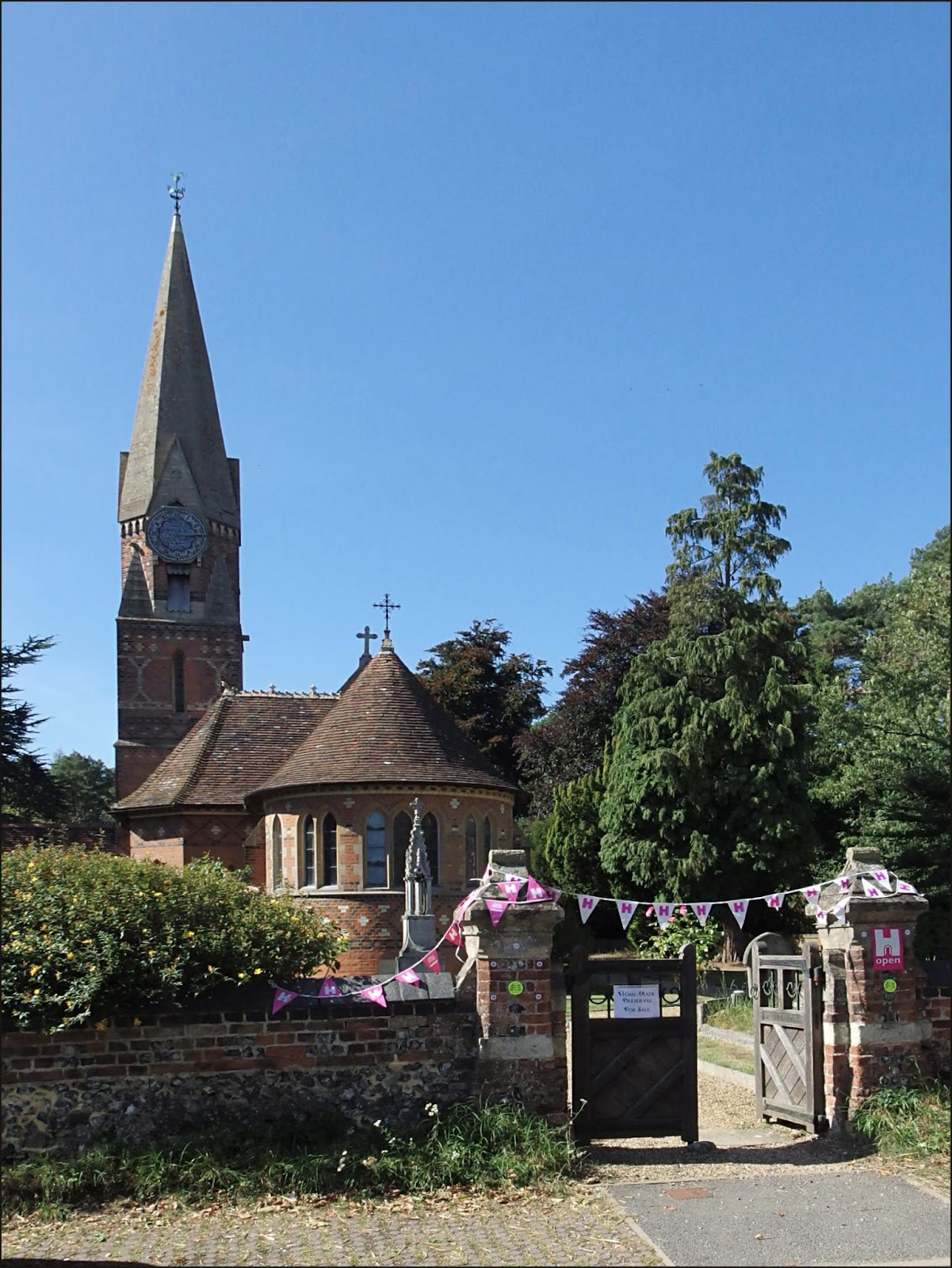
Back in August 2015 I was pedalling my bicycle down one of Hertfordshire's minor backroads when I spotted "one of the prettiest little churches I've ever seen". That's what I said then and another viewing hasn't changed my opinion. Yesterday though the door of the church in Ayot St Peter was unlocked for the national Heritage Open Days weekend.
As English churches go it has no great age, it was built as recently as 1875, the previous church having been struck by lightning and burned down the previous year. The architect was J P Seddon who also oversaw most of the internal fittings and decoration too. There have been a few additions since but all in keeping with the original concept and carried out to the highest standard.
What we see today is one of the most complete small churches built in the Arts and Crafts style of the Victorian era.
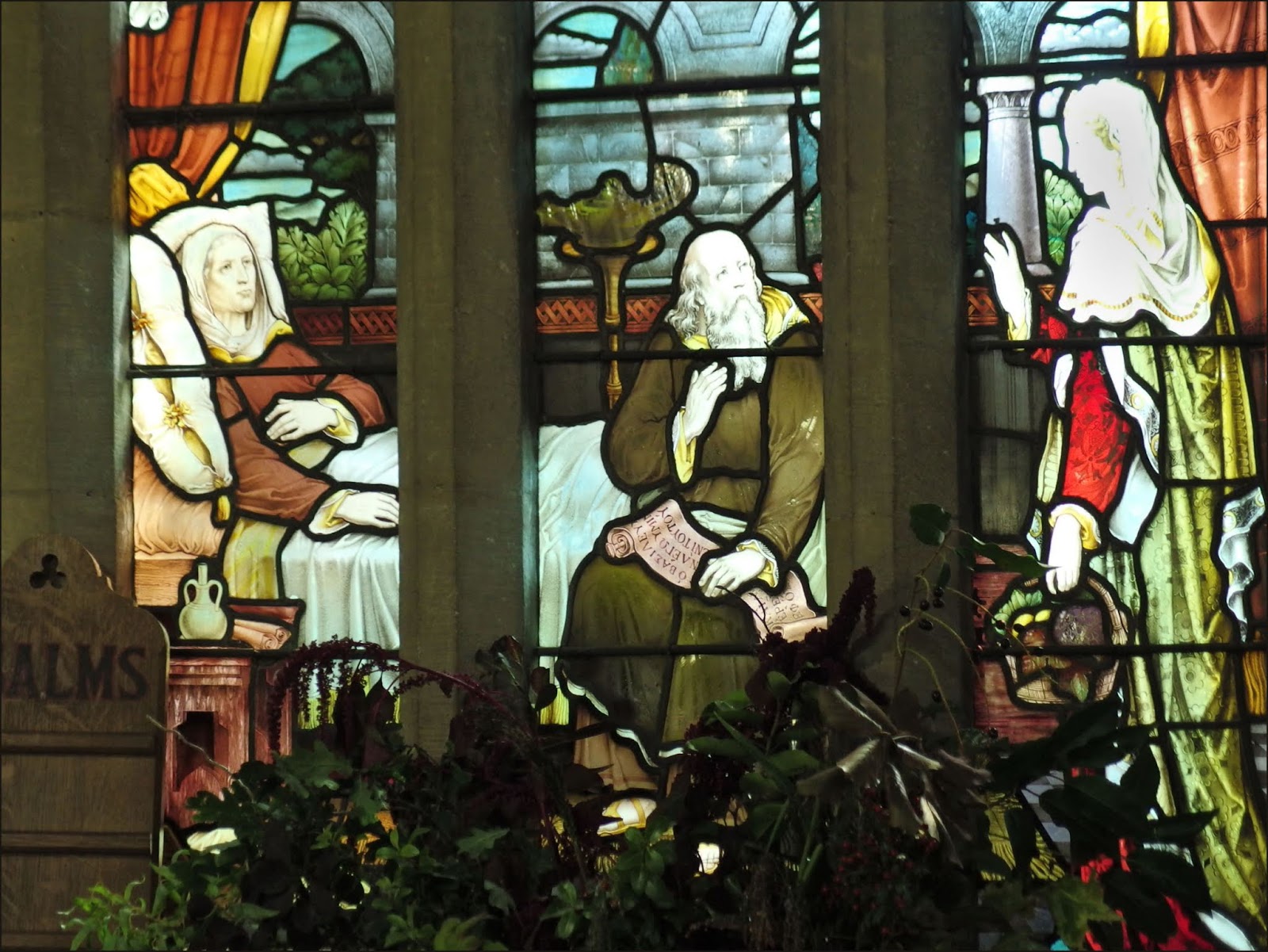
As a special bonus this weekend it's been skilfully and colourfully adorned in readiness for Harvest Festival.
The Arts and Crafts movement grew up in England in response to the rapid industrialisation of the country. Many artists and intellectuals despaired at what they saw as a decline in craftsmanship in the face of mass production and sought a return to traditional values.
There was also a movement within the Church of England to return to what they saw as a golden age of church building before the Reformation. Churches then had been much more colourful and elaborate.
Although the buildings constructed in this style are undoubtedly dazzling, the insistence on craftsmanship and materials of the highest order made them unbelievably expensive. Many a landowner was reduced to poverty by building in this style. Here there must have been several wealthy backers to finance the building of such a fine church. The ongoing cost of maintaining it must also place a heavy burden on the parish.
I've refrained from giving you too much detail about the individual items in the church, but if you want to find out more the village has an excellent website which will provide you with the full details about their beautiful church.
There was just one more thing I wanted to see......
….. a small glass case displays this lump of misshapen metal which comes from the bells of the previous church, melted by that fateful lightning strike in 1874.
Ayot St Peter is in a pleasant bit of countryside just west of Welwyn Garden City. I'll show you a few shots of the walk I took to get there in the next post. What I won't be sharing is the jar of home-made jam made by a local resident and on sale in the church; I'm having that all myself!
Take care.
Sunday, 15 September 2019
Wednesday, 11 September 2019
Heavy Friends
It's full name is the Haddenham Steam Rally And Heavy Horse Show, so I'd better show you a few pictures of our weighty equine companions.
They are all turned out beautifully for the show which takes place in a corner of the huge field, away from the noise of the machines and the bustle of the crowd.
I know these stocky, short-legged chesnut horses are Suffolk Punches, a breed well-suited for farm work on the heavy soils of East Anglia, so it's fitting that they should be here alongside the steam engines and tractors who followed them in doing the hard graft of agriculture.
I believe the dappled grey is a Percheron; most Percherons are that colour. They came originally from Western France and were first bred as war-horses in much the same way as our English Shire Horses are descended from the Great Horse which was developed to carry armoured knights.
There were special classes for mares with their foals. The gentleman in black is one of the competition judges while tweeds and flat caps are usually favoured by horse-people of both sexes.
Even quite small horsemen can be seen wearing caps.
It's necessary to keep ones strength up with a quick snack of hay.
The parading and judging seemed to go on throughout the day, though it was easier to take pictures while they were awaiting their turn in the ring.
I'm sure that horses understand exactly what is required when they pose for a photo. And just to finish off here are some beautifully carved wooden horses on the carousel.
Take care.
They are all turned out beautifully for the show which takes place in a corner of the huge field, away from the noise of the machines and the bustle of the crowd.
I know these stocky, short-legged chesnut horses are Suffolk Punches, a breed well-suited for farm work on the heavy soils of East Anglia, so it's fitting that they should be here alongside the steam engines and tractors who followed them in doing the hard graft of agriculture.
I believe the dappled grey is a Percheron; most Percherons are that colour. They came originally from Western France and were first bred as war-horses in much the same way as our English Shire Horses are descended from the Great Horse which was developed to carry armoured knights.
There were special classes for mares with their foals. The gentleman in black is one of the competition judges while tweeds and flat caps are usually favoured by horse-people of both sexes.
Even quite small horsemen can be seen wearing caps.
It's necessary to keep ones strength up with a quick snack of hay.
The parading and judging seemed to go on throughout the day, though it was easier to take pictures while they were awaiting their turn in the ring.
I'm sure that horses understand exactly what is required when they pose for a photo. And just to finish off here are some beautifully carved wooden horses on the carousel.
Take care.
Tuesday, 10 September 2019
A Head Of Steam
A fine day with patches of sunlight drifting over the flat fen towards the Isle of Ely. Also floating on the wind were wisps of smoke, the scent of steam coal and the sounds of a friendly and informative country voice carried from the public address system....."a foine owd tractor that, owned by a chap lives just down the road. Probbly built about 1958, somewhere round that toime. "
Yes, we're at the annual Haddenham Steam Rally, just south of Ely. There are of course a large number of steam traction-engines present, but even more tractors of various vintages, some restored to look as though they've just rolled off the production line, others in what might be called "farmyard condition". I've often wondered what happened to all the old rusty tractors that used to stand, covered in nettles and ivy, behind every shed in the fens. I think I may have found my answer.
Here they are, fully functional and spruced up enough to win cups.
Here's a bean drill that lacks a steering wheel but is controlled by a bar which can be moved left and right. But we'd better have a look at the steam engines...
....like this showman's engine that would have been used to tow fairground rides from town to town and then to power the roundabouts and big wheels.
There's an awful lot of cleaning and polishing involved in keeping such huge machines in tip-top condition. There were also some smaller representatives of the brotherhood of steam....
These are often home-built by enthusiasts who may spend years on a project. They work just like the real thing and are correct in every detail. Some are even based on plans of machines that have not survived the intervening decades.
Where to next?
Commercial vehicles from the past are well represented. There were also plenty of vintage cars and motorcycles on display.
All this shininess is hard for the photographer to resist, even if some onlookers think you're crazy!
Fish and chips are difficult to pass by too, especially when served from a converted London Transport bus. You can even go upstairs to eat if you want.
After eating you might like to wander around some of the stalls...
…..where all that rustiness calls out to be photographed, if not purchased.
It's amazing what some people will sell - and buy!
These stylish figures were part of one of the fairground organs that were pumping out their jolly music across the site. I always get home wishing I'd taken more close-ups of these ornate creations, maybe one day I will.
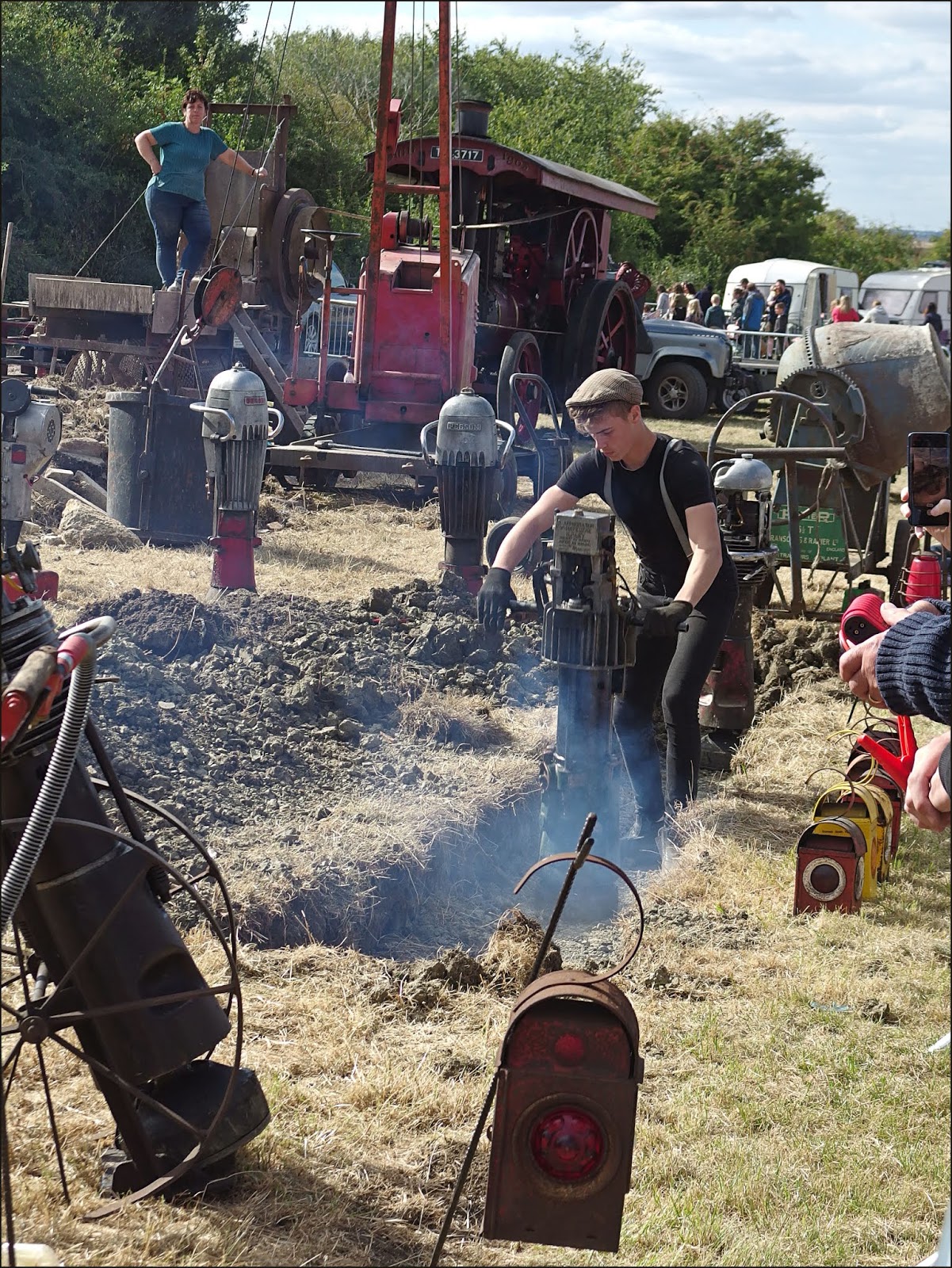
Over in one corner of the showground there was a demonstration of road-making machinery, some of the workers labouring much harder than others.
Abel's World Wide Furniture Removals brought several vehicles of differing ages, but I was rather taken with this splendid bicycle - though I'm not sure how much furniture you could move world-wide with such a machine!
Take care.
(there were also lots of heavy horses there, but nobody wants to see them, do they?) 😉
Yes, we're at the annual Haddenham Steam Rally, just south of Ely. There are of course a large number of steam traction-engines present, but even more tractors of various vintages, some restored to look as though they've just rolled off the production line, others in what might be called "farmyard condition". I've often wondered what happened to all the old rusty tractors that used to stand, covered in nettles and ivy, behind every shed in the fens. I think I may have found my answer.
Here they are, fully functional and spruced up enough to win cups.
Here's a bean drill that lacks a steering wheel but is controlled by a bar which can be moved left and right. But we'd better have a look at the steam engines...
....like this showman's engine that would have been used to tow fairground rides from town to town and then to power the roundabouts and big wheels.
There's an awful lot of cleaning and polishing involved in keeping such huge machines in tip-top condition. There were also some smaller representatives of the brotherhood of steam....
These are often home-built by enthusiasts who may spend years on a project. They work just like the real thing and are correct in every detail. Some are even based on plans of machines that have not survived the intervening decades.
Where to next?
Commercial vehicles from the past are well represented. There were also plenty of vintage cars and motorcycles on display.
All this shininess is hard for the photographer to resist, even if some onlookers think you're crazy!
Fish and chips are difficult to pass by too, especially when served from a converted London Transport bus. You can even go upstairs to eat if you want.
After eating you might like to wander around some of the stalls...
…..where all that rustiness calls out to be photographed, if not purchased.
It's amazing what some people will sell - and buy!
These stylish figures were part of one of the fairground organs that were pumping out their jolly music across the site. I always get home wishing I'd taken more close-ups of these ornate creations, maybe one day I will.
Over in one corner of the showground there was a demonstration of road-making machinery, some of the workers labouring much harder than others.
Abel's World Wide Furniture Removals brought several vehicles of differing ages, but I was rather taken with this splendid bicycle - though I'm not sure how much furniture you could move world-wide with such a machine!
Take care.
(there were also lots of heavy horses there, but nobody wants to see them, do they?) 😉
Friday, 6 September 2019
This Modern World
I know this may sound weird to those of you who live in big cities or in lands where history is less varied and visible than in the United Kingdom, but from time to time I get bored with photographing the countryside or historic buildings. I feel a need to "re-boot" my diminishing stock of grey cells in some way and point my lens at something different, something outside my usual drift of experience. One way of doing it is to examine some of the constructions and contrivances of modern architecture. Although I'm not much interested in the kind of world they represent, there's something about their sharp angles and shiny surfaces that I find compelling.
Take care.
Monday, 2 September 2019
Impressions Of Crowland
Crow-land. Even as the two syllables slide across the tongue they start to conjure images. Dark birds wheel around crooked ruins rising above the misty fenland marshes, perhaps. Sometimes it's called Croyland. What might that mean? Maybe from the French croyable - believable - a land of belief? Or Croix-land - land of the cross?
In fact the place was first mentioned in The Life Of St Guthlac, the story of a religious hermit who came to live here in about 700 AD, where it was recorded with various spellings including the unlikely Cruuuland. That's right, three "u"s, though I suspect the second and third were really meant to be a "w"; cruw being an old word for a bend in the river. Even so it's still a rather strange little place even when visited on a warm summer's afternoon in the twenty-first century.
The first thing you encounter, once you've parked the car in the main street, is an extremely odd, and obviously very old, three-cornered bridge. Three sets of worn stone steps rise unevenly to the apex which spans - absolutely nothing! It's said that before the fens were drained the River Welland collected one of its tributaries here and the three-way Trinity Bridge was a neat cost-effective solution to crossing this meeting of the waters. In those days a boat would be essential to getting anywhere in this watery landscape.
Just down a short side street stands this imposing façade which turns out to be the parish church, though it's obviously very different from the norm. What's more it seems to have a semi-detached ruin.....
The statues in the niches whisper that this was once a very important building and also pre-dates the Reformation, though somehow the graven images have escaped destruction even though this part of the building has fared less well.
In the earliest days of Christianity devout men and women sought out isolated and often inhospitable places in which to practise their faith, and the islands in the fens offered them the chance to withdraw from wider society. In time they were joined by others and small religious communities developed. That's what happened on the marshy isle of Crowland, around St Guthlac whom we mentioned earlier.
Although they had to contend with isolation, water-borne disease and frequent flooding, the fens would have provided them with ample food resources. Fish, particularly eels were plentiful as were wildfowl. The silts brought by the floodwaters proved to be very fertile allowing them to grow their own vegetables and providing summer grazing for cattle and sheep. The early attempts at draining small areas of the fens were carried out on the margins of their island.
In fact the place was first mentioned in The Life Of St Guthlac, the story of a religious hermit who came to live here in about 700 AD, where it was recorded with various spellings including the unlikely Cruuuland. That's right, three "u"s, though I suspect the second and third were really meant to be a "w"; cruw being an old word for a bend in the river. Even so it's still a rather strange little place even when visited on a warm summer's afternoon in the twenty-first century.
The first thing you encounter, once you've parked the car in the main street, is an extremely odd, and obviously very old, three-cornered bridge. Three sets of worn stone steps rise unevenly to the apex which spans - absolutely nothing! It's said that before the fens were drained the River Welland collected one of its tributaries here and the three-way Trinity Bridge was a neat cost-effective solution to crossing this meeting of the waters. In those days a boat would be essential to getting anywhere in this watery landscape.
Just down a short side street stands this imposing façade which turns out to be the parish church, though it's obviously very different from the norm. What's more it seems to have a semi-detached ruin.....
The statues in the niches whisper that this was once a very important building and also pre-dates the Reformation, though somehow the graven images have escaped destruction even though this part of the building has fared less well.
In the earliest days of Christianity devout men and women sought out isolated and often inhospitable places in which to practise their faith, and the islands in the fens offered them the chance to withdraw from wider society. In time they were joined by others and small religious communities developed. That's what happened on the marshy isle of Crowland, around St Guthlac whom we mentioned earlier.
Although they had to contend with isolation, water-borne disease and frequent flooding, the fens would have provided them with ample food resources. Fish, particularly eels were plentiful as were wildfowl. The silts brought by the floodwaters proved to be very fertile allowing them to grow their own vegetables and providing summer grazing for cattle and sheep. The early attempts at draining small areas of the fens were carried out on the margins of their island.
The earliest formal monastery on the site was founded by King Ó”thelbald in the early eighth century. It was completely destroyed and all the inhabitants put to death by the Danes in 866 AD. It was rebuilt shortly afterwards, as it was on two subsequent occasions after it had been destroyed by fire. But from about 1200 AD onwards the community flourished right through to the dissolution of the monasteries by Henry VIII.
What we see today are the ruins of the nave and the south aisle, dating from about 1260 AD, though some parts may be as early as 1165 AD. The north aisle of the old Abbey Church has been retained as the parish church and has obviously needed restoration work over the centuries.
Just to re-iterate: this vast, long and lofty space is merely the northern aisle of the huge former church. If you think the left-hand wall and columns look a little askew, well, that's because they are.
At the western end of church stands the bell tower with some of the longest bell-ropes in the land. In most great churches and cathedrals there is a ringing-chamber part-way up the tower, but here they are rung from ground level. It is claimed that the first peal of bells to be heard in England were those installed in Crowland Abbey. It was while the mechanism to hang these bells was being installed, at the time of the building of the western tower, that a miracle is said to have occurred which was attributed to the intervention of St Guthlac. The enormous weight of the apparatus put such a strain on the ropes and pulleys being used to hoist it aloft that the whole contraption came crashing down onto the workmen fifty feet below, but somehow none of them suffered any injury.
As you may have noticed, on the shot of the church interior which we saw earlier, there was a flower show taking place in the church.
Also on the wall was an artist's impression of how the Abbey might have looked in its hey-day, before Henry VIII's men got to work on it....
With many thanks to my brother Les, who did the driving, and three of my American cousins, Sue, Theresa and Judy, who made the whole day so enjoyable.
(It strikes me that if St Guthlac could perform miracles to save the workmen from a seemingly certain death, then he might have just as easily persuaded them to make their ropes and pulleys a little stronger. Just a thought).
Take care.
Subscribe to:
Posts (Atom)