Tuesday, 23 July 2019

Poppies A-Plenty

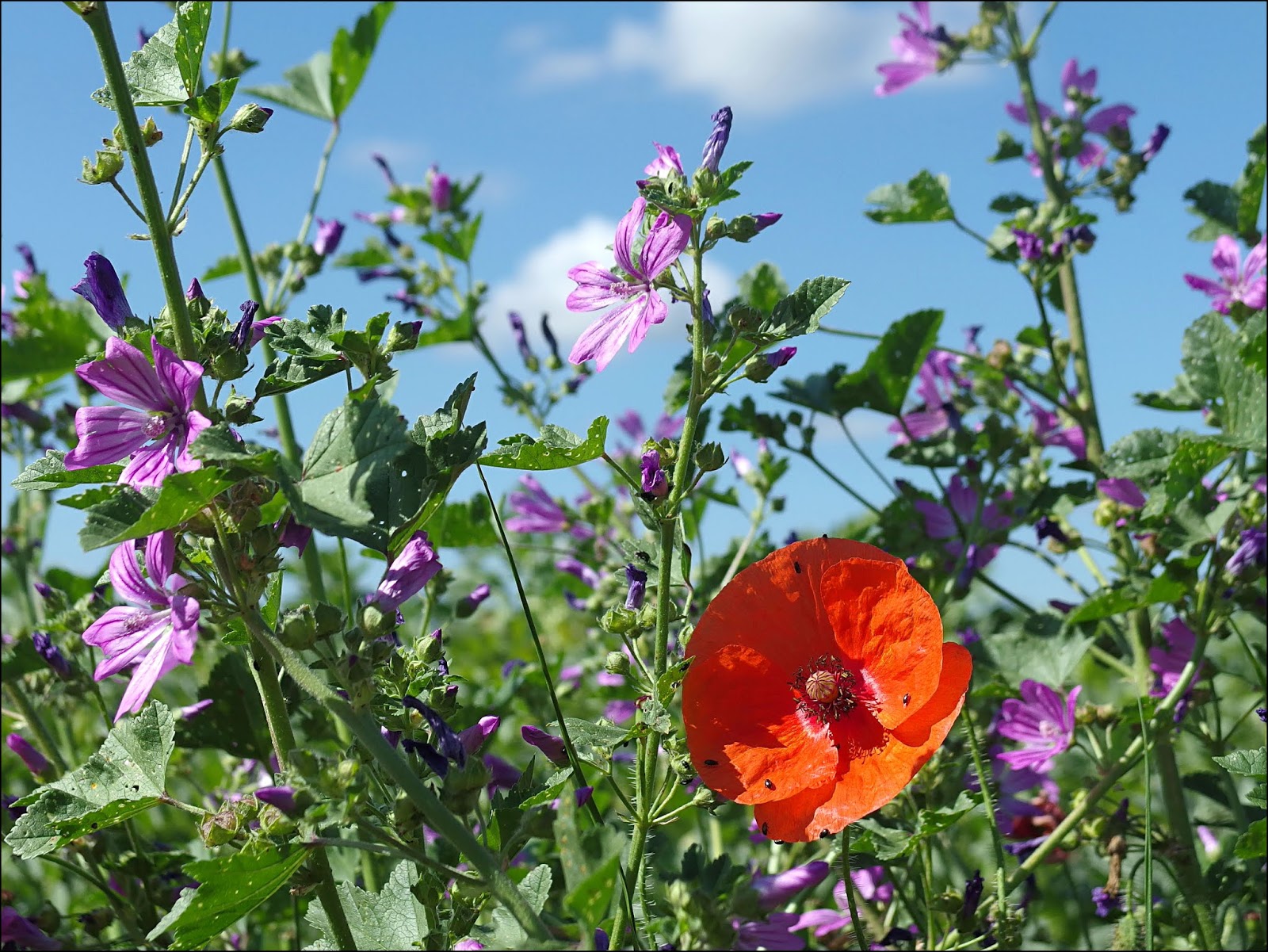
It's been a good year for the poppies. Everywhere I wander I find their cheery scarlet faces smiling up at me, as farmers become a little less eager to spray every last inch of their land. So here's a pocketful of poppy pics just for you....


I've also glimpsed, as I wander near my home, another of those completely red fields of poppies. I've gone to the trouble of taking compass bearings and plotting them on a map, only to find that there are no public roads of paths within a mile of it, so no chance of photographing that one.


*******
If you're suffering from too much summer heat in your part of the world then I hope you'll manage to keep cool any way you can....


Take care.


Monday, 22 July 2019

The Lost Words: Spell Songs

Back in 2007 something happened which those who perpetrated the act thought would go unnoticed. But since then a movement has quietly grown and it appeared in its latest incarnation at the Folk By The Oak festival at Hatfield House.


Early in the afternoon three people appeared on the Acorn Stage. They had no instruments with them and were not about to burst into unaccompanied three-part harmony. On the left was the writer Robert Macfarlane. In the centre, the artist Jackie Morris. And interviewing the pair of them was the broadcaster Matthew Bannister.


Rachel Newton

(just what the Scottish harpist and singer, Rachel Newton, and others who follow have got to do with this will become clear later. Back to the interview...)

The Oxford Junior Dictionary of 2007 made a decision to exclude certain words from its pages to make room for other words which they deemed more relevant to today's children.
The missing words included "dandelion", "acorn", "bluebell" and "otter", all words to do with the natural world, left out in favour of words to do with the internet and computers.


Kris Drever

The loss of the words from the dictionary was of course not the fault of the publishers; they merely reflect what's going on in the world. But if children do not know the names of these things how will they know how important it is to protect them?


Julie Fowlis

I can't recall the exact details of how it came about but the landscape writer Robert Macfarlane and wildlife artist Jackie Morris came together to produce the book "The Lost Words" to celebrate the beauty and mystery of the very words left out of the dictionary.


Beth Porter

Each double page contains one of Robert's "spells", illustrated by Jackie's painting. The word "spell" here has two meanings: firstly the initial letter of each line spells out the name of the subject - O T T E R for example, but the words also conjure up a vision of the animal - like a witch's spell. There is absolutely no "talking down" to children - more like the words of Dylan Thomas than Enid Blyton!


Seckou Keita

Every year Folk By The Oak brings musicians and singers together to produce a suite of new songs on a theme, and these are presented as the central set of the afternoon's music. And this year the songs were based on the Lost Words. And the musicians pictured here are the ones who collaborated in the project.

Karine Polwart

The book itself has been the subject of a crowd-funded scheme to introduce it into every primary school in England. And recently a CD of the songs has also become available.


Somehow I didn't get a picture of Jim Molyneux apart from where he sneaks into the left-hand edge of the band shot above. Kerry Andrew, who was also part of the group, was not at the event but does appear on the CD. So here they are, The Lost Words book and CD, floating ethereally above the festival site surrounded by a golden glow....


There's lots online about the project for those who are interested:


Take care.


Saturday, 20 July 2019

Oops! - June Tree, June Flower

I've been doing very well keeping up with my regular monthly posts from the Botanic Gardens, I thought. But when I visited yesterday and saw the Hop Hornbeam tree still flowering I realised that I'd not shown you the photos from last month. Oh well, better late than never...…

Hop Hornbeam - ostrya carpinifolia


The Hop Hornbeam grows on the southern edge of the garden in amongst a varied selection of other trees. It makes it rather difficult to photograph, or indeed appreciate, the whole of it at a glance. It's as if the learned gardeners here have made the mistake that everyone else makes when planting trees - that of not realising just how big they're going to get!


Not that it's a tree to sink into anonymity amongst its fellows. It leans out over the path, dangling its branches in the faces of passers-by and demanding attention! And it gets that attention too, judging by the number of people who make their way over to read the little sign attached to he trunk.


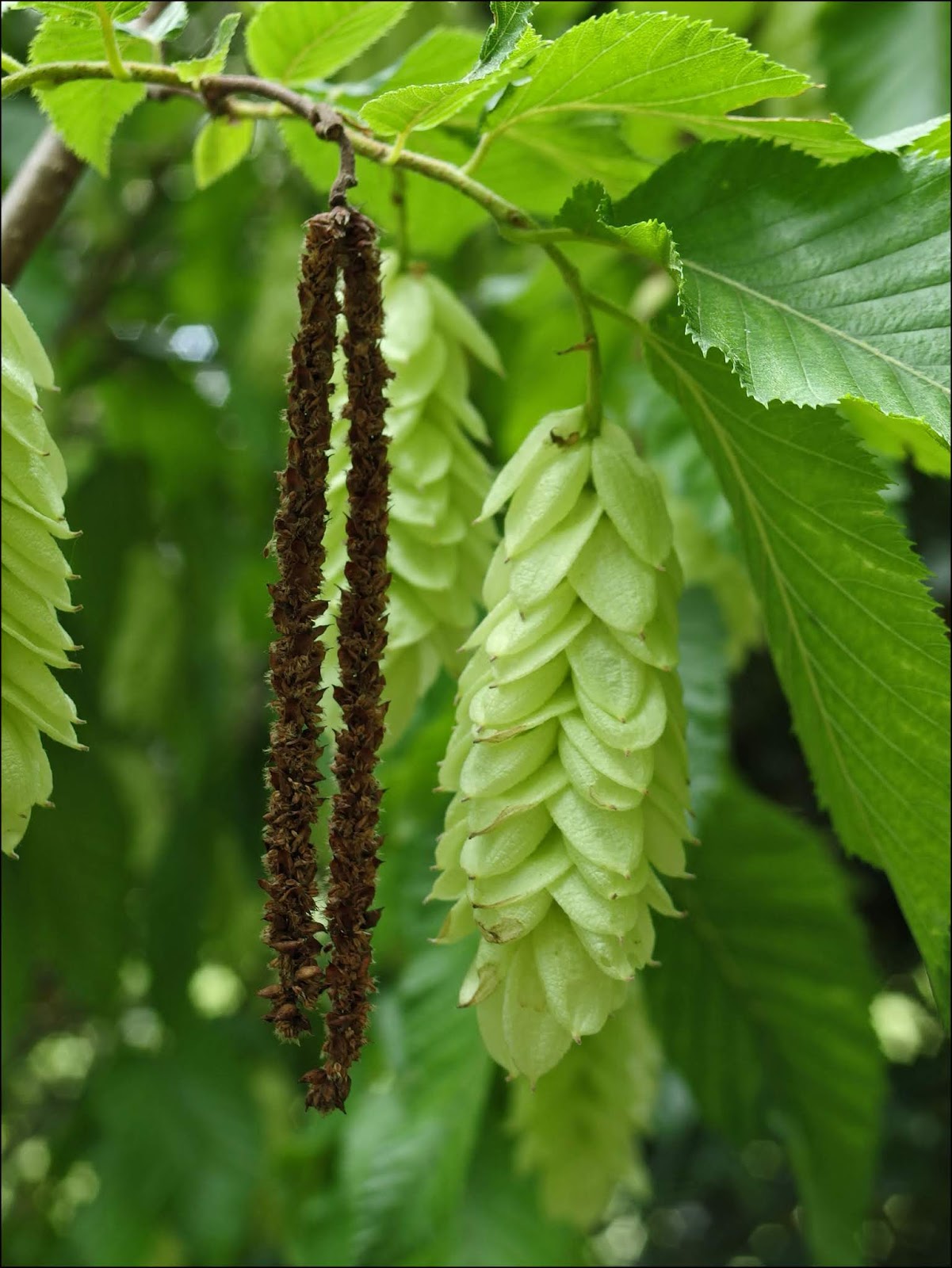
The sign will tell them that it's origins are in Southern Europe and Turkey. The English name, Hop Hornbeam, refers to the hop-like clusters which it produces in summer, but seems suggest that it's a Hornbeam. In fact the Ostryas, although in the Birch family along with the Hornbeams, are a distinct group, though the carpinifolia part of the name means "with leaves like a Hornbeam".


Either way it makes it an easy tree to identify and remember the name of - as long as you know what Hornbeams and Hops look like. As you can see it also bears long catkins.


The trunk has many bumps and hollows as well as intricate though rather scruffy bark which is full of character. The timber is very hard and was traditionally used for making the old-fashioned wooden carpentry planes. It was too difficult to work to be of much use for anything else.

Rose - rosa


You sometimes overhear rose-enthusiasts muttering that they don't think much to the roses here and that some of them are no more than the wild roses that you find growing in the hedgerows.


They are rather missing the point: this is not a show-garden but a teaching resource and the roses here were laid out according to the work of Charles Hurst who spent a the first quarter of the twentieth century unravelling the hybridisation which had resulted in our wide array of modern roses. 


Luckily, those of us less obsessed than Mr Hurst, can still enjoy some wonderful blooms.


Now, as long as I don't forget to show you the July photos from the garden, we shall have caught up!


Take care.


Tuesday, 16 July 2019

Mohsen And His Music

On Sunday I was in the grounds of Hatfield House for the Folk By The Oak one-day festival of folk music. This year there seemed to be a firm focus on youth with many young musicians and some acts clearly aimed at getting a younger audience than you'll find at a lot of festivals. But it didn't stop old codgers like me going along and enjoying myself too.


And so it was that in mid-afternoon I found myself talking to a member of The London Youth Folk Ensemble about our shared enthusiasm for the music of a concertina-playing Scotsman and the band Talisk or TΔLISK as they like to brand themselves.


On fiddle is Hayley Keenan......


…..and on guitar is Graeme Armstrong, both very fine musicians in their own right.


But the eye (and my camera lens) is inevitably drawn to the hair-raising concertina playing of Mohsen Amini. He launches into the tunes with unstoppable energy and gusto, crouching over his instrument to shoot out rapid-fire volleys of notes from his lightning fingers


Then he's leaning back exchanging glances with the other members of the band who produce some of the most exciting music you'll ever hear from just three musicians - and three people sitting down at that!


In 2016 Mohsen won the BBC Radio Scotland Young Musician Of The Year,
in 2018 he was named the BBC Radio 2 Musician Of The Year,
then in 2019 he was awarded the Fatea Awards Instrumentalist Of The Year.


Meanwhile the band Talisk have received a BBC Radio 2 Folk Award as well as Folk Band Of The Year and a Belhaven Bursary For Innovation at BBC Alba Scots Trad Music Awards. They've appeared at festivals throughout the world, now including Folk By The Oak at Hatfield House!


I didn't take any video but here's a video borrowed from Talisk's website. They are playing a track called "Montreal" from their album "Beyond". From the sound of it Montreal must be an exciting place!


Take care.


Monday, 15 July 2019

Summer On The Fen


I was last at Wicken Fen, ten miles or so NE of Cambridge, back in January when everything looked a lot less green and a little more bleak than now in mid-summer.


Back then the Highland Cattle were up to their hairy knees in mud and water, grazing on whatever rough vegetation they could find. Now they are sheltering under the shade of the trees and bushes, trying to rid themselves of the flies that inevitably find them. There are other less irritating insects around too....


…..a Gatekeeper butterfly and a Ruddy Darter dragonfly were two that stuck around long enough to photograph. 


The above view is looking across Adventurers' Fen. Don't expect to find any survival experts or rugged explorers here though; the adventurers in question were those who "adventured" their money to pay for the land to be drained and subsequently were rewarded with parcels of the new land.


The bird hides are still open though you won't see the flocks of wintering wildfowl or the specialist winter birds of prey like Short-Eared Owls or Hen Harriers. But you might find a Marsh Harrier or two, or perhaps a Cuckoo. You just never know.


Near the hide is this curious bridge, built so that the herds of cattle or Konik ponies that graze the area can make their way to all parts of the reserve.


Harrison's Drove leads between Adventurers' Fen and Baker's Fen. I really don't mind what wildlife I see or don't see; I enjoy the simple pleasure of putting one foot in front of the other in such peaceful surroundings, especially when the sun is shining and a refreshing breeze is blowing.


A little standing water can be seen from Charlie's Hide. The hide is small and a rather rough structure, like most hides used to be. I expect it will be replaced soon - a pity.


A lot of new land has been added to the reserve in recent years, all part of an ambitious plan to create a reserve of 13,000 acres (5,260 hectares). So far the land managed for nature totals about 2,000 acres (809 hectares), all a big improvement from the 2 acres which were bought for £10 in 1899.


Over 9,300 species have been recorded in this unique landscape. One of the more recent ones gave a sudden loud burst of song from the bushes - a Cetti's Warbler. They first bred down in Kent in 1972, now there are reckoned to be 2,000 breeding pairs in the country. Infuriatingly you hardly ever see them though; they hide in dense undergrowth and you just know they're present from their abrupt blasts of song.


The water lilies are flowering along Wicken Lode.


A great place to spend a few hours walking around then. But you don't have to walk if you don't want to; the National Trust also do boat trips in their electric-powered boat.


Take care.