Friday, 12 October 2018

Into The Sun


Wednesday was unseasonably sunny in this part of the world as summer had what may be its final fling. As we drove through Newmarket we saw the racehorses returning from their early morning gallop. Horse racing dominates this small town to the extent that, when a statue of the Queen is commissioned, it's no surprise to see that it also includes a racehorse and a foal.


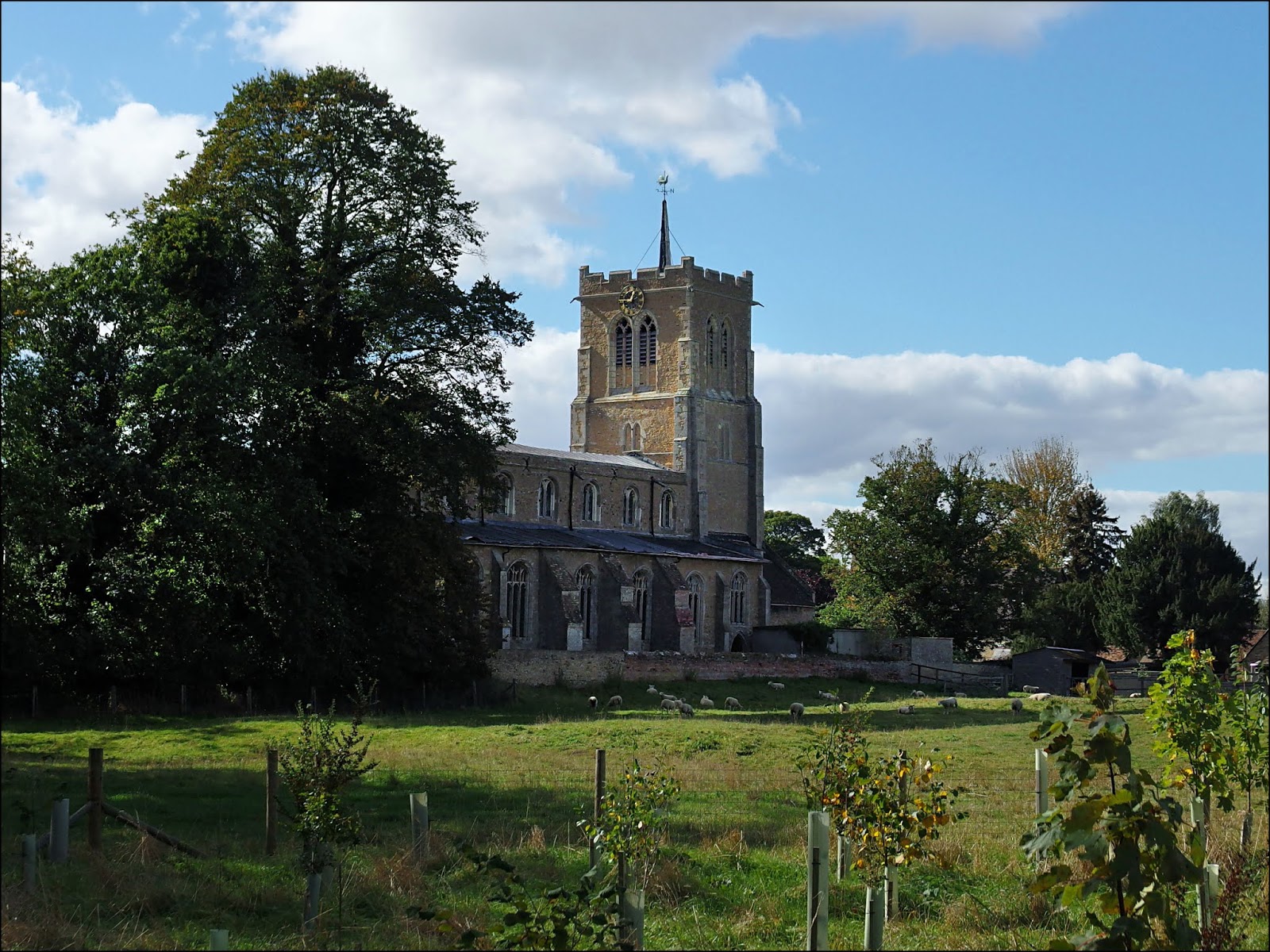
But my brother and I are on our way to Moulton to do a circular walk through the villages of Moulton,  Dalham and Gazeley. I've done the walk before, but today I see a sign that tells me that my route coincides with the Three Churches Walk and there's a map outside Moulton church which echoes our intended journey.


The sun at this time of year is quite low in the sky and we were heading straight towards it for the first leg of the journey.


Sunbeams filter down through the leafy branches.


Dalham is a small but perfectly formed little village with many picturesque cottages.


It also has this puzzling structure by the roadside. It's actually an eighteenth century malt kiln, an important part of the brewing process. Most villages would have had one of these in the past but this is one of only a few survivors.


An avenue of trees leads up towards Dalham Hall.


The Hall was built for the Bishop of Ely in the early eighteenth century. Nowadays it's owned by Sheik Mohammed, Prime Minister of the UAE and leading race horse owner.


This is the view the Sheik can enjoy from the property, not as extensive as that from his Burj Khalifa in Dubai but pleasant enough to my eye.


The path from Dalham to Gazeley passes along woodland edges with views out across the newly ploughed arable fields.


This seventeenth century barn in Gazeley has also been taken over by horse racing and is converted to stables. 


The footpath here is confined between fences. Walking near Newmarket you get used to the security around the racing stables which is quite understandable considering the value of some of these horses.


Just a trace of autumn gold along the roadside leading back to Moulton.


And in Moulton you'll find this rather grand packhorse bridge, built back in the days when horses were used to carry goods from town to town - rather different beasts from those that today carry small men at high speed towards the winning post. The village also has a prize-winning village-shop-cum-post-office-cum-coffee-shop where we enjoyed a well-earned mug of tea.


Take care.


Saturday, 6 October 2018

The Entertainers

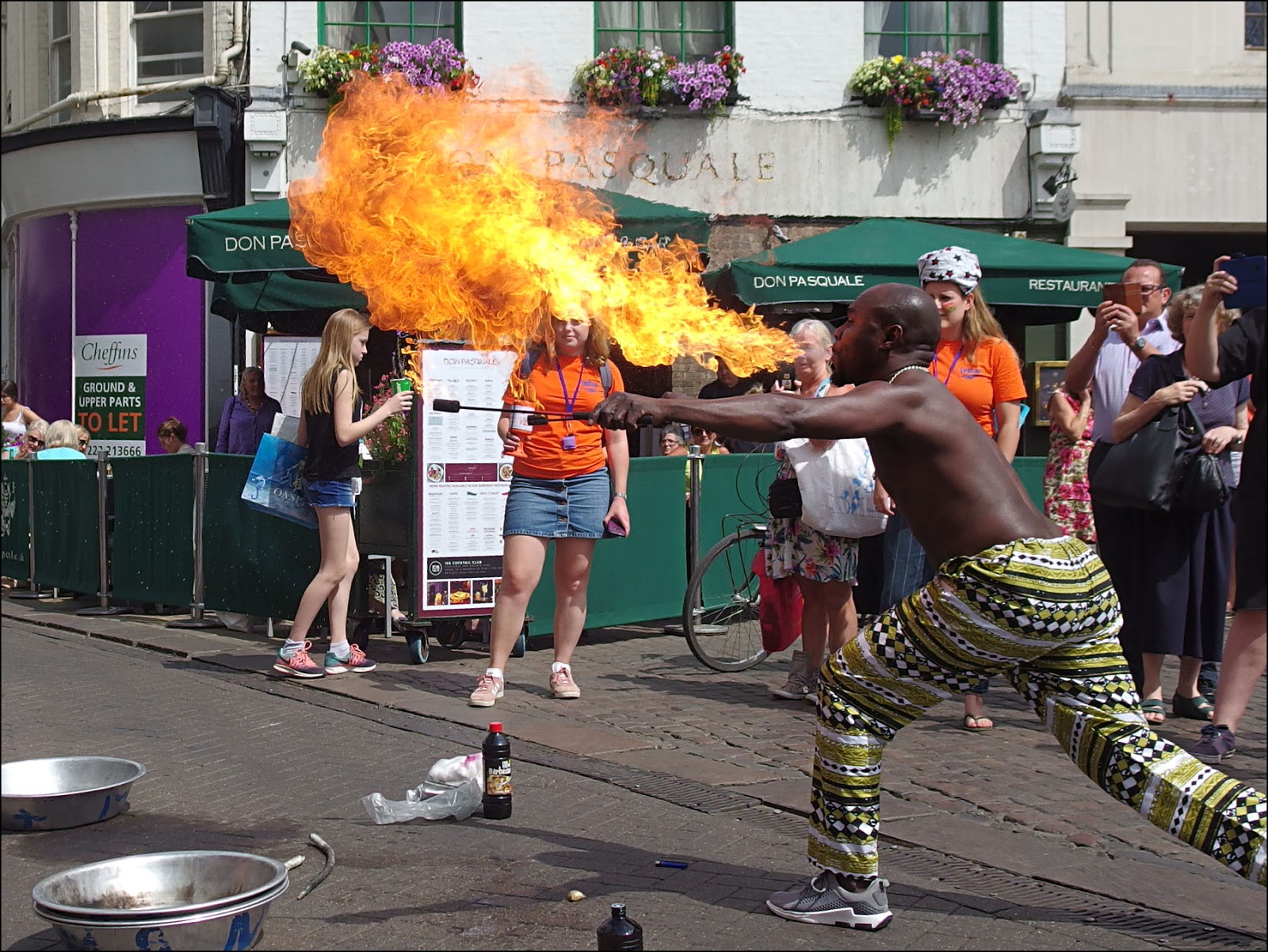
This post is a big Thank You to all the people who've brightened my visits to the fair city of Cambridge this summer - plus a few from previous years....


Take care.


Thursday, 4 October 2018

The Countryside Slumbers


The commuters have left on the train to London, children are in school, but this morning the land sleeps on. Grey curtains of cloud allow just a veiled and muted light to fall gently upon the fields. Deep silence hangs over the distant trees, with just a whisper of autumn gold. 


We're starting today from the little Essex town of Newport and heading into farming country. Most of the fields are now lying brown and bare after the bustle and activity of harvest time. Flocks of Rooks probe craftily for any worms they can find in the newly cultivated fields.


An old barn stands battered and proud on the skyline as we follow a farm track along the edge of a wood.


Cock Pheasants parade around self-importantly, blissfully unaware that it's now the shooting season in England. Keep your heads down at the weekend, my beauties!


A handful of picturesque thatched cottages form the isolated hamlet of Rook End.


Our path then dives into woodland and follows a tiny stream through the trees where just a hint of autumn is scattered on the quiet waters.


Debden church was once dowdy and unremarkable till the owners of the Hall added fanciful pinnacles, a tall spire and an ornate apse. All this was simply to improve the view of it from Debden Hall and to impress any visitors or passers-by. The spire has long gone and its replacement is a more modest affair.


But we can still go inside to see the fancy apse with its miniature vaulted ceiling.


We saw this building in a long-ago post. All I could tell you about it then was that I had no clear idea what it was. I didn't know much more today but met a man, out walking his dog, who thought it was a stable block for the hall. When I got home I rummaged through the internet once more and - hey, presto - found a historic buildings report that confirmed that it once housed stables, it also contained a coach house, harness-rooms, storage for hay and accommodation for a coachman and  stable hands. It was older than I thought too, dating from the early 1700s. Nowadays it languishes unloved and largely unused, apart from sheltering bits of agricultural equipment.


The ornamental lake is still here too, though the hall itself was demolished in 1936 as the family could no longer afford the upkeep. No longer required by the privileged few, the glistening waters can now be enjoyed by anyone out walking the footpaths.


And those paths lead us through this little valley, back towards Newport. In the lower right of the picture are the remains of a WWII "pill-box" (a guard post or blockhouse). There are several of these in the area, perhaps associated with the nearby wartime airfield.


It's so deserted and peaceful here today that it's difficult to imagine it teeming with soldiers and military vehicles. Today, apart from us, there were just a few sheep and a flock or two of Wood Pigeons.


Then we're suddenly back in the busy little town of Newport which is mostly strung out along the road which, before the M11 motorway was built in the nineteen-seventies, was the main highway from London towards Newmarket and on to Norwich.


This is just one of the historic buildings that line the main street, a reminder of the heyday of the town.


Take care.


Tuesday, 2 October 2018

Mythic Beasts And Angels


While making my visit to St Mary's church at Over recently I took the opportunity to walk the mile or so down the road to the neighbouring village of Swavesey. It's another place with a big church, reflecting the former importance of the area. 


By the 1860s the church was in need of extensive restoration. One small aspect of this work was to replace most of the pew benches. If you look carefully at the photo above you'll see that there are small carvings on top of each bench end. These are known as poppy-heads, a name which derives from puppis which means the figure-head on a ship. Lets have a closer look...


During the Victorian period there was a belief that our churches should be returned to some kind of medieval perfection. A few 15th century pews remain here and the picture on the right above is almost certainly a rather battered medieval survival, whereas the one on the left is a nineteenth century copy. Many of the 120 poppyhead designs on show are copies, but no less interesting for that.


Sometimes the Victorian craftsmen incorporated any usable fragments of the earlier work. The front part of the ass (?) above seems to be grafted on to an older remnant.


The style of the work varies enormously. The left one here could be a scene from a fable and strikes me as very Victorian. The one on the right however is just plain weird as many medieval carvings were.


The owl here has caught a rat - predation by animals is often a theme in this set of poppyheads.


Sometimes the animals are mythical beasts of some kind, while others are clearly recognisable.


No one can doubt the artistry of the woodcarving, though most of the artists are unknown tradesmen. A few like Henry Ringham and William Polley are known to be associated with certain churches but here no one seems to know who the artists were.


A dog is surprised to find it's grown a fin on its back. Nearby a lion with wings appears to resent having to hold a heraldic shield.


The style here, with oddly elongated forms but vigorous movement, is different again. Does this reveal different restorers, different original carving from earlier times or a mixture of both.


There were many angels amongst the assembled throng, though I seem to have concentrated mostly on the bizarre creatures. 


Isn't that boar magnificent?


Here a unicorn seems to have found a use for his horn, scratching that difficult to reach spot. And a very odd-looking animal finds it all highly amusing.

OK. I got rather carried away taking pictures of these poppyhead pews. But there are more than 100 others, plus more in the choir stalls. And no one really knows why on earth such things find themselves in church, but there are many examples, both originals and reproductions, in the country churches of East Anglia.


Take care.