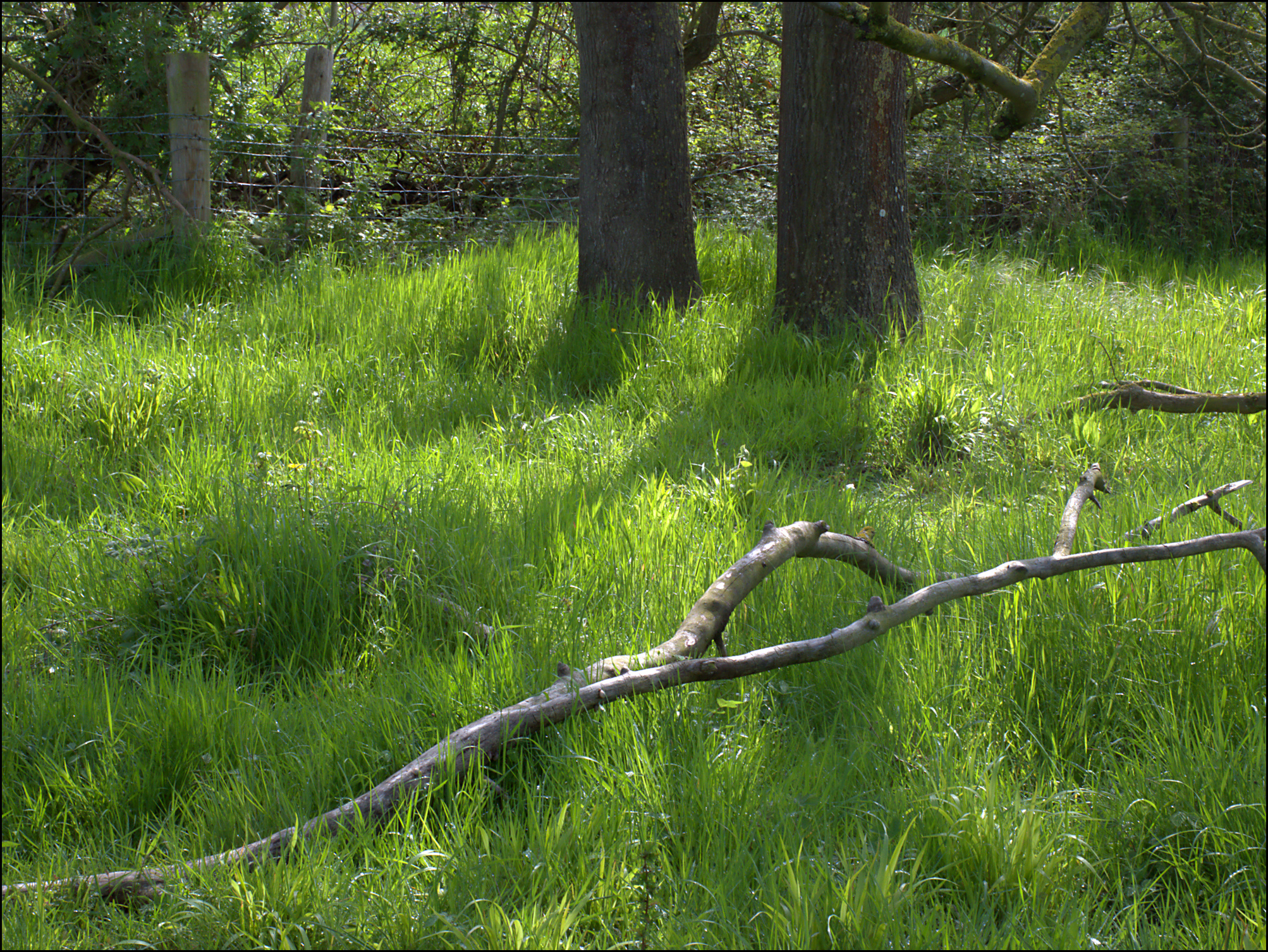
Around the year 1100 AD King Henry I took a liking to a piece of the Essex countryside and declared it a Royal Hunting Forest. That kind of Forest (with a big F) is simply an area of land set aside for hunting; it doesn't necessarily imply anything about there being trees there, though in this case at least part of the area was probably wooded. Fallow Deer were imported around this time to improve the hunting, but we don't know whether Henry himself ever hunted here, though he surely would have consumed the venison.
Over the next few centuries Hatfield Forest developed into a true medieval forest. Such a forest was about as far from our modern concept of forestry as is possible. Whereas modern forests are monocultures of regimented rows of conifers, the medieval equivalent was a fully developed species-rich ecosystem.
Oliver Rackham, who was the leading authority on the development of English woodlands, wrote a whole book about Hatfield Forest as the area fascinated him so much.
As you wander around here today you can easily imagine how it looked several hundred years ago. Unlike modern forests there were open areas used for grazing in amongst the trees. And that is still the case today.
These are Red Poll cattle, a breed much favoured by conservationists. They are small beasts that do not churn up the wet land too much; they also don't bother the many walkers who pass by.
So just what was the medieval forest used for? Modern forestry produces only timber and wood-pulp, with increasing emphasis on recreational uses such as walking and off-road biking. Medieval forests were rather more productive.
We've already heard about venison and beef production within the forest, and pigs were also kept in some forests. Large areas were "coppiced" - that is the trees were cut off near to ground level, whereupon the stump grew a large number of upright poles which could be harvested every few years. Elsewhere some trees were left to grow large enough to provide timber for building houses, barns and ships.
The local people would also have foraged in the forest for edible fungi, birds and their eggs, nuts, berries and firewood. They also collected leaves which were fed to animals. Ownership and rights within the forest were extremely complex, so while the king had exclusive rights to the hunting, he didn't own the timber and different groups of people may have had rights to the grazing or foraging.
All this needed management and you can still see the Forest Lodge where the head forester would have lived.
We now know, through the detailed work of scientists, that such a system of forest management was sustainable - good for wildlife, economically viable and suited the population of the time. Was the system arrived at by accident? After all none of those who developed the system were scientists.
I can only draw parallels with mothers who bring up their children satisfactorily despite not having a degree in child psychology - or gardeners who instinctively seem to understand what needs doing to grow prize-winning vegetables without being able to explain how their methods work - or even market traders who know exactly how to sell you their wares without studying advertising or marketing.
It's all based on lifelong experience, knowledge passed down from previous generations and pure gut instinct; all of which are acquired by living closer to the land than we do today, though we can glimpse what we've lost as we wander around absorbing the beauty and realities of the countryside.

To the north of the present-day forest is a pleasant footpath which was, between 1869 and 1972, the course of the Bishops Stortford-Dunmow-Braintree railway. If I hadn't told you it could easily pass for a picture of the forest, couldn't it?
And we'll finish up with a picture of a horse. He's nothing to do with the forest at all, but is here because I have a cousin who reads this blog and who's very fond of horses. My brother and I think of her whenever we spot a horse on our walks.
Take care.