Wednesday, 17 April 2019

Four Churches Walk - Part One (St Peter)

As you travel north on the train from Cambridge the landscape, to most people's eyes anyway, is dead flat. A true Fenman would be able to point out minor dips and rises, he'd also notice that as you go north the colour of the bare fields changes from black to light brown and he'd know the significance of that shift of colour. The black soil is peat, formed by decomposing plant matter, whereas further north the soil is silt brought down by the rivers and washed back in by high tides. And that has made all the difference.


The land up here in the Marshland was drained long before the peat fens, even the Romans had a go at it, and it proved to be very rich fertile agricultural land. It still flooded fairly frequently but by the Medieval period the agricultural economy was thriving. And a thriving economy at that time usually means big, impressive churches. And so it is here, unlikely as it seems in these wide acres dominated by modern agriculture and drainage schemes.


I was on a walk to discover four churches in four neighbouring villages: Wiggenhall St Mary Magdalen, Wiggenhall St Mary The Virgin, Wiggenhall St Germans and first off Wiggenhall St Peter. There's much to see so I'll give them a post apiece.


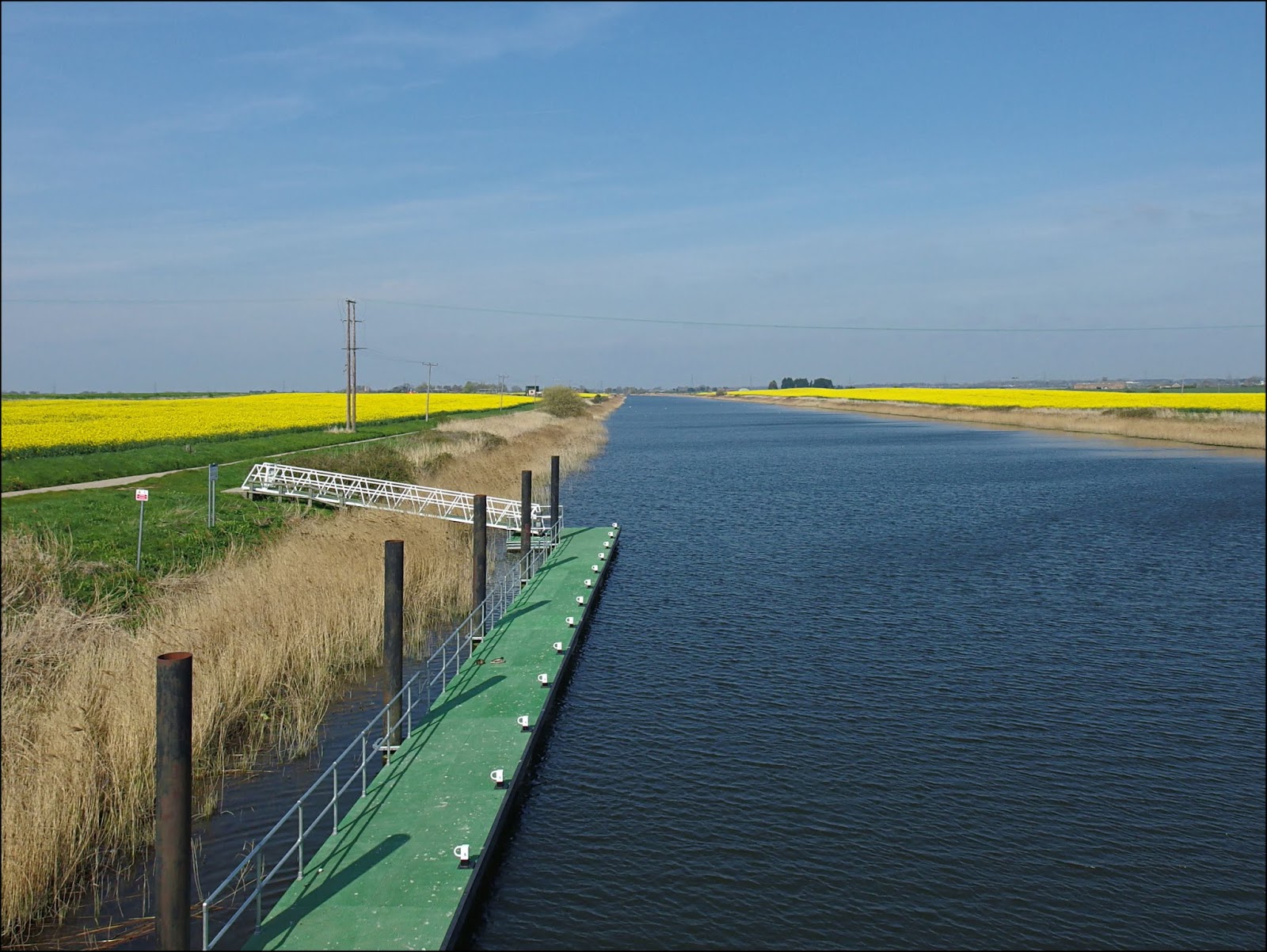
I walked along the high flood-bank along the River Great Ouse, overlooking the gaudy fields of oil-seed rape (canola) and could see the tower of St Peter's long before I arrived.


As you'll see the church of St Peter is now a ruin. It's a wonder that there are not more ruinous churches around here. The small scattered population of this rural area has a greater concentration of large medieval churches than anywhere else I know. And Wiggenhall St Peter has just a handful of houses.


While it is sad to see churches that have fallen into disrepair, it's also exciting - from a photographic point of view - to find "ruined church" marked on the map. Usually though this excitement is short lived as you normally arrive to find the remains vandalised, overgrown with nettles and fenced off from prying visitors. But not here.


Apart from some mesh panels erected to prevent you being brained by falling masonry from the tower arch, this is a ruin just as you might dream of it - accessible, unspoiled and full of interest and with just enough encroaching ivy to soften the lines of the red brick walls.


You can still make out most of the features you'd expect to find in a small rural church and there are even small carved faces looking down on you.


I could have spent a long time poking around here - in fact, I did spend a long time here! And ended up with more photographs than I can show you here.


Those columns revealed in the brickwork look as though this south wall was once an arcade with an aisle on this side. And, without the distraction of any glass in the windows, the stone tracery looks magnificent.


Rather reluctantly I turned to leave as there were three other churches to visit which were not ruins, though one of them is no longer used by a congregation. They promised to be even more interesting. There was only one disappointment and that was that I could find no trace of the pub that, a century ago, stood nearby; not because I was thinking about beer at this early hour of the morning, but because it used to be called "The Struggling Monkey" - a rare beast indeed among the many Red Lions, White Horses and Black Bulls that lend their names to so many English pubs


Take care.


Sunday, 14 April 2019

April Flower, April Tree

As you may have noticed there's no thought out plan to which flower and tree I choose each month from my wanderings in the Botanic Garden. It's just a question of what happens to catch my eye at the time. So April's flower is one that's normally associated with the earlier part of the year, while the tree is one that I'd happily photograph at any season, though the fresh, bright green leaves of Spring give it a special appeal.

Hellebore - helleborus


The Hellebores have been flowering since early in the year and have now developed their seed pods, but they are no less attractive for that. Despite having the common name of Lenten Rose they are not closely related to roses at all, but are part of the same family as Buttercups.


There are twenty or so species of Hellebore and gardeners have created many more hybrids. They are all poisonous causing a wide variety of distressing symptoms. However the ancient Greeks and Romans convinced themselves that it would cure madness. Witches are also supposed to have used it to summon up demons. Best to leave it well alone.


I
t must be one of a very limited number of flowers that have won a military victory. This is supposed to have occurred during the siege of Kirrha in 585 BC; the besieging troops used it to poison the defenders water supply and gave them diarrhoea, rendering them so weak that they couldn't fight.


There are several kinds in the garden including the Corsican Hellebore, above.


And here is the rather unattractively named Stinking Hellebore. It's a rather unfair description because it doesn't stink at all until you crush the leaves. The one photographed is probably a garden variety as it has more purple colouration than those that naturally occur in the British countryside. They were once used as a rather hazardous cure for intestinal worms; as Gilbert White wrote,  "Where it killed not the patient, it would certainly kill the worms; but the worst of it is, it will sometimes kill both". 

Lets move on to something less deadly....


Dawn Redwood - Metasequoia glyptostroboides


A shapely silhouette; bright green foliage in Spring; rough reddish bark; and developing a striking foxy-red hue in Autumn - it's one of my favourite trees in the garden. And one with a fascinating history.


Until 1941 this tree was unknown to science: then it was discovered twice within a year. Firstly, Dr. Shigeru Miki, from Kyoto University, was studying very ancient fossil samples and discovered a hitherto unknown species which he named Metasequoia, which merely means "like a sequoia". Meanwhile, over in a remote part of China, a forester known as T Kan, from Beijing University, discovered a stand of living trees which he could not identify. It took till 1946 before it was established that they were both the same species.


Seed was sent to Cambridge from Beijing and led to the first Dawn Redwoods to grow in Britain. They were planted by the lake as the Chinese trees had been found growing by water (though they also planted one in a rather obscure nook between the glasshouses and the toilets!). It was later found that the trees also flourished in much less specialised habitats.


As has already been suggested, the Dawn Redwood is a deciduous tree, unlike the Giant Redwood which is evergreen. It's closest relative is probably the Swamp Cypress. The University has taken the opportunity to plant the two similar-looking trees in close proximity so you can easily compare the two.


The Dawn Redwood is the larger tree in the centre of the photo, while the Swamp Cypress is on the right of it with its feet in the water.


Take care.


Thursday, 11 April 2019

April's Garden

Spring got off to an early start this year but then some colder-than-average weather slowed everything down. But today I took advantage of a bright sunny day to take a walk around the Botanic Garden in Cambridge. Schools are on Easter holidays so I sought out one of the quiet parts of the garden.


Most visitors follow the gravel paths around the garden but few realise that there's a mown strip that leads among the trees on the eastern side of the garden. 


It's known as "The Fairway" and it would not look out of place at Augusta - emerald grass and beautiful trees but without the irritation of a small white ball!


At this time of year the "rough" at the side of this Fairway is dappled with the yellow of cowslips.


It's the best place in the garden to see trees bursting into leaf. Some are in full leaf while others are just beginning to push out tiny buds.


Others are heavy with blossom.


There are also occasional glimpses between the trees of other parts of the garden, above is part of the Winter Garden that we saw in January.


And that's the little shelter in the Scented Garden where we wandered in March. It's taking shape nicely after the work that was being done back then.


A pair of crows were strutting about in that proprietorial way which they have perfected. Jays and Magpies were also laying claim to perches in the branches.


Just enough sunlight is filtering through the new foliage to light up the fresh growth at ground level.


Well, I hope you've enjoyed our little hack along the Fairway. I'll leave you with a little portrait of the one of the faces of Spring.....


Take care.


Monday, 8 April 2019

Three Doors Ancient, Three Doors Dinky

A post about doors - you could say "a doorpost"!

First of all some rather ancient doors I've found on my travels. And some are rather ancient pictures too, so I hope I've got their locations right.

The door on the oldest house in Hertford, "The Old Verger's House".
The house dates from 1450, though the door must be newer.

I'm reasonably certain this one was in Histon, near Cambridge.
You can't buy a door like that these days!

And our final ancient entrance was photographed in Newport, Essex.


Now on to the second selection of doors. These have started to spring up in Cambridge in the last few months. I noticed the first one as I crossed Parker's Piece, the park in the centre of Cambridge.


It's hard to spot, but it's in the base of that famous lamppost known as Reality Checkpoint. Some time in 1973 it was painted in psychedelic colours by some students. It's not so gaudy these days but the name has survived and it's even marked on some maps and has its own Wikipedia page. And now it has a little door where the person in charge of checking reality presumably resides.


Here it is, though there's a note to say that the reality checker is on holiday at the moment. Anyone reading the news would have guessed as much! Then near the Market Square I found this....


Squeezed between two telephone boxes are more dinky doors, this time on a Teleport-O-Matic machine. A portal onto another reality perhaps. But there's more....


This one may look familiar but it's actually Number 10¼, not Number Ten. And where in Cambridge would you find this miniature seat of power??


Obviously. 

You can read all about these Dinky Doors and others online too.


Take care.


Thursday, 4 April 2019

Right In The Middle Of The Road

Now where could we go in Cambridge to see pictures relating the history and scenery of the city? The University Library? The Museum? Art galleries?


How about the Elizabeth Way traffic island? The traffic here veers in a wild vortex making its way between Newmarket Road (which leads east), East Road (which doesn't) and of course Elizabeth Way itself. You'd be a fool to try to cross the road here, so you're directed underground.


There's a little oasis of tranquility down here, albeit one with traffic whizzing round overhead. There are a few trees and even a garden of sorts.


And what few graffiti there are have a bit more class and artistic merit than some you'll see.


But these are not the pictures we've come to see; they are in the narrow tunnels that burrow under the roads to meet in this central space. And here they are....


This one celebrates Stourbridge Fair that was held just outside the old city and was once the largest trading fair in the country and probably in Western Europe. Because of the length of these murals and the narrow passages in which they are situated it's impossible to view them all in one go - let alone photograph them. I did think I'd join several images but even that was difficult so I'll just present you with a few selections.


Another interpretation of a medieval fair.


And more details from the fair.

Punts on the river, as seen from a bridge.

Cows in the riverside meadows.

Romans in Cambridge.

This seems to be about the hustle and bustle of city life, and modern inventions.

Finally a view of the densely-packed Victorian housing around Mill Road.


And that's where we'll leave it and make our way back up to street level.


Take care.