The annual Christmas Tree Festival took place last weekend at our village church. Trees were decorated by various clubs and organisations in the village, including the school where I work. Yours truly went along to take some photos.
As promised a few days ago here are two rather grand village churches, just a few miles apart in Suffolk. Superficially at least these two churches have certain similarities - both stand right in the heart of attractive villages, each has a spire and a grand porch, inside there are fine roofs and rood screens in both churches. And both villages, of course, have rather odd names! Lets look at them one at a time in the order that I visited. Rattlesden
Rattlesden nestles snugly in the steep little valley of the cutely-named River Rat. It's a place of beauty to which I feel I shall be returning some day. It's church stands on a little rise to the south of the river. In this part of Suffolk each church seems to have a different spire or tower, Rattlesden's is a neat but plain affair and is the result of rebuilding in the nineteenth century.
There's a pleasant, airy porch which seems to beckon you into the building.
In the bell-tower is a marvellous wrought-iron spiral staircase. The only way to get a photograph was to reach into the structure with the camera, point it upwards and hope for the best. I'm rather pleased with the result.
Turning from the tower into the body of the church you can see what a grand place it is. The chief glory is the wonderfully carved wooden rood screen, to the right of which can be seen the parclose screen which forms a little side chapel. The whole thing only dates from 1909-16 and was designed by George Halford Fellowes Prynne.
A rood screen should hold a representation of the crucifixion and this one has an especially fine one, quite beautifully carved.
It's by no means a strict replica of a medieval screen though the carving is based on a fragment of the original screen which survived. The whole structure is covered with fine carving.
As if this was not enough there is also a fine "angel roof", again a reconstruction as almost all such roofs are.
Woolpit
A couple of miles or so over the hill from Rattlesden stands Woolpit. It's one of those buildings that one can fall in love with straight away. The spire is an outrageous confection dating from 1850 and designed by Richard Phipson.
It has a porch which is even more ambitious than that at Rattlesden. In fact it almost looks too big for the building to which it is attached, almost forming a small tower.
Inside the church is every bit as grand as you might expect with large clerestory windows throwing light into the upper reaches of the nave and also lighting up the magnificent carved roof.
Now you understand why I didn't show you more photos of the roof at Rattlesden; I knew this one was still to come.
There are over one hundred angels as well as other figures and carving in this amazing roof. It was restored by Henry Ringham. Henry Ringham (1806-1866) was the son of a Lincolnshire farm worker. In 1822 he moved to Ipswich and taught himself to read and write, draw and carve wood. In 1844 there was a competition to find carvers skilled enough to work on the newly built Houses Of Parliament. The work of Henry and six others was exhibited in London and, though he did not work on the parliament building other commissions poured in.
The first of these was to restore the hammerbeam roof and carved bench ends at Woolpit. By the time of his death he had worked on 160 churches. His work was characterised by his refusal to replace even small fragments of older carving which were still serviceable.
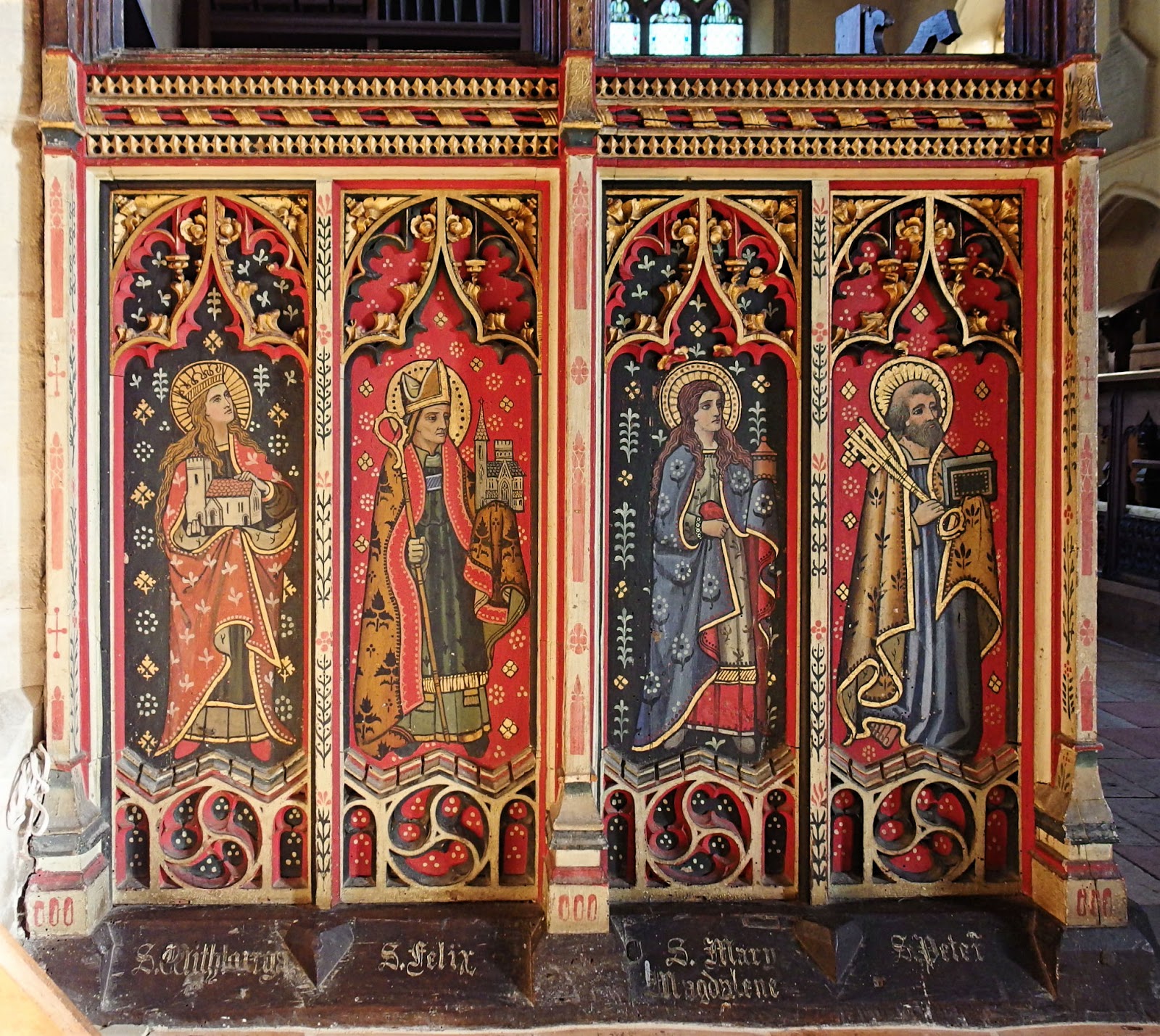
There's also an interesting rood screen at Woolpit; not as elaborate as that at Rattlesden but older, dating from at least 1750. As you can just about make out from the photo above it was once brightly painted.
The depiction of saints on the lower portion of the screen gives some idea of what once was.
Earlier I mentioned the bench-ends which were restored by Henry Ringham and there are just four examples above. These are on the ends of the pews and represent a menagerie of animals, both real and fanciful. Some of these are original fifteenth century work while others are exact copies made by Ringham. They are extremely picturesque and I'm sure that children love them but what on earth is their significance in a church?
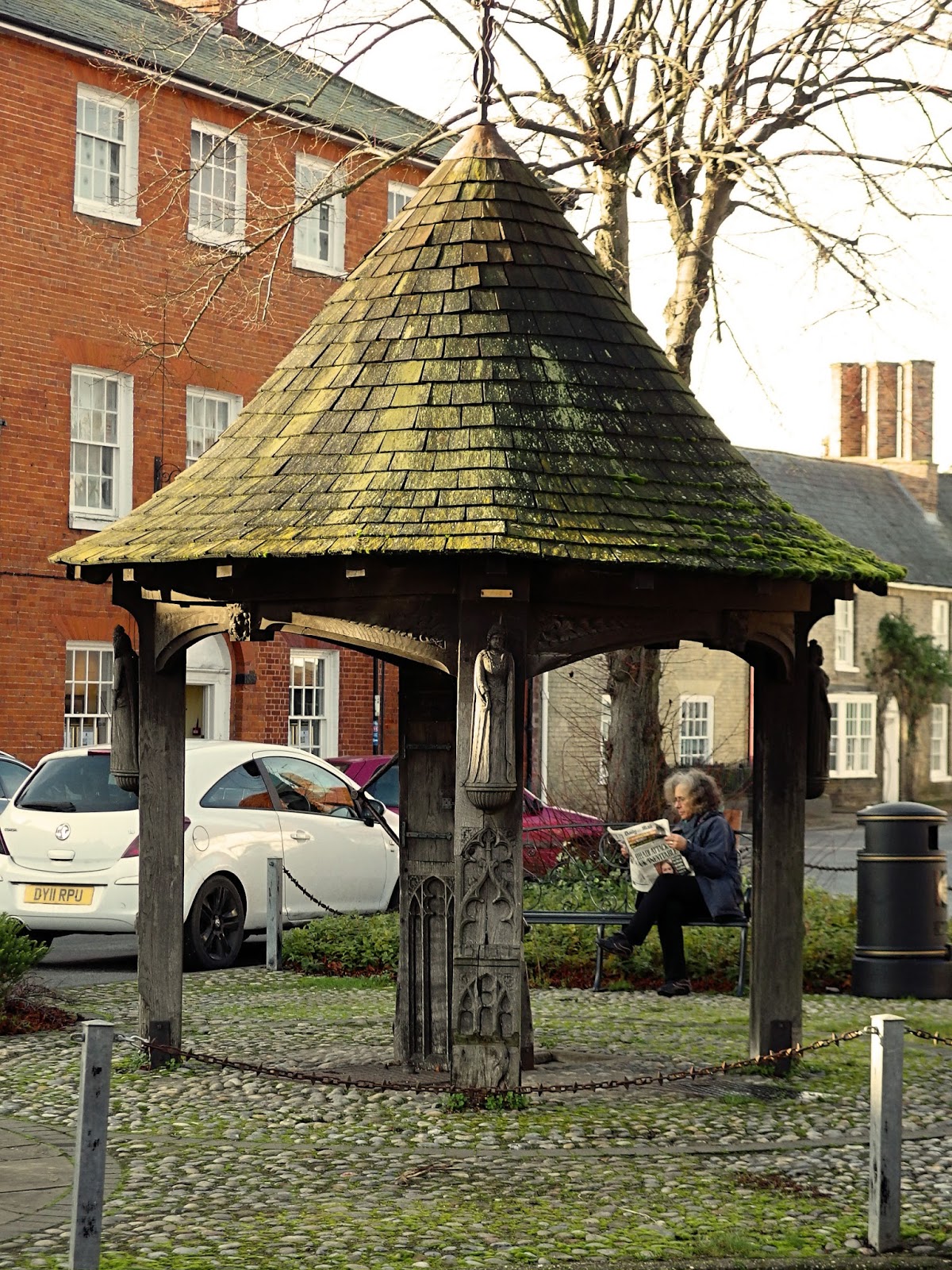
Not far from Stowmarket in Suffolk is the busy little village of Woolpit. Today we're going to have a quick look around the village and, as we do so, I'll tell you the tale about the Green Children of Woolpit.
But first you'll be wanting to know how the village got its peculiar name. Although wool was important hereabouts in the fifteenth century, the name pre-dates the wool trade. The usual explanation is that it comes from Wulf pytt meaning "wolf pit" and that it is the site of the trap where the last wolf in these parts was killed. A nice explanation though surely there would have had to be lots of wolf pits to exterminate the wolves which once roamed the land, but there's only one place in all England called Woolpit (or anything like it). The local history society in the village believes that it gets its name from Ulfketel, a famous local warrior and counsellor at the court of Ethelred the Unready in the tenth century.
Now, about those green children.... Back in the reign of King Stephen (1135-1154), or perhaps King Henry II (1154-1189), so the story goes, the men of Woolpit were busy gathering in the harvest when they came across two strange children, a boy and a girl. They wore odd-looking clothes, spoke an unintelligible language and, most remarkably, their skin was green.
The men tried to feed the children but they would eat nothing. The children were taken to the manor of Sir Richard de Calne who was equally baffled by these peculiar children. After several attempts to get them to eat, it was discovered that they would eat beans but nothing else.
The girl gradually became more healthy and began to eat other foods and slowly her green skin took on a more normal hue. The boy, on the other hand, became sick and died. In time the girl learned to speak English and told how she and her brother came from a land of constant twilight where everyone was of a green colour. One day the children were following their flocks when they came to a cavern which they entered. Inside there was the sound of bells which they followed until they came out into a blinding light. They were terrified but could not find their way back into the cavern and so they were caught by the reapers as they gathered their harvest.
The girl grew into a beautiful woman, "though rather loose and wanton in her conduct", and married a man from Kings Lynn. She went under the name of Agnes Barre and some say that her husband was an ambassador in the court of Henry II. There are also said to be people in Woolpit to this day who are her descendants, but nobody will admit who they are.
The tale turns up in the writings of Ralph of Coggeshall and William of Newburgh, who both wrote within a hundred years of these unlikely occurrences, so it seems the story was widespread. But could there be an element of truth in it?
The green skin colouration might be due to chlorosis, a form of anaemia which was quite common amongst undernourished and overworked children as recently as the nineteenth century. It certainly could affect someone who lived on a diet of nothing but beans. As their diet improved the colouration would have faded.
The strange language which the children spoke could mean that they were Flemish, as Flemish mercenaries were active in the area at that time, but equally it could just be a reflection of the wide variety of local dialects which flourished at that time.
Many people over the years have come up with all kinds of outlandish explanations for the story, involving the bells of Bury St Edmunds abbey, the flint mines at Grimes Graves, Thetford Forest, the Babes in the Wood story (which took place miles away in Norfolk) and more recently parallel universes and space travel. My own explanation is just that they were two poor children who were either lost or abandoned. Take your pick.... ....and take care!
Churches are sometimes like people. Even those that are not famous, handsome, wealthy or remarkable can be equally charming in their quiet, self-effacing way. Here are three that hide away modestly in the deep Suffolk countryside, much loved no doubt by those that know them, but doing little to advertise themselves to the wider public. Onehouse
Onehouse, as its name would suggest, is not a large settlement and its church lurks surreptitiously among trees on the edge of agricultural land. Externally it is rather pretty and timeless. Despite looking so inviting the door is firmly locked so I can't tell you what goes on in its heart. Lets move on. Harleston
A short way down the road, or along some rather wet field-paths if you travel with me, stands the church of St Augustine at Harleston. If anything it's even harder to find than Onehouse, even my detailed map doesn't mark it very clearly.
But here it is, a quaint little building with a neatly thatched roof standing amongst Scots pines. At first glance the door appears to be barred....
...but actually that's a handrail fixed to outside of the door, so that when the door opens inwards you can hold it to descend the few steps down into the church.
Inside everything is as rustic and simple as you would expect - and to my mind utterly enchanting. There's a nice little bit of wood carving in the chancel too.
Back outside again on this glorious morning the sun was streaming down through the pines and all seemed well with the world.
How sad then to come across this row of rusting iron grave markers....
They commemorate the brief lives of the five Armstrong children: Percy (14), Spencer (12), Beatrice (8), Nelson (6) and Frank (6 months) all of whom died within a few weeks of each other in 1891. According to an internet source the children died of diphtheria, but only mentions three graves. Another source mentions four. Now there are five; I suspect that the other crosses have been found recently, perhaps with metal detectors. Shelland
Another quiet retiring church reached by the narrowest of country lanes. It's in an exquisite location but seems rather a drab little building and one tries the door without any expectation of finding anything remarkable within.
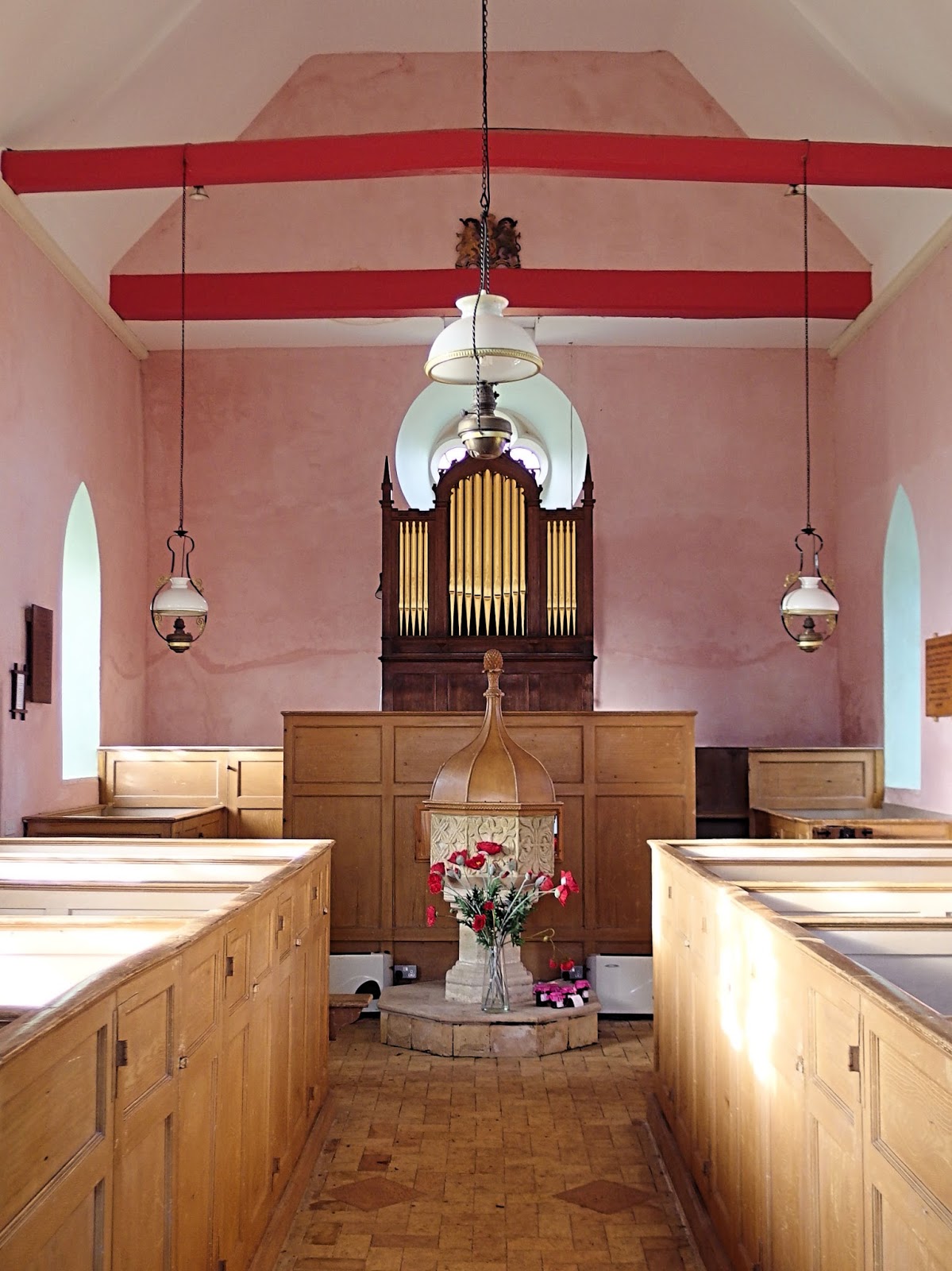
What a surprise then to find an elegant interior painted in pastel shades with matching light wood box-pews and pulpit. What we have here is decoration from the Georgian period which has somehow largely escaped the attention of Victorian restorers. I'm certain those staunch upholders of standards would not have approved of these bright red beams!
There's also a barrel-organ which apparently plays 36 different hymn tunes and is the only one in Suffolk - and there can't be many elsewhere. As if this little church wasn't eccentric and daring enough there is also its dedication, which is to King Charles the Martyr, bestowed upon it by its builder, the local landowner Thomas Cropley, in 1646 - a dangerous thing to do during the Civil War. Sometimes it's just as well to be hidden away in the Suffolk countryside!
I also visited two much grander churches on my little walking tour and I'll be showing you those in a few days, though next time I've a tale to tell you from one of the villages that I passed through.