History's random and ragged path has left us a heritage that's full of surprises. Sometimes things turn up in places where you might not expect them, and at other times things survive through chance happenings which we can no longer fully explain. We've just been on a garden visit (don't panic - you'll see those pictures next time) and on the way home we'll take a short diversion, passing wheatfields and outdoor piggeries, to a onetime market town that is nowadays just a big village.
St Peter's and St Paul's church at East Harling is clearly a first-rate parish church which stands in a large churchyard which these days is managed for nature. Hang on a minute....lets have a closer look at that tower....
Architecturally it's called a flèche, a small spire made of timber and lead, but you don't see many as ornate as this, with miniature flying buttresses. Anyone living here would feel they were home as soon as they saw such a singular feature appearing above the treetops.
Like most English villages there's been a church here since at least Saxon times, but most of what we see here today dates from the second half of the fifteenth century and was financed by one woman (albeit with some financial assistance from at least two of her three husbands).
That lady was Anne Harling who was born here in 1426. Like many wealthy families they took their surname from the village on which their lands were based. She was the only child and heiress of Sir Robert Harling and his wife, Lady Jane Gonville. When Anne was just nine years old her father died in France.
Unlike so many important men who are depicted in full armour on their tombs, Sir Robert was actually killed in battle. Anne thus inherited some 23 manors throughout East Anglia. She was so wealthy that there was some dispute about who would become her guardian. Strangely enough it was someone you might have heard of - Sir John Fastolf, on whom Shakespeare based (very loosely) the character of Sir John Falstaff. Fastolf carried out the major part of his responsibility by marrying Anne to a wealthy man when she was just twelve.
Once she became an adult she began improving the church, rebuilding the aisles, erecting the fancy spirelet and battlements which we saw on the tower, and beautifying the interior. The wooden screen, which you can see in the above photo, was designed to enclose that corner of the building to serve as a chantry chapel for the tomb of her parents.
As you can see it's quite an elaborate structure which has survived the centuries well. It's worth closer inspection...
It must have been quite something when freshly painted. It also now encloses some later tombs, most notably that of Sir Thomas and Lady Alice Lovell....
This is a sixteenth-century memorial, very much in the pompous style of that era. They certainly didn't want the people of East Harling to ever forget them!
A handsome couple were they not?
Anne Harling, who did so much for this church, lies in the tomb shown above, with her first husband. There's much to see here, but I'll just show you a few more before we get on to the most important feature.
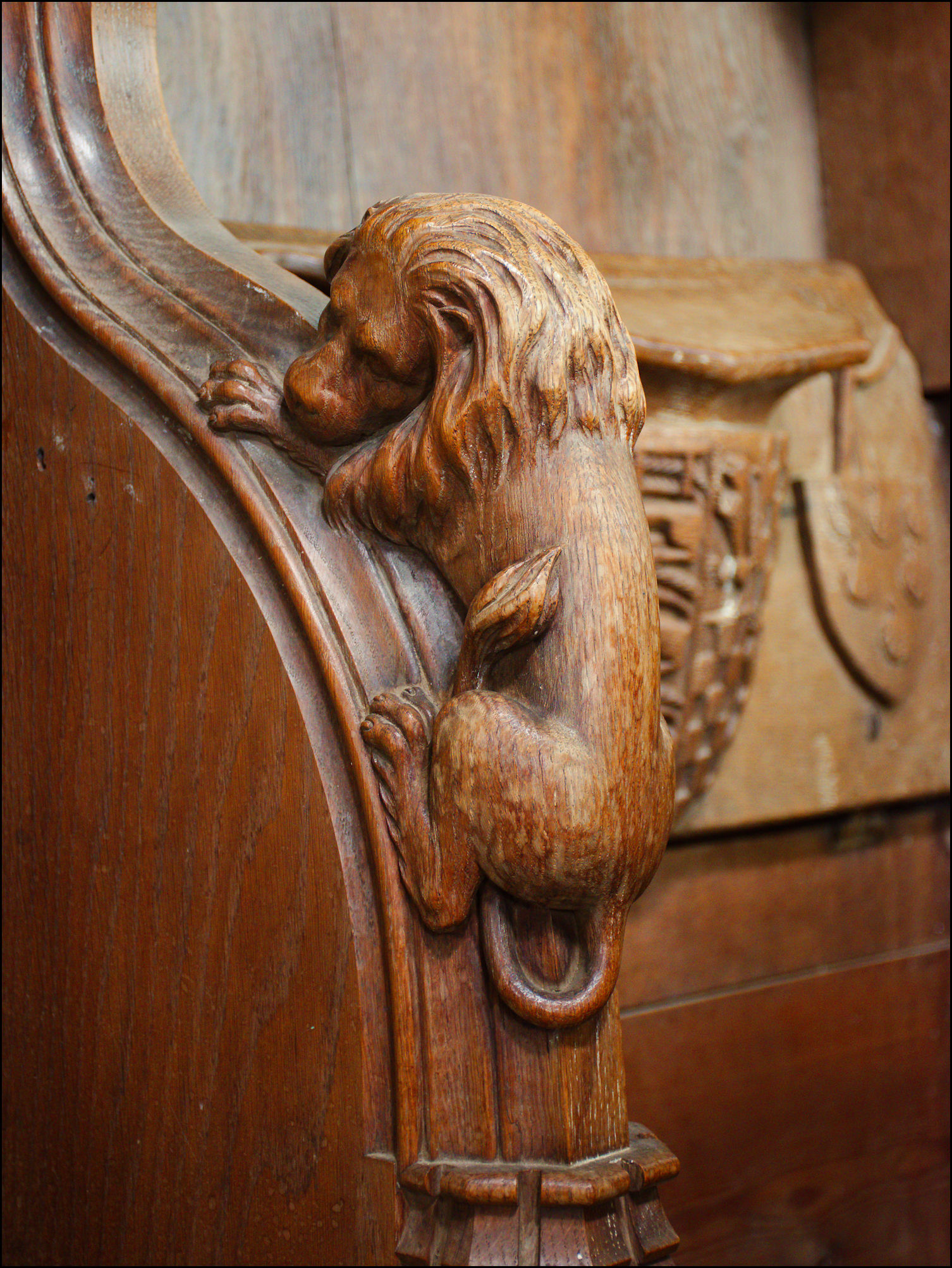
I really liked the lion armrest on these seats. They also have "misericords" or "mercy seats"; we've seen these elsewhere and, you may remember, besides folding down to serve as normal seats they also provide a perch for those who were supposed to stand through long sermons. They are recorded by British Listed Buildings as being from the fifteenth century, but they must surely have been extensively repaired more recently; the carving is altogether much too crisp and the lion far too realistic to date from earlier times.
There's a splendid hammerbeam roof in the nave which receives little attention in any of the literature; probably because it's so gloomy up there that it's very difficult to see. It's only when I brightened up that part of the photo on the computer that the details swam into view!
What we mostly came to see is that large East Window. You'll notice that there's a woman doing some cleaning and a red plastic bucket on the altar. They were getting ready for a "church tea-party" at the weekend. If we want to fully appreciate the window we'll need to look through a telephoto lens....
These windows were also paid for by Anne Harling, which means that they are from the fifteenth century and have survived the attentions of those vandalistic puritans, who destroyed so much elsewhere.
Nativity
We know how these windows were saved, but we don't know exactly when or why. At some time they were removed to the hall, presumably when it became clear that they'd be destroyed if left where they were, but was the intention to beautify the hall or to return them once safe to do so?
Adoration of the Shepherds (detail)
When they were returned they were put back in the wrong place. They were originally intended for the side chapels, where it would be much easier to see the individual panels than high up in the East window, where they are now.
The windows were moved once again during WWII to prevent possible bomb damage.
Assumption
There are many more scenes from the life of Christ than I've shown you here. You can find them all on the exhaustive
Norfolk Churches website, one of several places I regularly consult before visiting any churches in that county.
Robert Wingfield:
second husband of Anne Harling
Ann's first two husbands are also represented in recognition of the donations which they made to her grand project. It's also known that there was once a panel to Anne herself, pictured kneeling at her prayer desk. But it was presumably badly damaged at some time and is no longer in existence.
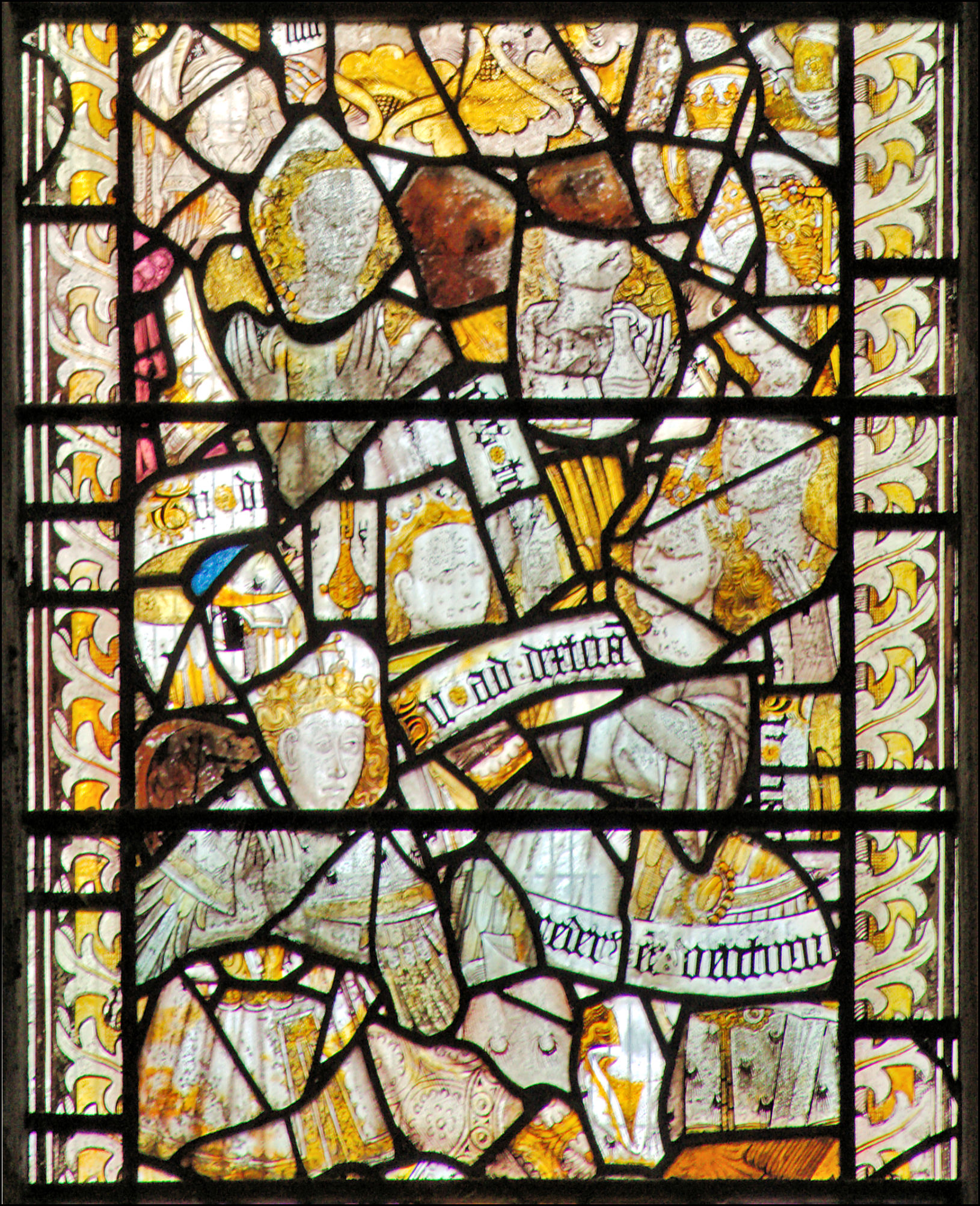
fragments
Who knows, maybe parts of Anne's window are incorporated into this panel of rescued fragments. I must admit I rather like the mysterious abstract quality of these jumbled pieces.
Back out into the sunshine once again with a view across the churchyard wall to the Grade II listed Eastfield House, which dates from the 1840s - yours for £1,619,000 according to the latest valuation.
Take care.