Thursday, 16 February 2023

An Anchor In The Fens

In order to locate this Anchor you need to head towards the village of Sutton-In-The-Isle, then turn off a street with the unlikely name of The America and trundle down Bury Lane. Here you will find The Anchor, a traditional pub which nowadays, I believe, also operates as a cafe and guesthouse. Last time I passed this way the place had closed down, but it appears to have been rescued.


The building dates from the seventeenth century, when it was constructed to house workers who were digging the New Bedford River, which was part of the scheme to drain the Fens. We can set off on our walk southwards along the top of the flood bank that those men built, alongside the river.


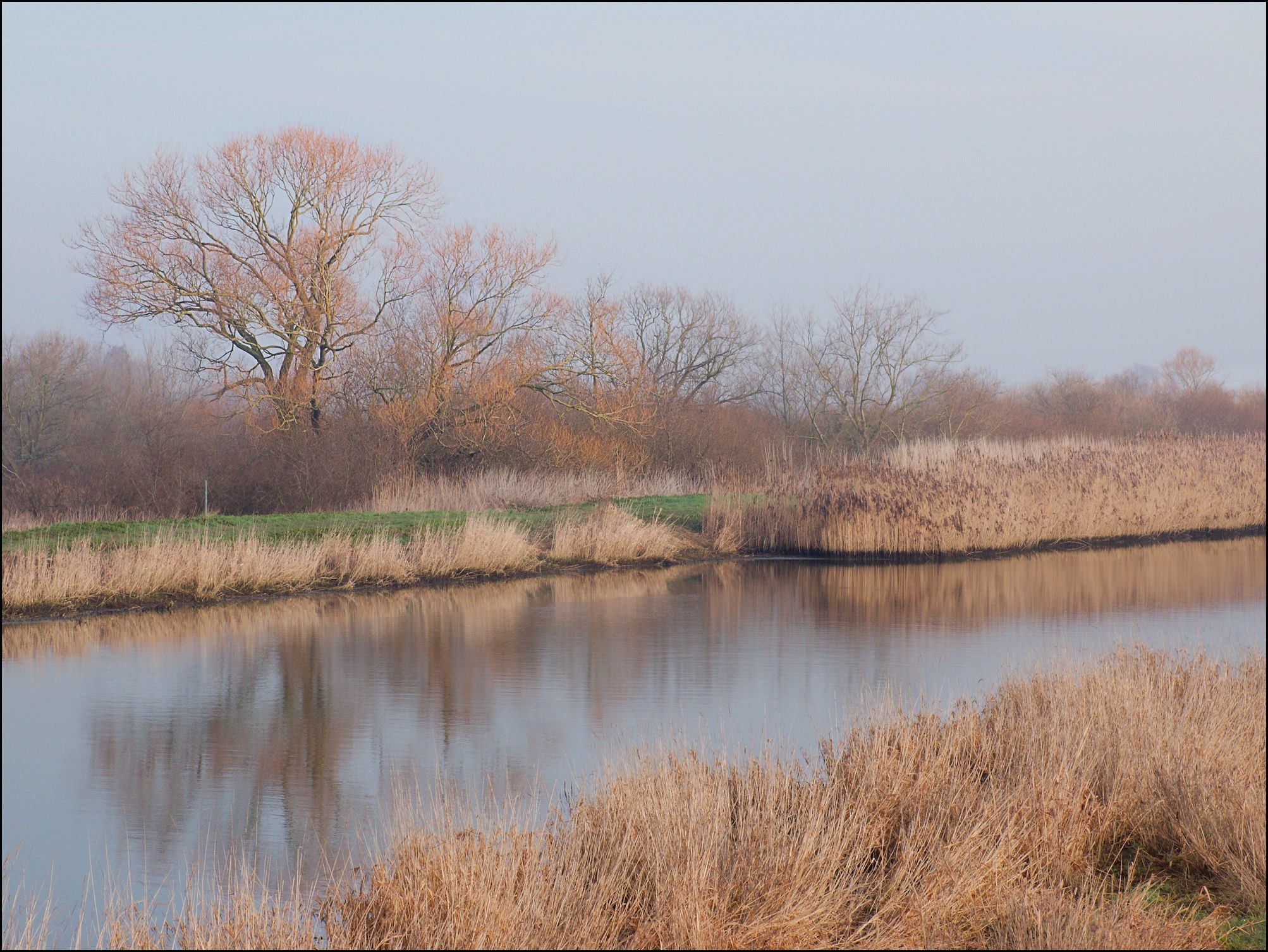
Over most of its length this man-made river follows a ruler-straight line, but here it's forced to curve around the slightly higher land which is the most westerly edge of the Isle Of Ely. The lands over the other side of the waterway are the Ouse Washes, a large area which is allowed to flood in times of high rainfall. The road beyond The Anchor is often under water in winter.


The depth of the floodwaters on the Washes varies from place to place and at the moment the "Goldilocks" area, where the birds agree that everything is "just perfect", is right here. The birds were mostly too distant for the camera, however the 'scope revealed a few hundred Black-Tailed Godwits and Wigeon, as well as half-a-dozen Great White Egrets, one of which is just visible in the photo above.


Over on the arable fields on our left there was a large flock of Whooper Swans (only part of which is shown here). Sorry about the rather misty picture but that's how conditions were, though I hope it gives you some idea of the Fens in winter. Have pity on the poor bird-watcher who has to scan through the entire flock, trying to find the rarer Bewick's Swans, which are only slightly smaller and have less yellow on their beaks. There weren't any! 


Above is a fine example of a Fenland footbridge - no wonder that in times past the fenmen used to prefer to vault across the drains and ditches on long poles!


We'll now wander back to where our car's parked, near The Anchor, have a cup of hot chocolate, then walk northwards along the floodbank.


As long as it's not too muddy, which it wasn't, the floodbank makes for excellent walking - dead flat, no need for a map and raised up enough to see over the surrounding countryside. And plenty of excuses to stop to look for birds - whether they're there or not!


A long, narrow pit beneath the floodbank is used for fishing and the "scarecrow" you can see is, I imagine, an attempt to keep Herons from stealing the fish. The fishing platforms look to me to be both unnecessary and unsafe.


The Washes here appeared to us to be exactly the same as those we'd seen earlier, but not to the birds, who shunned these soggy meadows as being distinctly inferior.
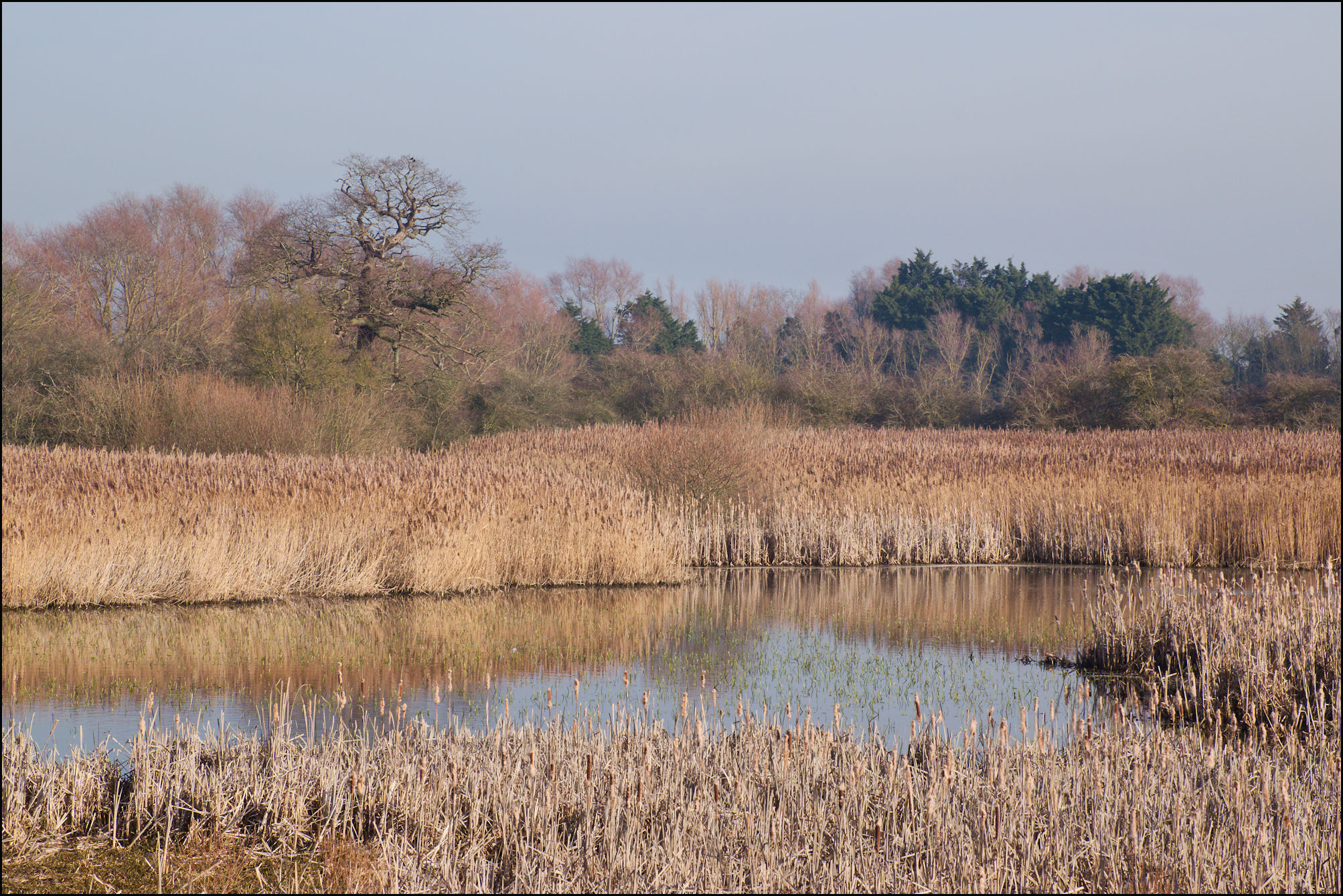


The path brought us to Mepal Gault Hole (they have such a poetic turn of phrase in the fens) where the local clay (or gault) was dug for making bricks and perhaps for re-enforcing the floodbanks. It can also be good for birds and Les spotted an overwintering Chiffchaff, which vanished before I could find it, probably because a Marsh Harrier appeared overhead.


We carried on as far as Mepal before turning back.


Another view of the reeds at the Gault Hole. I just can't resist photographing reeds in winter.

A quick roll-call of "poetic" place-names in the vicinity of Sutton Gault: Tubb's Drove, The Gullet, Between Ditches Drove, Foulmire Fen, Cradge Bank, Hundred Foot Drain and Grunty Fen. Only relieved by Jolly Bankers Bridge, the "bankers" in this case being the hard-working labourers who built the floodbank, not the posh boys from the City of London.


Someone asked recently whether I carried the big tripods and telescopes so adored by proper birdwatchers. The answer is no, just binoculars, and the small 'scope and cheap monopod that Les is using above. I think he'd just found a Grey Wagtail.


And here we are, as if by magic, back at The Anchor. No, we didn't go in as it showed no sign of being open and, besides, we still had some of that hot chocolate left in the flask.

Take care.


Saturday, 11 February 2023

Beside The River Cam

There are two maps which overlie the countryside. One is a road map and the other a chart of the footpaths, bridleways and tracks which we take when we are walking. Occasionally these two impressions of the landscape meet up unexpectedly. It's always a great surprise when a feature like a ruined church, which I've only known as a place reached by muddy field paths, appears on the horizon from a main road. And it's equally discombobulating when an ancient walking track suddenly deposits you right beside a much-travelled highway.


How many motorists and lorry-drivers know what lies beyond the litter-strewn embankments that confine the busy M11 motorway near Cambridge? Not even people who have spent a large part of their lives in the area it turns out, as my brother and I discovered recently.


It begins like this. Long ago there was a small piece of woodland that flanked Byron's Pool, a well-known beauty-spot on the River Cam. It was here that we came as boys to ride bikes, walk and fish. We'd often sat at the very point where the above picture was taken and wished that we could explore further, but there was a fence which made it clear that we weren't welcome.


We did manage to outflank the landowners eventually by the simple expedient of getting our punt up above the weir and to "boldly punt where no punter had punted before"!


What has changed since our pioneering expedition is that a housing company wanted to develop a piece of land nearby and erect some houses and apartments. In order to ease their way through the planning rules and the expected local opposition, they agreed to also transform the area between the projected new development and Byron's Pool into a nature reserve to be known as Trumpington Meadows. Mostly it's meadowland which has been sown with wild flower seeds. 


But beyond the motorway it also takes in a strip of rougher land alongside the river and it was this part which came as a pleasant surprise to us - an area of countryside which we had never imagined was there. It took a while to figure out exactly where we were.


This long, narrow pond, a notice informed us, was a trench left from the digging of "coprolites". These phosphatic nodules were thought to be dinosaur dung and were exploited for their mineral content; ground-up they made excellent fertilizer. Within a few decades the value of coprolites fell, as guano (sea-bird droppings) began to be imported from tropical islands. The notice had a helpful illustration to help you imagine the once-industrious scene....


It also went on to explain that this trench was not part of the original "coprolite rush", but a revival in the trade when the Great War disrupted supplies of guano. However before the project got into full swing the war ended and the trench was abandoned.


Part of the work of transforming agricultural land into a nature reserve involved the planting of many native trees, including hazel and alder.


And, of course, it's almost compulsory these days to have carvings of the wildlife that you might or might not see when you visit. I'm all for promoting any artistic endeavours (with just one or two exceptions) but I admit that there are times when I curse these sculptures for getting in the way of my photos! I think these are (clockwise from top-left) Skylark, Brown Trout, unidentified birds feeding on berries, and Otter.


There's a pond too to attract more wildlife. We were surprised to see a Stonechat here perching among the reeds. And this fellow was on duty as well...


A Black-Headed Gull - one of those hopeless names which doesn't tell you that in winter the head is mostly white and even in summer it's not really black but chocolate-brown. I hope he was OK; it made no attempt to fly as I approached with my camera, though I wasn't as close as the photo makes it look.


We hadn't really expected much from this outing - the picture above is how I remember much of our punt trip some fifty years ago! But it really provided a pleasant walk and, despite the noise of the motorway, it felt as though we were in an entirely different world.


And who can resist when the low winter sun lights up the first colourful signs of spring growth?


Take care.


Wednesday, 8 February 2023

A Camera At The Coast

As we travelled up to the north Norfolk coast I was considering how I might take photographs that were a little different from my normal approach. What I had in mind was a more "documentary" style, showing you what it was like to visit the RSPB's flagship bird reserve at Titchwell Marsh. It all started very well....

A good start


....I overcame my usual reluctance to take such pictures to show you inside the visitor centre shop where you can buy books about birds, gifts featuring birds, food for birds, equipment for watching birds.....you get the idea. They'll also tell you of any particular birds you should watch out for.


Then you proceed along the footpath past reedbeds, marshes and lagoons which are normally teeming with birdlife. Big problem: but not today. The lagoons were comparatively deserted and as a result so were the hides. I've no idea where the birds were this morning, but, as an old-timer birdwatcher once remarked to me, "They got wings - they can go where they like! Tha's your job to find 'em!"


Lets walk along the beach


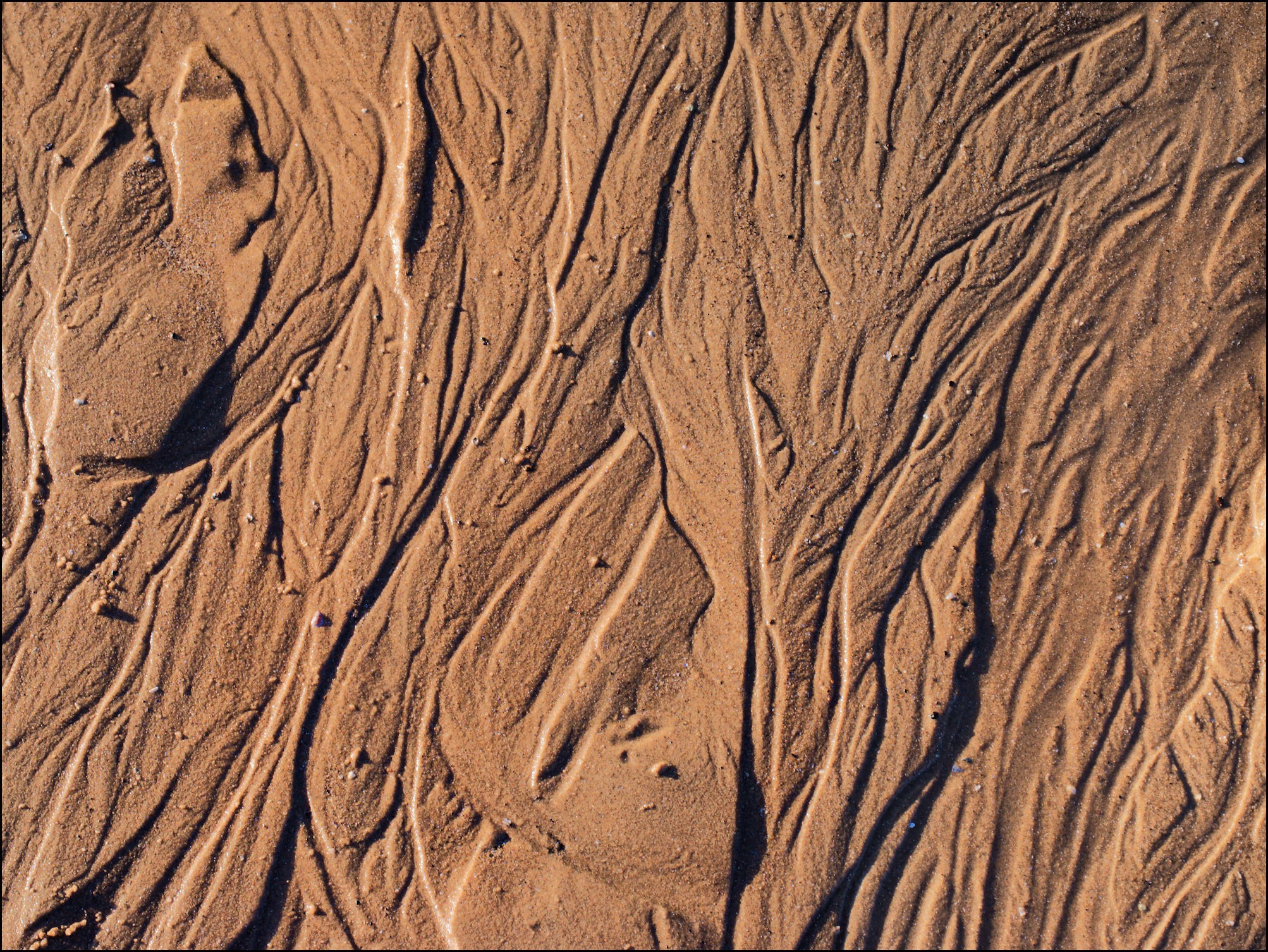
There were some birds down at the sea's edge and one particularly enthusiastic soul was commando-crawling across the wet sand carrying a camera with a howitzer of a lens attached - but that man certainly wasn't me! I preferred to amuse myself with the patterns in the sand.


I can't help it; I love these wide open spaces.


That's the clubhouse of Royal West Norfolk Golf Club up ahead, a real seaside "links" course which gets cut off at high tide. 


Unusually, the tide seemed to have washed in something looking like coal-dust which made some strange patterns on the beach.


I'm always mesmerised by the alternating sandbars and inlets that stretch away towards the horizon along this bit of coastline. But we're heading up alongside a small stream that's making its way out to sea.


"Seal Creek"


I don't think Seal Creek is its proper name - it doesn't even have a name on
 my maps - but regular visitors to Titchwell will know where I mean. There are nearly always a few seals hauled up on the sand, just taking it easy. There's a sign to prevent you going too close, but that doesn't matter, the seals will come to see you.


What a privilege it always is to see these wonderful creatures.


Back to Titchwell

By the time we'd walked back along the beach there were definitely some birds at Titchwell and, judging by the cacophony they were creating, they were geese.


These small, dark geese are Brent Geese. They are not much bigger than the familiar Mallard and are only seen around these shores in winter.


While I was happily snapping away at these welcome visitors I glimpsed a small flock of dazzling white birds flying overhead. I quickly raised my camera and took a single picture.


It wasn't till I got home and looked at the pictures on the computer that I realised that we'd seen some Avocets, the only ones we'd seen all day.


Whatever had spooked the Avocets also put up the geese.


Where next?

I know, lets go to Hunstanton cliffs and see the Fulmars. Surely they will be there.


Fulmars hang around these cliffs nearly all year, nesting here during spring and summer. 


The low, late-afternoon sun was throwing beautiful golden light on the patterns in the sand.


It had been a great day, if rather different from what I'd expected. Then, safely back home and having sorted through these photographs during the evening, I glanced out of the kitchen window...


Take care.


Tuesday, 7 February 2023

One Morning In February


If you're passing along the minor road towards the hamlet of Frog End on an early spring morning, and you happen to spy a bike leaning against a tree, right beside a gate where a footpath leads through a tiny wood, you can be sure that it's reached that time of year once again. A time when an aging man from a neighbouring village pedals laboriously this way to take a few photos to try to lift hearts and perhaps raise a little tide of jealousy among a handful of people scattered across some of the world's less temperate climes. Yes, it's snowdrop time in Southern England!


Take care.


Friday, 3 February 2023

Six At Daybreak

We had a beautiful dawn earlier this week and I went out on a short village walk to enjoy the spectacle, take some photos and share them with you. I was hoping that our local geese might overfly the recreation ground as they do most mornings, but that was not to be.


That seems a rather short post. Lets find some music....

....so....

....from February to April, and from the dawning of the day to perhaps the dawning of a musical career. This popped up unexpectedly on YouTube the other day. If you click on the image below it will take you to the music on YouTube. That will allow you to click on the "thumbs up" icon below the video to let a young lady know that you like her music.


When this was recorded she was just ten years old. (As if you needed me to tell you, she won the competition).


Take care.