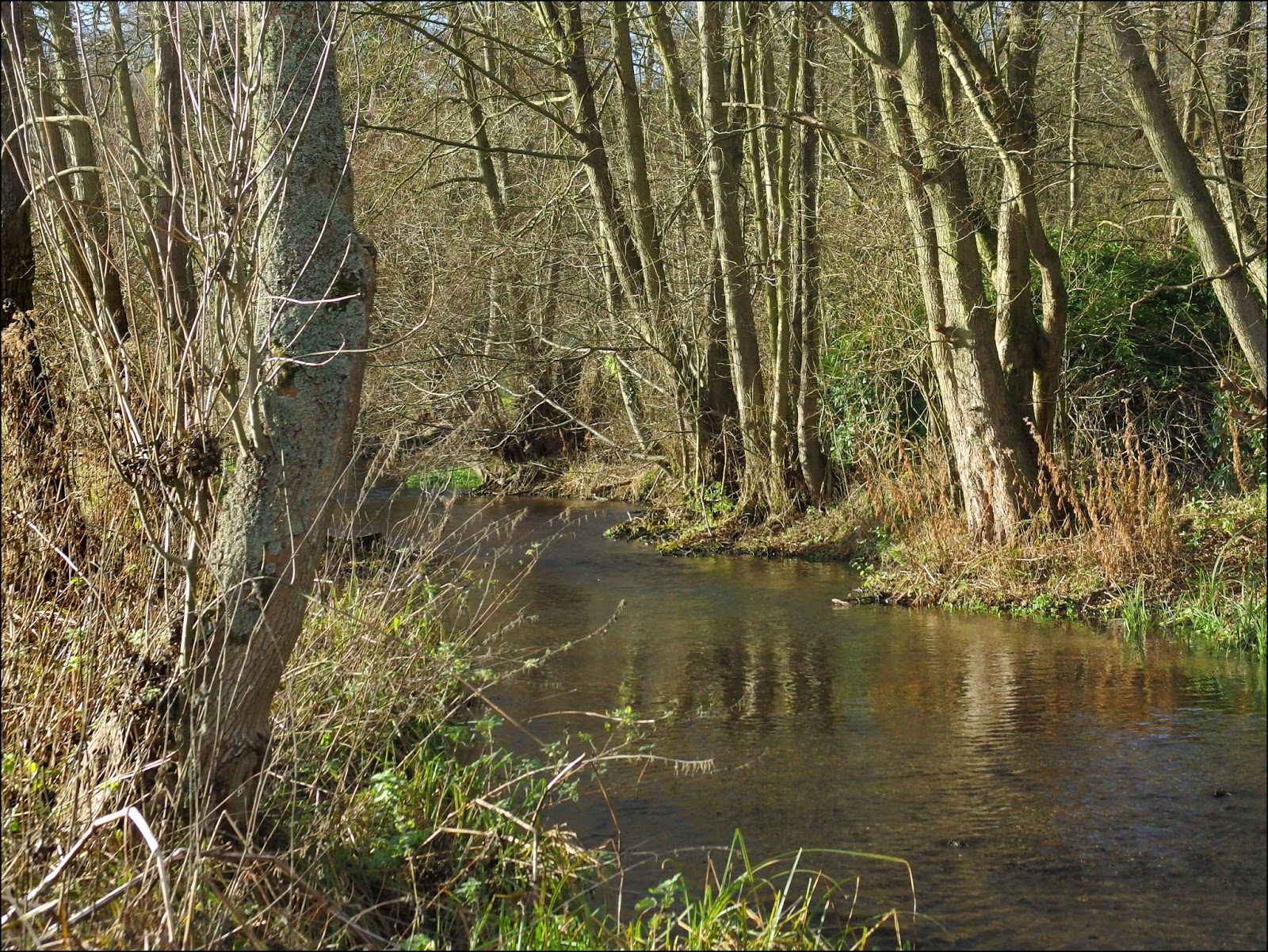
Travelling by train up to London, as I used to do regularly many years ago, you pass between wide fields, past factories and warehouses, through cuttings and alongside rows of back gardens. Then suddenly, just north of Welwyn Garden City, you seem to be flying. Looking down there's a dainty winding river threading its way through emerald green pastures. I looked it up when I got home: it's the River Mimram.
Yesterday I began walking at Hertford where the Mimram flows into the River Lea which then flows down to join the Thames just opposite the O2 Arena.
After a few minutes walking I entered Panshanger Park. Once the extensive grounds of Panshanger House, home of Earl Cowper, the area has had a chequered history. It must have once been a very grand place with landscaping by Capability Brown and Humphrey Repton but when what remained of the estate was put up for auction in 1952 there was no one interested in buying the house which was subsequently demolished. But much of the grounds was of interest - to gravel extraction companies.
Over the years more than 400 million tonnes of sand and gravel have been removed. If you live in Hertfordshire there's a good chance that your house contains a little bit of Panshanger Park! Quarrying continues but as each phase concludes the land is being returned to a more natural state as a country park.
The restoration includes wetlands and woodlands, which will benefit the wildlife, as well as footpaths, a cycle-way (coming soon) and wide grassy areas which are popular with families and dog-walkers.
Although the house is gone the remains of the Orangery, built in Victorian times, can still be seen and gives some idea of the grandeur which has been lost.
At present the Orangery is behind high wire fences as the structure is unsound and might be dangerous if the public were allowed to wander beneath the disintegrating brickwork. I was able to poke my camera lens between the wire to get these pictures.
Some of the big trees that grew near the house have also survived, including The Great Oak which has been measured at 7.6 metres in circumference and is said to have been planted by Queen Elizabeth I.
Elsewhere there are also relics of other times, like this cast iron waterwheel.
And several lakes, some of which date from the landscaping done during the eighteenth century and some which may have resulted from the later quarrying. But what turned the waterwheel and filled the lakes.......?
The River Mimram.
Interesting and scenic as Panshanger Park is, it hasn't got us much nearer to the end of today's walk as all we've done so far is describe a big loop, bringing us almost back to where we started. I'm sure I'll visit the park again and explore the area more, but it's time to press on.
We'll complete the walk and catch up with the River Mimram further upstream. But it will have to wait till the next post.
Take care.

 We interrupt normal service to bring you news of snow. It's been so long since we had any sensible amount that dads were having to show their little ones how to built snowmen and throw snowballs. It was ideal for the purpose too as it was wet, sticky stuff. Big kids went out with their cameras.