Sunday, 17 November 2013

A Countryside Ramble.

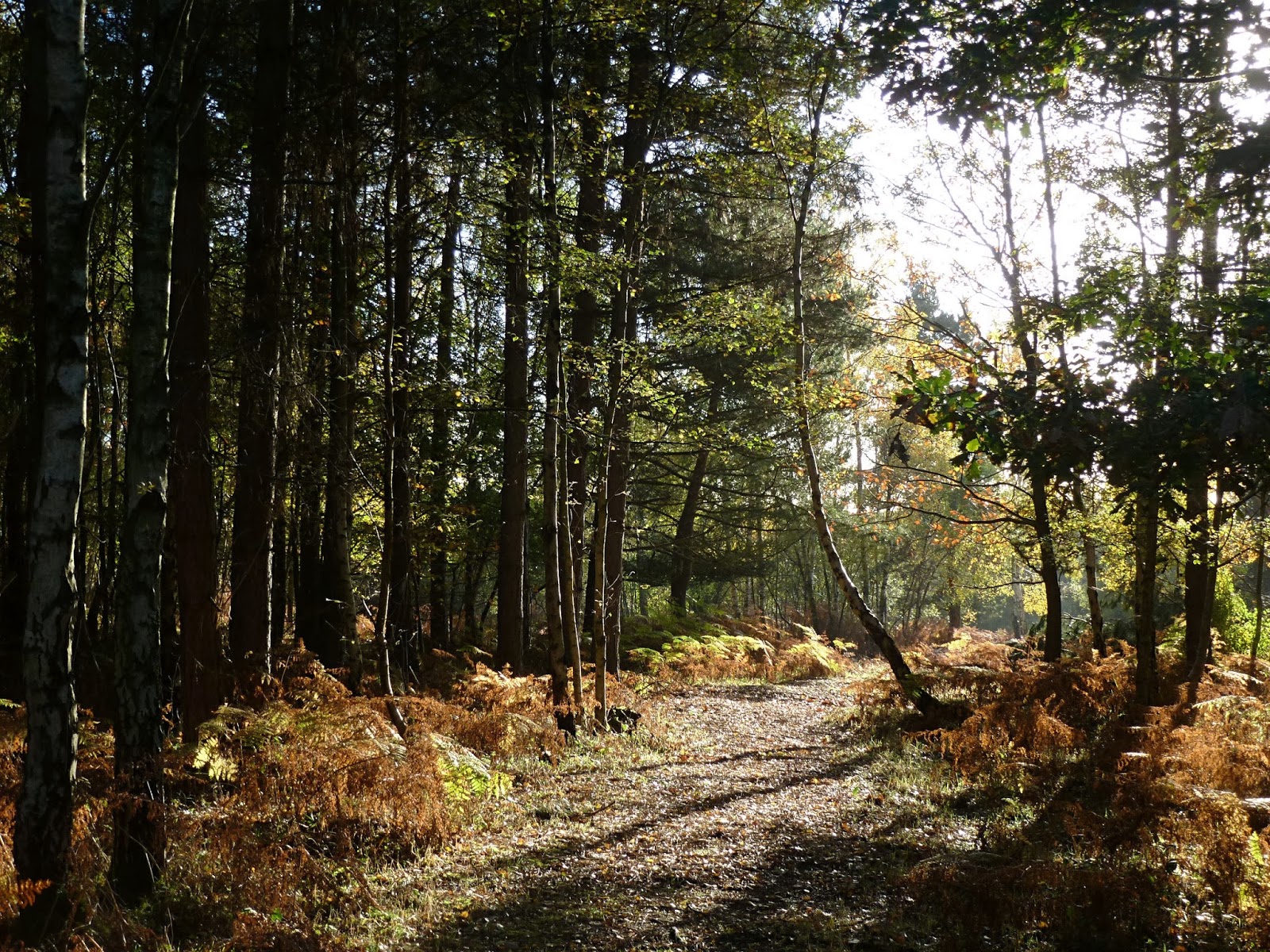
The Greensand Ridge is a barely noticeable geographical feature in the neighbouring county of Bedfordshire. When the chalks and clays of East Anglia were being laid down in shallow seas there were also deposits of sandstone being formed among them. One of the sandstones was the greensand - it's not really very green, more rusty brown with a greenish tinge. As it's harder than other rocks in the area it stands proud of them in a long, low, broken ridge. Someone had the bright idea of making a walking route along it, mostly along already existing rights of way. Here are some photos along the stretch from Sandy to Gamlingay that I walked today.


Just out of the small town of Sandy and up on to "Caesar's Camp",
a hill with evidence of a Roman Fort for those with time to look.
There are definitely some humps and bumps on it!


Even a bit of road walking can be attractive on a day like today.


Down a farm track called Hasell Hedge,
but it's actually the course of a Roman road too.


A working farm - Waterloo Farm, you can probably guess its era.


A field path leads up onto the ridge - such as it is.


Views opening up behind despite the modest elevation.


The church at Everton is made of locally-quarried greensand.
Some of the stone shows a slight greenish hue.


On past an estate farm. 
Long-time Stargoosers might recognise a dovecot in the corner of the yard.


Through parkland with magnificent trees.


And a fine old hall overlooking its grounds.


The ridge walk ends near the village of Gamlingay.
I walked back by a different route.


A different route but equally lovely Autumn scenery.

Take care.

Thursday, 14 November 2013

Lost In The Woods


You can't really get lost in Broxbourne Wood or Wormley Wood; the paths are clear on the ground, the popular routes are generously waymarked and, anyway, it's quite a compact area so if you walk in a straight line you're bound to encounter a road or fence which you can follow. So if you're careless enough to get lost then it's "lost" as in "lost in thought" and "careless" as in "without a worldly care".


Autumn is creeping in strangely this year; some trees have embraced the new season with enthusiasm while others choose to ignore the shortening days and are still rampant in their greenery. Grasses and bracken are filled with the same indecision.


Jays and Magpie swear at each other in the treetops while flocks of tits and finches call slyly in the underbrush. And just through here is a small pond where birds sometimes come to drink. As I push open the gate a Woodcock, that enigmatic shadow-speckled bird and master of camouflage, springs up and makes its urgent but off-kilter flight between the trees.


Sun lances in through the branches and momentarily lights a particular tree, leaving others loitering in the gloom. But the low sun will move on, hurrying across the sky, and the woodland floor will be cast in deep shade long before the sun dips slowly beneath some far horizon 


Footsteps fall softly on the damp leaf-litter, pushing through bowing, dew-laden grasses, then descending carefully down a steep slippery slope between mossy banks.


Here in the valley bottom a tiny stream waltzes over the sparkling gravel to join hands with other waters to journey on towards the sea.


Oak, Hornbeam and Silver Birch are falling under autumn's spell. Yellow leaves drift down like butterflies to settle where they may.


A scattering of yellow jewels settle on a forest pool, denting the fragile, reflecting surface with their tiny weight. 


Up above other leaves look down in all their golden glory, one last hurrah before they take their final bow.


Fallen branches support tiny fungi that will, given time, break down the timber to nutrients for new growth. Another turn of the wheel of life.


Just how many fungi can a child kick over before being struck by their architectural elegance - a fan-vaulted ceiling for ground-dwelling insects.


Meanwhile teenagers are trying the same trick with an old tractor; to break it down and return it to the earth! Coming on it through the wood I almost mistook it for some kind of sculpture.


And now the Hornbeams are twisting and writhing to produce their own kind of sculpture. Is it the agony of slow death or a dance of ecstasy?

Now where the devil has that path gone??!!! 


Take care.

Tuesday, 12 November 2013

Crazed On The Dulcimer

The first time I heard the word "dulcimer" must have been when Brian Jones played one, with a feather quill, on the Rolling Stones track "Lady Jane". Very hip, very cool. It was an Appalachian Dulcimer but I didn't know that. 


A little later I was talking to a neighbour, Geoff, a pipe-smoking builder - very un-hip, very un-cool - who told me that his father, Will Lawrence, used to play the dulcimer and travelled around to village feasts and fairs with his cousin, playing tunes and dancing. Geoff described the instrument to me and it was clearly a different beast, a heavyweight  made from an old door or unwanted pieces of furniture - "you need seasoned timber, see, else it'd bend and warp under the tension of the strings". It was a Hammered Dulcimer, but I didn't know that either.


Then I was visiting a musician friend, very hip and cool too, and there hanging on the wall was an Appalachian Dulcimer. You used to see them often enough hanging on walls in those hippy-trippy days but this guy could play it too. I mean really play it. And he put me straight on the rest of the family of instruments - zither, psaltery,  cymbalon, hackbrett, santoor and probably others too. All of them basically strings stretched across a wooden box and either plucked or hit with hammers. 


He also put me on to an LP of English dance music played by village musicians. It included players of the squeezebox and mouth-organ as well as the Hammered Dulcimer player, Billy Bennington.


Billy Bennington learned to play from Billy Cooper and says that as a young man he was "crazed on the dulcimer". And for a while it seemed that the whole folk music scene became crazed on the dulcimer too and there were lots of players around in the folk clubs. Some of them even made LP records.


I hadn't heard one or seen one for quite a while. Then, in the Cambridge Folk Museum the other day, I came face to face with the rather dusty instrument in the second photo on this page. You'll notice there's a little card on it...


HAMMER DULCIMER
This musical instrument was made by George Willmott
Lawrence of Haslingfield, and later Thriplow Heath, in
about 1866. His son Herbert who died in 1947 was the
last of the family to play the dulcimer. In his youth he
toured the village feasts during the summer, playing in
 the dancing booths and public houses with his cousin
Will, who also played and made dulcimers.               

So this dulcimer was made by my former neighbour's great uncle nearly 150 years ago. But even though the dulcimer-playing died out in the Lawrence family the role of providing music for people to dance to lingered on a little longer: Geoff's son Dave had a mobile disco for a few years in the 1970s!

http://www.youtube.com/watch?v=ONhyQelMA94 to hear John Kirkpatrick and Sue Harris playing on the album pictured above.

Take care.
              

Friday, 8 November 2013

Glimpses Of The Past

Just a few weird or wondrous things encountered during the last year or so:


Four Marys


Representations of Mary and Jesus from different churches that I've visited recently. All of them are relatively modern additions as places of worship continue to evolve.


A Military Man


Rather rusty but still instantly recognisable from his resolute profile - The Duke Of Wellington. These cast iron plaques date from the nineteenth century, patriotic times when admiration of military heroes was perhaps more fashionable than today. I think these plaques would have originally been painted. Quite how the noble Duke has come to be nailed up beside a selection of old horseshoes I can not imagine.


Protection


This symbol, known as a daisy-wheel, is said to protect against ghosts and witchcraft. They are often found on mantelpieces to discourage evil spirits from entering down the chimney, for whereas doors and windows could be locked at night the fireplace remained open. This one dates from the seventeenth century.

How Long Is A Pound Of Butter?


Believe it or not it was formerly possible to buy butter in Cambridge by the yard! In fact it was the only way to buy it (though shorter measures were also available). Butter sellers carried butter made into yard-long rolls in baskets like the one above and would cut you off whatever length you wanted. This carried on into the middle of the last century when butter rationing made this method of sale both impractical and illegal.

On The Fiddle


This fine fellow was exhibited at an country show to publicise Burwell Museum. We've already visited and you can read all about it here. What the model holds beneath his arm is a seed-fiddle, an early piece of agricultural mechanisation. The handle was drawn back and forth like the bow of a fiddle to turn a wheel which distributed the seed; a great improvement on broadcasting by hand apparently.


Hell's Angels?


This piece of design, which would not look out of place on the back of a leather jacket or the cover of a heavy metal album, is actually a detail from an old tomb. Not the most subtle imagery but I think it makes its point!


And Finally....
A couple of bits of motoring memorabilia. The first an old tax disc (for a "mechanically propelled vehicle") from a vintage car seen at a show.....

And the second an old petrol pump that still stands in the village of Melbourn, just a mile or so from my house...

....at one time nearly every village had its own garage where you could top up your tank.


Take care

Wednesday, 6 November 2013

The Old Grey Ferguson


The Old Grey Ferguson

When I was a young fella-me-lad
I worked down on the farm
They gave me lots of jobs to do
Where I could be no harm
But when nobody was about
And no one to complain
I climbed up on the Ferguson
And rattled off down the lane.

 Oh! Crunch go the gears
  Clatter, bang and groan
  So long as I'm on me Ferguson
  I never curse or moan
  I'm twice as well contented
  As any man alive
  Me and the old grey Ferguson
  A-Rattling down the drive

It's not much good for ploughin'
That suits me to the ground
What could be more tedious
Than drivin' up an' down
I takes the hens their corn
And then I takes the horse his hay,
Then I jumps up on me tractor
And I rattles along me way.
Crunch go the gears...  

The chaps that does the ploughin'
They work so late at nights
But lucky for me the Ferguson
She don't have any lights
So seven o'clock in the mornin'
Is the time of my departures
An' I'm always home in time enough
To listen to The Archers.
Crunch go the gears...

So if perchance you travel
Down some English country road
And find your way's obstructed
By a slowly movin' load
Just sit and watch the scenery
Enjoy the flowers of spring
You can blow your hooter if you like
But I shan't hear a thing
 For crunch go the gears...


A rather silly song made up at a time when I felt that many so called Modern Folk Songs weren't being written for "folks" at all, but for "posh people and hinty-lek-chewalls" as Old Bert would have said. I hope he'd have approved of this little ditty which is a sort of updated version of a semi-real folk song called "Rattling Old Grey Mare" or "The Country Carrier". For those in foreign parts I should perhaps point out that The Archers is a very long-running British radio programme that was billed as "an everyday story of countryfolk".

Take care, tractor boys!

Sunday, 3 November 2013

Stories In Stone

If you live in, or near to, a city like Cambridge you can pass by sculpture and public artwork without a second glance. The colleges cannot have a courtyard or open space without feeling the compulsion to erect a statue, fountain or abstract piece in its centre. The local council, banks, shops and offices are similarly afflicted. It can all become a bit overwhelming but even so certain pieces catch the eye and the imagination.


When I was four years old I was a big fan of "The Big Soldier" on Station Road corner. I didn't know then that it was a war memorial or understand its significance. It's not actually called "The Big Soldier" but "Coming Home" and is by the Canadian artist Robert Tait MacKenzie. 


But that infatuation was short-lived and by the time I walked that way to and from school my allegiance turned to a work on the side of a modern office block. It depicts figures gathered beneath a tree, but that was all I knew. My mother went to work in that office block, I walked past it twice every schoolday but I learned nothing more, which probably means that I was daydreaming during a History lesson; a not uncommon occurrence. Then, some years later, the building was surrounded by scaffolding and builders moved in. I found myself worrying whether the artwork would disappear forever. I was pleased to find that it survived.Clearly I ought to find out more.


The office block was called Kett House, which ought to have rung a bell, but didn't. It takes its name, not from a local building firm as I had supposed, but from Robert Kett. The scene depicted is Kett and his followers gathered beneath what became known as Kett's Oak. Here, briefly, is his story:

    Robert Kett was a yeoman farmer in the town of Wymondham, near Norwich, in the sixteenth century. It was a time when sheep farming had become hugely profitable and as a result the wealthier landowners began enclosing parts of the common land for their flocks, leaving the poor to starve. The ensuing unrest became known as "The Commotion Tyme". The peasants responded by tearing down the fences and visited Kett with the intention of doing the same to his enclosures. To their astonishment Kett agreed with them and aided them in destroying his own fences and hedges. 
   Kett was an educated man and soon became their leader. The discontents assembled beneath an oak tree, Kett's Oak, to draw up a list of demands which centred on the wealthy barons giving back the common lands to the poor and allowing them to live as before. The movement escalated until their encampment numbered some 15,000 men making it the biggest settlement outside of London!
   The rebels marched on and eventually took Norwich. Armies were assembled, mostly consisting of foreign mercenaries, to confront the rebels. Finally the rebels were defeated at a place called Dussindale (don't bother looking on a map - no one knows where it was!). 3,000 rebels were killed and the following day Kett was arrested. On 7th December 1549 Kett was hanged from the battlements of Norwich Castle.
   In the four and a half centuries since his death Kett has been transformed from traitor into hero of the poor.

   I really should have paid more attention during History!


Now follow my schoolday trudge a little further and you'll come to Lensfield Road and the Scott Polar Museum. Outside is a statue entitled "Youth" which catches the eye. But high up on the wall is a bust of Capt Robert Falcon Scott, Scott Of The Antarctic himself. To my mind he looks more kindly romantic than rugged hero, perhaps because the bust of Scott (and the statue of Youth) are the work of Scott's widow, Kathleen Scott. Incidentally the model for "Youth" was A W Lawrence, the brother of T E Lawrence or Lawrence of Arabia.


But tucked away around the side of the museum, overlooking the bicycle racks of the Department Of Chemistry, is this curious construction:


He, she, or it is an inuksuk (plural inuksuit) and formerly resided in the wilds of Baffin Island, Canada. In fact it's a special kind of inuksuk in that it is a representation of a human figure and therefore qualifies to be called an inunnguaq. These are made, as I understand it, by the Inuit people of Baffin Island and elsewhere for a variety of reasons: to mark the way in the trackless wastes, as memorials to their ancestors or to guide the migrating caribou to areas where they can be slaughtered. This particular one was brought from such a wild location to this rather less exotic site where presumably he is employed to direct the chemistry students to where they can park their bicycles. Fate can be cruel.


And finally....alongside the path which leads through the grounds of Clare College stands Confucius. He is the product of the skill and imagination of Wu Wei-Shan, one of China's leading sculptors. I think it's wonderful!


Take care.