
In the village of Chelmondiston in Suffolk there's a narrow lane which threads its way down to the tidal estuary of the River Orwell. The lane ends abruptly at the riverside where there's an old pub and a confused cluster of houses which form the hamlet of Pin Mill.
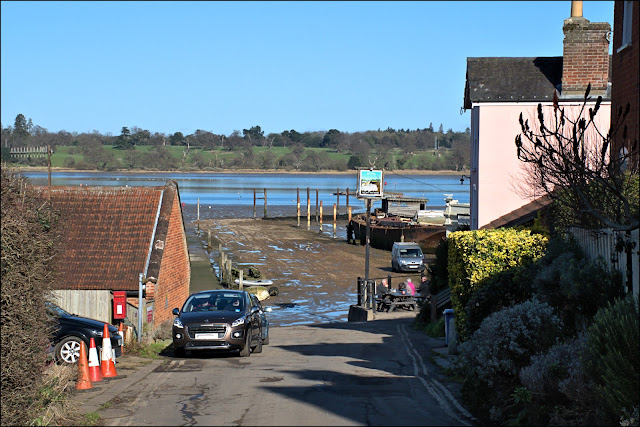
There's no mill in Pin Mill, neither on the ground nor in the annals of history; this is a place of boats. In the past small vessels were loaded and unloaded and the old Thames sailing barges were brought here for repairs. Yacht repairs are carried out to this day.

It's the sort of place where one can imagine Arthur Ransome setting one of his adventure stories for children - and indeed he did. "We Didn't Mean To Go To Sea" is set here and his own boat Selina King was built in Harry King's boatyard and was frequently moored here. Although other yachting facilities around this coast are dominated by luxurious clubhouses and modern marinas, here all is delightfully informal and gloriously untidy.

But we're here to go on a walk, albeit one which will be dominated by boats as we make our way alongside the estuary. First we have to sneak along the shore in front of the pub. A footpath leads amongst trees and here we encounter what looks like a shanty town - a fairly prosperous shanty, 'tis true, but you get the idea.

Old houseboats, converted barges, tumbledown shacks and rotting wooden jetties form weekend homes for keen boat people. Planning restrictions prevent them building anything more permanent, so every spring the ravages of the winter are made good for another season of carefree sailing. Amazingly this stretch of coast is owned by the National Trust, the charity which usually concerns itself with grand mansions and perfect beauty-spots. Further along things get even more ungroomed.

Beyond the houseboats is what can only be described as a maritime graveyard, where old boats are left to rust and rot. These old wrecks are much loved by photographers: they arrive at high tide, assemble their tripods and take long-exposure photos with blurry water - you can find basically the same photo all over the place. It's much more fun though to arrive as the water goes down and squelch about in the clinging mud and examine the disintegrating hulks up close. More of that in another blogpost!

So, an hour or so later, we can continue up through the woodlands.

They call this "the cliff", though only in countryside as flat as East Anglia would such a modest feature be honoured with such a grand name. It does however give pleasant views through the trees of the boats on the estuary.

Beyond the woodland the countryside opens up once more and here, completely isolated, stands a single cottage on its own little muddy inlet. Perfection. We watched the birds here for a while, spotting several duck and wader species, including one Black-Tailed Godwit already in its brick-red summer breeding plumage.

We're going to turn back here and return to Pin Mill, but not to visit the pub, which is fully booked-up for lunch. Instead we'll have sandwiches, bananas and hot chocolate back at the car, which will give us plenty of time for an afternoon walk - and no concerns about contracting communicable viruses!

The pub at Pin Mill has the memorable name of the Butt And Oyster. The "butt" in this case refers to a wine barrel, maybe a reference to the fact that oysters were once transported in such barrels, or just possibly it's a subtle hint about the commodities which were once smuggled through this quiet port at dead of night.

Setting out again, much refreshed after lunch, in the upstream direction, we passed close to these old coastguard cottages, another reminder of the old days of smuggling.

It's strange how remote and unspoiled this little area seems, even with the influx of tourists and yachtspeople, though I admit that our reason for being here in February was to avoid the worst of the crowds. However we're only about five miles (8 Km) from the container ports of Harwich and Felixstowe, in one direction, and the busy town of Ipswich in the other.

There are many characterful trees along the riverside, including these two old "pensioners", standing hand-in-hand and gazing in disbelief towards the new Orwell Bridge.

I know you wanted to see a big concrete bridge carrying the A14 road on its way to Felixstowe docks! One day, when such structures become old and less numerous, people will suddenly appreciate that they have a certain grace and elegance - when viewed from about four miles away at least!

We are now in the environs of The Royal Harwich Yacht Club, founded in 1843. Soon the skies here will be bristling with white masts and sails, and expensive cars will be parked near the modernistic clubhouse. All very different from the mud, rust and real ale to be had back at Pin Mill.

But what's this? It looks like a church or chapel. But, then again it seems that somebody lives here. And there's a sign on the fence that reads The Cat House. Research required.
It was built in 1793 in the grounds of Woolverstone Hall (which we'll pass later) and is described by Historic England as a house and eyecatcher. In other words it was designed to beautify the estate, provide housing for one of the employees and to impress visitors and passers-by.
Now then; at some time in the past the inhabitant of this building had a cat and, when that animal died, he had it stuffed. So far, so mildly eccentric. But this cat, after its demise, took to an afterlife of crime and played a vital role in illegal activity. For, when there were no excise men snooping around, this ex-cat was displayed in an upstairs window to inform smugglers that the coast was clear.

Our path turned inland through woodland....

.....and emerged, rather suddenly, at St Michael's Church, Woolvestone. The church was much restored in the late-1700s when the very wealthy Berners family built their country residence in the area.

And here is Woolverstone Hall today, no longer a haunt of the aristocracy but now home to the Ipswich High School. It's a Grade I listed building and one of the finest British examples of the Palladian style of architecture.

This sheep showed not the slightest interest in historic architecture.

Passing through more woodland, I spotted a bracken frond resting artistically on a lump of fallen tree bark. Honestly I didn't put it there, though I did a little tidying up around it.

Take care.


